Skyfall: NASA’s Bold New Mars Mission to Drop Six Helicopters From the Sky

Share via:

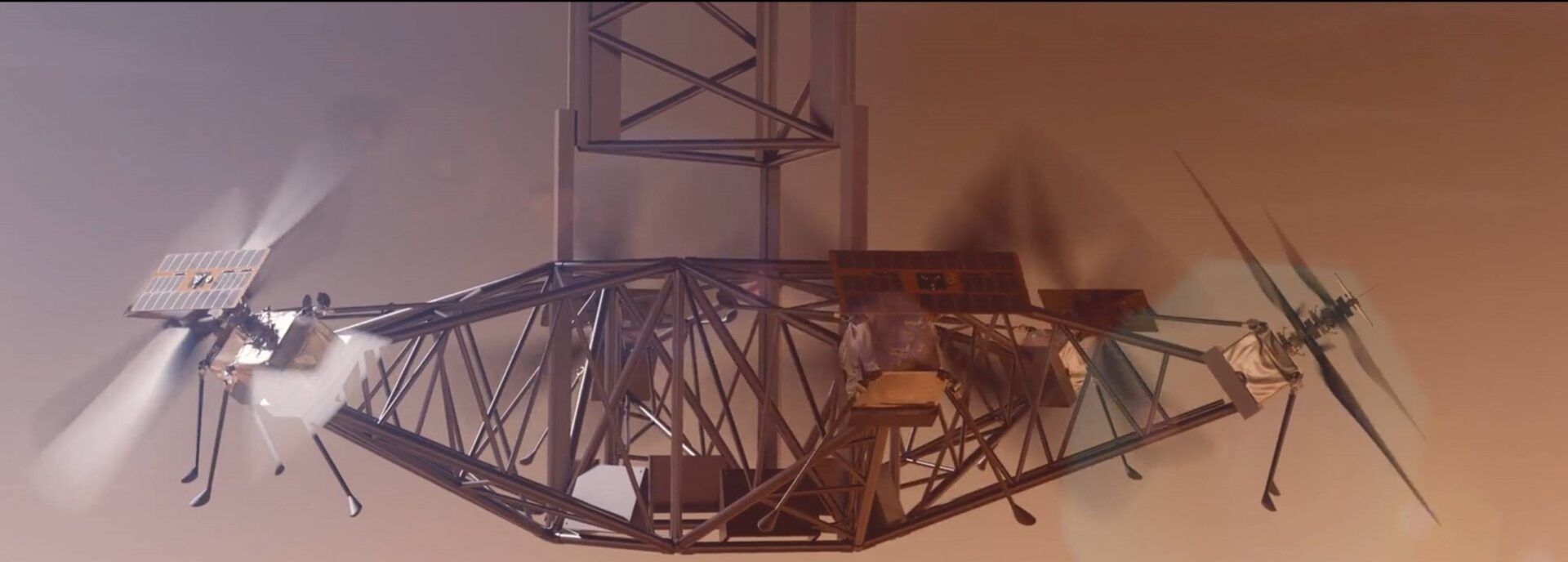
In a revolutionary step toward Mars exploration, NASA, in partnership with AeroVironment, has unveiled an ambitious concept dubbed “Skyfall.” The mission plans to deploy six advanced scout helicopters mid-air onto the Red Planet, eliminating the need for traditional landing platforms. This breakthrough could radically reshape how humans explore and eventually inhabit Mars.

A New Era of Martian Exploration

The Skyfall mission draws on the massive success of Ingenuity, NASA’s first Mars helicopter, which completed 72 flights over nearly three years. Building on that legacy, the Skyfall system will take autonomous aerial reconnaissance to a whole new level.

Instead of relying on expensive, risk-laden landers, Skyfall will release six UAVs directly from the entry capsule during atmospheric descent. Each helicopter will autonomously navigate and explore various pre-selected landing zones. These zones are considered top candidates for future human missions due to their proximity to Martian resources like water and ice.

Key Highlights of the Skyfall Mission

  • Six scout helicopters will be released mid-air during entry, descent, and landing (EDL).
  • No traditional lander is required, reducing costs and engineering complexity.
  • Each drone will independently map terrain, capture high-resolution imagery, and scan subsurface layers using radar.
  • Target sites include areas rich in essential resources to aid future human colonization.

According to William Pomerantz, Head of Space Ventures at AeroVironment, “Skyfall offers a low-cost solution that multiplies the range we would cover, the data we would collect, and the scientific research we would conduct – making humanity’s first footprints on Mars meaningfully closer.”

Why Skyfall Is a Game Changer

The Skyfall mission introduces a significant cost-effective advancement in Mars exploration. Traditional rovers and landers face numerous technical and budgetary hurdles, especially for pinpoint landings. By bypassing the need for such hardware, Skyfall simplifies the deployment process, enabling broader and faster terrain coverage.

From an engineering standpoint, this marks a pivotal transition. Not only are the helicopters smaller and lighter than previous Mars rovers, but their autonomous nature allows simultaneous multi-site exploration—a first in interplanetary mission history.

Scientific and Human Mission Implications

The data collected by the Skyfall helicopters will help scientists evaluate potential human landing sites with greater accuracy than ever before. These aircraft will also examine subsurface conditions, offering insights into the presence of water ice, mineral composition, and safe terrain features.

A successful Skyfall mission would directly feed into NASA’s Mars 2030 crewed mission roadmap, helping researchers select the most viable and resource-rich locations for long-term human habitation.

Project Timeline

Although still in its conceptual phase, internal investment and collaboration are underway. NASA’s Jet Propulsion Laboratory and AeroVironment are aiming for a potential launch in 2028, subject to development milestones and funding approvals.

Skyfall Could Be the Leap Forward Mars Exploration Needs

The Skyfall Mars mission isn’t just another concept; it’s a bold reimagining of how humanity interacts with alien worlds. With scalability, affordability, and precision at its core, Skyfall may well be the project that finally bridges robotic and human exploration on Mars.

As we look toward a future that increasingly includes off-world living, Skyfall might be the technological stepping stone that makes Mars not just a distant dream—but a reachable destination.

Want more such updates on space-tech, startups, and innovation? Visit StartupNews.FYI — your hub for the most exciting developments in the startup ecosystem!

Disclaimer

We strive to uphold the highest ethical standards in all of our reporting and coverage. We StartupNews.fyi want to be transparent with our readers about any potential conflicts of interest that may arise in our work. It’s possible that some of the investors we feature may have connections to other businesses, including competitors or companies we write about. However, we want to assure our readers that this will not have any impact on the integrity or impartiality of our reporting. We are committed to delivering accurate, unbiased news and information to our audience, and we will continue to uphold our ethics and principles in all of our work. Thank you for your trust and support.

Popular

More Like this

Skyfall: NASA’s Bold New Mars Mission to Drop Six Helicopters From the Sky

In a revolutionary step toward Mars exploration, NASA, in partnership with AeroVironment, has unveiled an ambitious concept dubbed “Skyfall.” The mission plans to deploy six advanced scout helicopters mid-air onto the Red Planet, eliminating the need for traditional landing platforms. This breakthrough could radically reshape how humans explore and eventually inhabit Mars.

A New Era of Martian Exploration

The Skyfall mission draws on the massive success of Ingenuity, NASA’s first Mars helicopter, which completed 72 flights over nearly three years. Building on that legacy, the Skyfall system will take autonomous aerial reconnaissance to a whole new level.

Instead of relying on expensive, risk-laden landers, Skyfall will release six UAVs directly from the entry capsule during atmospheric descent. Each helicopter will autonomously navigate and explore various pre-selected landing zones. These zones are considered top candidates for future human missions due to their proximity to Martian resources like water and ice.

Key Highlights of the Skyfall Mission

  • Six scout helicopters will be released mid-air during entry, descent, and landing (EDL).
  • No traditional lander is required, reducing costs and engineering complexity.
  • Each drone will independently map terrain, capture high-resolution imagery, and scan subsurface layers using radar.
  • Target sites include areas rich in essential resources to aid future human colonization.

According to William Pomerantz, Head of Space Ventures at AeroVironment, “Skyfall offers a low-cost solution that multiplies the range we would cover, the data we would collect, and the scientific research we would conduct – making humanity’s first footprints on Mars meaningfully closer.”

Why Skyfall Is a Game Changer

The Skyfall mission introduces a significant cost-effective advancement in Mars exploration. Traditional rovers and landers face numerous technical and budgetary hurdles, especially for pinpoint landings. By bypassing the need for such hardware, Skyfall simplifies the deployment process, enabling broader and faster terrain coverage.

From an engineering standpoint, this marks a pivotal transition. Not only are the helicopters smaller and lighter than previous Mars rovers, but their autonomous nature allows simultaneous multi-site exploration—a first in interplanetary mission history.

Scientific and Human Mission Implications

The data collected by the Skyfall helicopters will help scientists evaluate potential human landing sites with greater accuracy than ever before. These aircraft will also examine subsurface conditions, offering insights into the presence of water ice, mineral composition, and safe terrain features.

A successful Skyfall mission would directly feed into NASA’s Mars 2030 crewed mission roadmap, helping researchers select the most viable and resource-rich locations for long-term human habitation.

Project Timeline

Although still in its conceptual phase, internal investment and collaboration are underway. NASA’s Jet Propulsion Laboratory and AeroVironment are aiming for a potential launch in 2028, subject to development milestones and funding approvals.

Skyfall Could Be the Leap Forward Mars Exploration Needs

The Skyfall Mars mission isn’t just another concept; it’s a bold reimagining of how humanity interacts with alien worlds. With scalability, affordability, and precision at its core, Skyfall may well be the project that finally bridges robotic and human exploration on Mars.

As we look toward a future that increasingly includes off-world living, Skyfall might be the technological stepping stone that makes Mars not just a distant dream—but a reachable destination.

Want more such updates on space-tech, startups, and innovation? Visit StartupNews.FYI — your hub for the most exciting developments in the startup ecosystem!

Disclaimer

We strive to uphold the highest ethical standards in all of our reporting and coverage. We StartupNews.fyi want to be transparent with our readers about any potential conflicts of interest that may arise in our work. It’s possible that some of the investors we feature may have connections to other businesses, including competitors or companies we write about. However, we want to assure our readers that this will not have any impact on the integrity or impartiality of our reporting. We are committed to delivering accurate, unbiased news and information to our audience, and we will continue to uphold our ethics and principles in all of our work. Thank you for your trust and support.

Website Upgradation is going on for any glitch kindly connect at office@startupnews.fyi

More like this

Nvidia CEO Jensen Huang Says AI Doomerism Has ‘Done...

Nvidia CEO Jensen Huang "said one of his...

Nvidia CEO Jensen Huang Says AI Doomerism Has ‘Done...

Nvidia CEO Jensen Huang "said one of his...

Google Maps’ audio navigation quirks make it difficult to...

Megan Ellis / Android AuthorityWhile I use Google Maps...

Popular

iptv iptv iptv
