China Opens World’s Tallest Bridge Over the Huajiang Canyon

Share via:

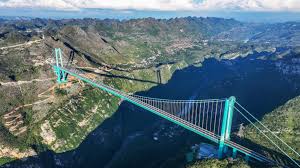
The world watched in awe this week as China unveiled the Huajiang Grand Canyon Bridge, a record-breaking engineering marvel that is now the tallest bridge in the world. Located in Guizhou Province, the bridge stretches nearly 10,000 feet and soars 2,050 feet above the Beipan River, cutting a two-hour mountain drive down to just two minutes.

A Canyon Spanning Feat of Engineering

The newly inaugurated Huajiang Grand Canyon Bridge is not just another infrastructure project—it’s a showcase of China’s growing dominance in engineering. Supported by seven massive concrete pillars, each standing at 1,125 feet tall, the bridge towers higher than the Eiffel Tower.

According to Zhang Shenglin, chief engineer at the Guizhou Highway Engineering Group Company, the bridge spans what locals call “earth’s crack.” He described the Huajiang Grand Canyon Bridge as a project that symbolizes China’s ambition to blend innovation with cultural and geographic significance.

Speed, Scale, and Precision

What makes this project stand out on the world stage is not just its scale but also the speed of its construction. While projects of this magnitude often take between five to ten years, the Huajiang Grand Canyon Bridge was completed in just three years.

University of Calgary civil engineering professor Mamdouh El-Badry noted that the rapid timeline demonstrates China’s growing expertise in large-scale infrastructure. The fact that such a project could be completed within three years reflects both efficient planning and technical precision.

Transforming Travel in China’s Canyon Region

Before the bridge, traveling across the Huajiang Canyon required winding through treacherous mountain roads—a journey that took about two hours. Now, thanks to the Huajiang Grand Canyon Bridge, travelers can make the crossing in just two minutes.

This drastic reduction in travel time is expected to transform Guizhou Province into a hub for tourism and commerce. The bridge not only boosts regional accessibility but also highlights China’s commitment to connecting remote areas with the rest of the world.

A Global Benchmark

The Huajiang Grand Canyon Bridge now surpasses France’s iconic Millau Viaduct, which previously held the record for the tallest bridge. While the Millau Viaduct stands nearly 1,000 feet above the Tarn River, the Huajiang Grand Canyon Bridge doubles that height, reinforcing China’s place on the world stage of architectural achievements.

In addition, the bridge competes with other monumental projects like Turkey’s Canakkale Bridge, though its height over a canyon makes it unique. For many in the engineering community, this project represents the latest benchmark in global infrastructure innovation.

Cultural and Economic Significance

China’s government and media have framed the opening of the Huajiang Grand Canyon Bridge as a symbol of national pride. Beyond its engineering marvel, it reflects the country’s determination to position itself as a world leader in transportation infrastructure.

The bridge is also expected to draw international tourists, eager to see one of the tallest structures ever built over a canyon. Its sweeping views and breathtaking design are already circulating on social media, boosting Guizhou’s visibility as a world-class tourist destination.

Looking Ahead

As global conversations continue about sustainable infrastructure, China’s Huajiang Grand Canyon Bridge raises questions about the balance between speed and environmental impact. While its efficiency is impressive, experts stress the importance of monitoring long-term effects on local ecosystems.

Nevertheless, the bridge stands as a testament to human ambition, reshaping the landscape of Guizhou and setting new records for the world. It is a reminder of how far engineering has come—and how projects spanning natural wonders like the Huajiang Canyon can change the way societies connect.

Stay informed with the latest breakthroughs in technology, infrastructure, and global business. Visit Startupnews


Disclaimer

We strive to uphold the highest ethical standards in all of our reporting and coverage. We StartupNews.fyi want to be transparent with our readers about any potential conflicts of interest that may arise in our work. It’s possible that some of the investors we feature may have connections to other businesses, including competitors or companies we write about. However, we want to assure our readers that this will not have any impact on the integrity or impartiality of our reporting. We are committed to delivering accurate, unbiased news and information to our audience, and we will continue to uphold our ethics and principles in all of our work. Thank you for your trust and support.

Popular

More Like this

China Opens World’s Tallest Bridge Over the Huajiang Canyon

The world watched in awe this week as China unveiled the Huajiang Grand Canyon Bridge, a record-breaking engineering marvel that is now the tallest bridge in the world. Located in Guizhou Province, the bridge stretches nearly 10,000 feet and soars 2,050 feet above the Beipan River, cutting a two-hour mountain drive down to just two minutes.

A Canyon Spanning Feat of Engineering

The newly inaugurated Huajiang Grand Canyon Bridge is not just another infrastructure project—it’s a showcase of China’s growing dominance in engineering. Supported by seven massive concrete pillars, each standing at 1,125 feet tall, the bridge towers higher than the Eiffel Tower.

According to Zhang Shenglin, chief engineer at the Guizhou Highway Engineering Group Company, the bridge spans what locals call “earth’s crack.” He described the Huajiang Grand Canyon Bridge as a project that symbolizes China’s ambition to blend innovation with cultural and geographic significance.

Speed, Scale, and Precision

What makes this project stand out on the world stage is not just its scale but also the speed of its construction. While projects of this magnitude often take between five to ten years, the Huajiang Grand Canyon Bridge was completed in just three years.

University of Calgary civil engineering professor Mamdouh El-Badry noted that the rapid timeline demonstrates China’s growing expertise in large-scale infrastructure. The fact that such a project could be completed within three years reflects both efficient planning and technical precision.

Transforming Travel in China’s Canyon Region

Before the bridge, traveling across the Huajiang Canyon required winding through treacherous mountain roads—a journey that took about two hours. Now, thanks to the Huajiang Grand Canyon Bridge, travelers can make the crossing in just two minutes.

This drastic reduction in travel time is expected to transform Guizhou Province into a hub for tourism and commerce. The bridge not only boosts regional accessibility but also highlights China’s commitment to connecting remote areas with the rest of the world.

A Global Benchmark

The Huajiang Grand Canyon Bridge now surpasses France’s iconic Millau Viaduct, which previously held the record for the tallest bridge. While the Millau Viaduct stands nearly 1,000 feet above the Tarn River, the Huajiang Grand Canyon Bridge doubles that height, reinforcing China’s place on the world stage of architectural achievements.

In addition, the bridge competes with other monumental projects like Turkey’s Canakkale Bridge, though its height over a canyon makes it unique. For many in the engineering community, this project represents the latest benchmark in global infrastructure innovation.

Cultural and Economic Significance

China’s government and media have framed the opening of the Huajiang Grand Canyon Bridge as a symbol of national pride. Beyond its engineering marvel, it reflects the country’s determination to position itself as a world leader in transportation infrastructure.

The bridge is also expected to draw international tourists, eager to see one of the tallest structures ever built over a canyon. Its sweeping views and breathtaking design are already circulating on social media, boosting Guizhou’s visibility as a world-class tourist destination.

Looking Ahead

As global conversations continue about sustainable infrastructure, China’s Huajiang Grand Canyon Bridge raises questions about the balance between speed and environmental impact. While its efficiency is impressive, experts stress the importance of monitoring long-term effects on local ecosystems.

Nevertheless, the bridge stands as a testament to human ambition, reshaping the landscape of Guizhou and setting new records for the world. It is a reminder of how far engineering has come—and how projects spanning natural wonders like the Huajiang Canyon can change the way societies connect.

Stay informed with the latest breakthroughs in technology, infrastructure, and global business. Visit Startupnews

Disclaimer

We strive to uphold the highest ethical standards in all of our reporting and coverage. We StartupNews.fyi want to be transparent with our readers about any potential conflicts of interest that may arise in our work. It’s possible that some of the investors we feature may have connections to other businesses, including competitors or companies we write about. However, we want to assure our readers that this will not have any impact on the integrity or impartiality of our reporting. We are committed to delivering accurate, unbiased news and information to our audience, and we will continue to uphold our ethics and principles in all of our work. Thank you for your trust and support.

Website Upgradation is going on for any glitch kindly connect at office@startupnews.fyi

More like this

Will Tuitions Be Replaced in 2026? EDZA AI Launches...

Mumbai (Maharashtra) , January 12: By 2026, India’s...

Morocco targets $10 billion AI contribution to GDP by...

Morocco is targeting a 100 ‍billion dirhams ($10...

Meta to build gigawatt-scale computing capacity under Meta Compute...

Synopsis​Meta will ⁠establish Meta ‌Compute ‌to ‌construct tens...

Popular

iptv iptv iptv