
At the Consumer Electronics Show 2026 in Las Vegas, Uber, Lucid Motors, and Nuro unveiled the production-intent version of their long-awaited robotaxi. The vehicle, revealed after months of quiet development, marks a major step in Uber’s push toward a premium, fully autonomous ride-hailing service.
The robotaxi has been in development for more than half a year, following a strategic deal in which Uber invested $300 million into Lucid and committed to purchasing 20,000 electric vehicles from the company. According to the partners, the robotaxi is already being tested on public roads, with a commercial launch planned for the San Francisco Bay Area later this year.
Built on the Lucid Gravity Platform
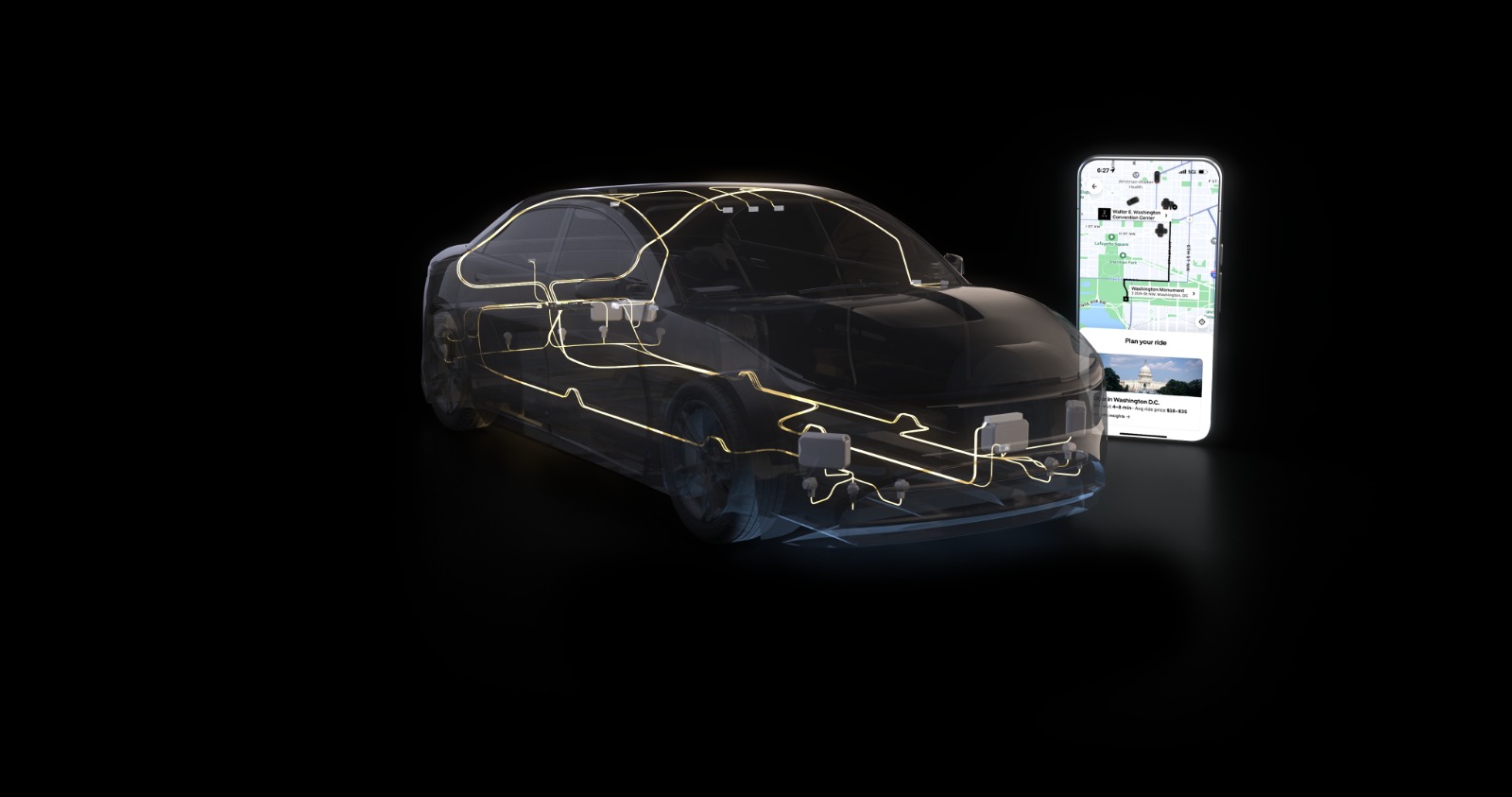
The robotaxi is based on the Lucid Gravity, Lucid’s large electric SUV, chosen for its spacious interior and premium positioning. The autonomy hardware is deeply integrated into the vehicle’s design rather than added as an afterthought.
High-resolution cameras, solid-state lidar sensors, and radar units are embedded directly into the body and a roof-mounted “halo.” That halo also features integrated LED lighting designed to help riders identify their vehicle at pickup, a concept similar to the visual cues used by Waymo’s robotaxis.
Powering the autonomy stack is Nvidia Drive AGX Thor, Nvidia’s high-performance automotive compute platform, which enables real-time perception, planning, and decision-making.
Manufacturing Autonomy at the Factory Level
One of the most significant aspects of the Uber–Lucid–Nuro collaboration is how the robotaxi is manufactured. All of the autonomous hardware is installed as the Gravity is built at Lucid’s Casa Grande, Arizona factory. This approach saves both time and cost by avoiding the need to retrofit vehicles after production.
By contrast, Waymo currently receives Jaguar I-Pace SUVs and disassembles them to integrate autonomous systems before reassembling the vehicles. While Waymo plans more purpose-built vehicles in the future, Uber’s approach with Lucid allows for faster scaling from day one.
Inside the Robotaxi Experience
The CES reveal also offered the first detailed look at how riders will interact with the robotaxi. A small external screen on the halo greets passengers, while multiple displays inside the cabin provide ride information and controls.
The rear passenger screen presents a familiar experience for anyone who has ridden in a Waymo vehicle: an isometric map view showing the robotaxi navigating city streets, with visual representations of nearby cars and pedestrians. Although the software was not interactive at the time of the demo, it is being developed by Uber to show estimated arrival times, remaining trip duration, and controls for climate and music. Riders will also have quick-access buttons to contact support or instruct the vehicle to pull over.
Up front, similar information appears on a larger central touchscreen. In the demonstration vehicle, these elements were displayed across the Gravity’s sweeping 34-inch curved OLED display, which spans the dashboard behind the steering wheel.
Why Uber Chose a “Premium” Robotaxi
Uber’s decision to build its autonomous service around the Gravity signals a clear positioning choice. The Gravity offers a noticeably roomy interior, particularly in the two-row configuration shown at CES, with Uber confirming that a three-row version will also be available.
This focus on comfort and space aligns with Uber’s strategy to position the service as a premium offering rather than a bare-bones autonomous shuttle. The goal appears to be matching—or exceeding—the experience offered by existing robotaxi leaders, while leveraging Uber’s massive rider base.
Lucid’s Recent Challenges and Rebound
The Gravity platform, however, has not been without issues. Lucid faced software challenges during the SUV’s initial production ramp, prompting interim CEO Marc Winterhoff to issue a public apology to owners in December for the “frustrations” they experienced.
Since then, Lucid says it has stabilized production and, on Monday, announced that it doubled its 2024 output and achieved new sales records. Whether the robotaxi variant avoids similar software hurdles remains to be seen.
What Comes Next
Uber, Lucid, and Nuro said that once final validation is completed later this year, full production robotaxis will begin rolling off Lucid’s Arizona assembly lines. While the companies have not shared a precise timeline, the announcement signals that Uber’s autonomous ambitions are moving from concept to concrete deployment.
If successful, the Gravity-based robotaxi could become a cornerstone of Uber’s next phase—one where autonomy, premium hardware, and AI-driven mobility converge on city streets.


