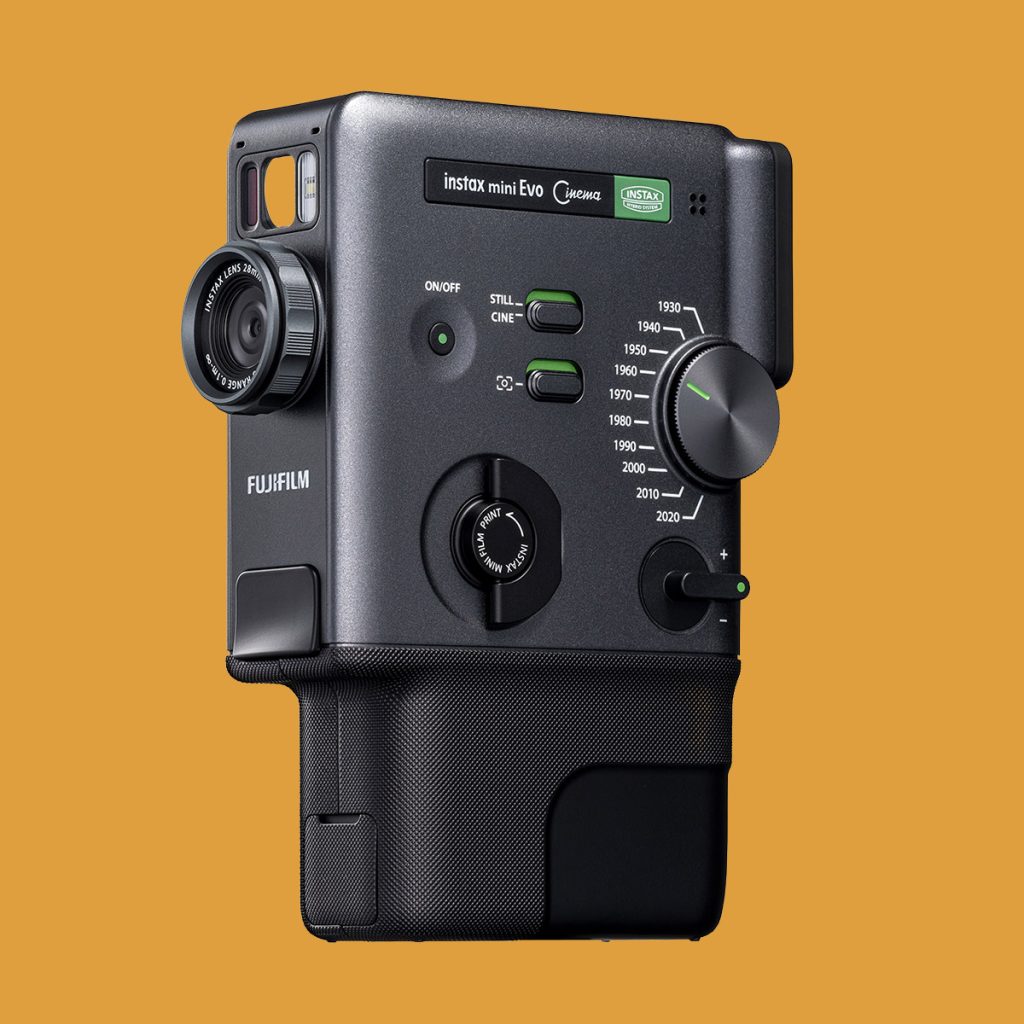
Fujifilm is pushing the instax brand into bold new territory. At CES season in early 2026, the company officially introduced the instax mini Evo Cinema™, a hybrid instant camera designed to blur the line between still photography, video, and physical prints. Launching in Japan on January 30, 2026, the mini Evo Cinema expands Fujifilm’s Evo series with a clear ambition: turn fleeting video moments into something you can hold, gift, and revisit.
At first glance, the mini Evo Cinema looks like a stylish nod to Fujifilm’s filmmaking heritage. Under the hood, however, it introduces one of the most distinctive ideas instax has ever attempted—printing videos.
A Camera That Lets You “Hand Over” a Video
The headline feature of the instax mini Evo Cinema is its ability to capture short videos and turn them into instax prints. Users can record clips of up to 15 seconds using simple shutter controls, review footage instantly on the rear LCD, and then select a still frame to print.
What makes this special is the QR code embedded directly on the instax print. Scan it with a smartphone, and the full video springs back to life. It’s a clever bridge between analog and digital—one that preserves a memory in physical form while keeping the motion and sound just a tap away.
In an era dominated by disappearing Stories and endlessly scrolling feeds, Fujifilm’s approach feels almost rebellious. This isn’t about endless cloud storage. It’s about creating a tangible keepsake that carries more than a single frozen moment.
Time Travel With the Eras Dial™
The mini Evo Cinema doesn’t just play with formats—it plays with time.
A new Eras Dial™ on the camera body introduces 10 era-inspired visual styles, ranging from grainy, mechanical textures inspired by 1960s 8mm film cameras to looks evoking 1970s CRT televisions and 2010s smartphone photo filters. Each era includes 10 adjustable intensity levels, giving users a total of 100 creative variations.
What sets these effects apart is their attention to detail. They don’t just alter visuals; they also modify audio characteristics and, in some cases, introduce nostalgic mechanical sounds while shooting—like the whir of film reels. The result is an immersive experience that feels less like applying a filter and more like stepping into another decade.
Design Rooted in Fujifilm’s Film Legacy
The mini Evo Cinema’s physical design leans heavily into Fujifilm’s cinematic history. Its vertical grip layout is inspired by the FUJICA Single-8, an 8mm film camera released in 1965 that helped democratize home video recording.
Every interaction reinforces that analog mindset. The tactile Eras Dial clicks as you turn it. The Print Lever mimics the motion of winding film. Optional accessories, including a viewfinder attachment and grip extension, allow users to switch between modern LCD shooting and a more immersive, old-school experience.
This isn’t accidental nostalgia—it’s a deliberate attempt to make the act of shooting and printing feel meaningful again.
A 3-in-1 Device Backed by a Dedicated App
Beyond shooting, the mini Evo Cinema doubles as a smartphone printer, reinforcing its hybrid identity. Through Fujifilm’s dedicated app, users can:
- View and transfer videos and stills
- Combine multiple clips into videos up to 30 seconds long
- Add cinematic opening and ending templates
- Design poster-style instax prints with custom titles
- Print photos stored on their smartphone directly
Bluetooth and Wi-Fi connectivity ensure fast transfers, while app-based editing expands the creative possibilities far beyond the camera itself.
Availability and Pricing
The instax mini Evo Cinema™ launches in Japan on January 30, 2026, with pricing listed as open for now. Matching accessories, including a dedicated camera case, will also be available. Fujifilm has yet to confirm global rollout details, but international availability is expected to follow.
Why the mini Evo Cinema Matters
With the mini Evo Cinema, Fujifilm isn’t just releasing another instant camera—it’s redefining what instant photography can be. By merging video, sound, physical prints, and nostalgic design, the camera offers something rare in modern tech: a slower, more intentional way to capture memories.
Fujifilm’s tagline for the device says it best: “One camera, decades of possibilities.” And for a generation craving both creativity and tangibility, that promise feels perfectly timed.