
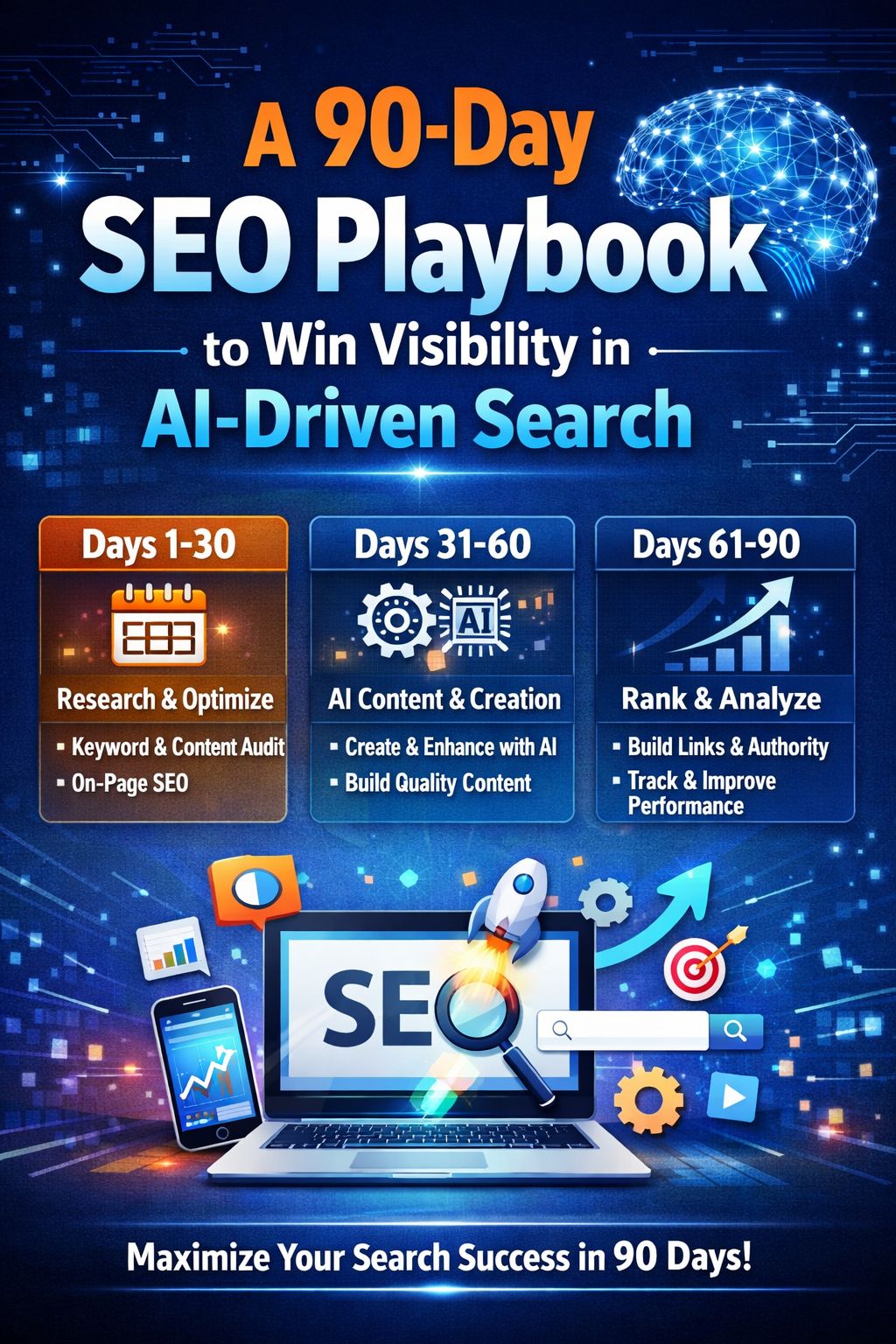
AI-driven search is reshaping how content is discovered, ranked, and summarized across the web. This 90-day SEO playbook outlines a structured, step-by-step approach to improving visibility in AI-powered search experiences, including Google’s generative results, answer engines, and conversational search tools. The guide focuses on content quality, technical foundations, authority signals, and optimization for how AI systems interpret and surface information.

Introduction: Why AI Has Changed SEO Forever
Search is no longer just about ranking blue links. With the rise of AI-powered experiences—such as generative answers, summaries, and conversational results—search engines increasingly interpret, extract, and rewrite content for users.
Platforms powered by large language models now aim to answer questions directly, often without requiring a click. This shift means traditional SEO tactics alone are no longer sufficient.
AI-driven search prioritizes:
- Clear, authoritative answers
- Well-structured, machine-readable content
- Demonstrated expertise and trust
- Context, intent, and semantic depth
This 90-day playbook is designed for publishers, startups, and marketers who want to adapt quickly and build durable visibility in this new environment.
How AI-Driven Search Works (In Simple Terms)
Modern search systems—particularly those influenced by generative AI—work differently than classic ranking algorithms.
Instead of only matching keywords, AI systems:
- Parse entire documents for meaning
- Identify entities, relationships, and claims
- Evaluate source credibility
- Synthesize answers across multiple sources
This approach is visible in initiatives like Search Generative Experiences from companies such as Google, as well as AI answer engines built on models from OpenAI.
For SEO, this means your content must be understood, trusted, and reusable by AI systems—not just indexed.
The 90-Day Framework: Overview
This playbook is divided into three phases:
- Days 1–30: Foundation and discovery
- Days 31–60: Content and authority optimization
- Days 61–90: AI-specific optimization and scaling
Each phase builds on the previous one, ensuring sustainable progress rather than short-term hacks.
Days 1–30: Build the Foundation for AI Search
1. Reframe Keyword Research Around Questions
AI-driven search is heavily question-based. Instead of focusing only on short keywords, prioritize user questions and problems.
Examples:
- “How does AI search rank content?”
- “What is the best SEO strategy for AI results?”
Focus on:
- Informational intent
- Long-tail queries
- “How,” “why,” and “what” phrasing
These formats align with how AI systems generate answers.
2. Audit Existing Content for AI Readiness
Review your top-performing and evergreen content.
Ask:
- Does it clearly answer a specific question?
- Is the structure easy to parse?
- Are claims supported and explained?
AI systems favor content that is:
- Logically structured
- Explicit in explanations
- Free from fluff and ambiguity
Thin or vague content should be flagged for rewriting.
3. Strengthen Technical SEO Basics
AI visibility still depends on strong technical SEO.
Key checks include:
- Fast page load speed
- Mobile-friendly layouts
- Clean URL structure
- Proper indexation
Ensure:
- Pages are crawlable
- No critical content is hidden behind scripts
- Canonical tags are correct
Without this foundation, even excellent content may be ignored.
4. Implement Structured Data Early
Structured data helps AI systems understand context.
Prioritize:
- Article schema
- FAQ schema
- How-to schema (where appropriate)
Schema does not guarantee inclusion in AI answers, but it reduces ambiguity, which is critical for generative systems.
Days 31–60: Optimize Content for Authority and AI Understanding
5. Create “Answer-First” Content
AI search favors content that answers the question immediately, then expands.
Structure articles with:
- Direct answers near the top
- Clear subheadings
- Bullet points for definitions and steps
Avoid burying key information deep in the article.
This mirrors how AI extracts content for summaries.
6. Build Topical Authority, Not Just Pages
AI systems evaluate topic coverage, not isolated articles.
Instead of publishing unrelated posts, create content clusters:
- Core pillar page
- Supporting articles answering sub-questions
- Internal links between them
This signals subject-matter depth and improves AI confidence in your site.
7. Optimize for Entities, Not Just Keywords
AI search relies heavily on entity recognition.
An entity can be:
- A person
- A company
- A technology
- A concept
Make entity relationships explicit:
- Define terms clearly
- Reference well-known entities accurately
- Maintain consistency in naming
This helps AI models connect your content to broader knowledge graphs.
8. Improve E-E-A-T Signals
Experience, Expertise, Authoritativeness, and Trust are increasingly important.
Actions to take:
- Add detailed author bios
- Cite reputable sources
- Keep content updated
- Avoid exaggerated or unsupported claims
AI systems favor content that appears reliable and written by knowledgeable sources.
9. Refresh and Expand Existing High-Value Pages
Updating existing content is often faster than creating new pages.
Enhance older posts by:
- Adding new sections
- Updating statistics
- Improving clarity
- Answering follow-up questions
AI-driven search values freshness combined with authority.
Days 61–90: Optimize Specifically for AI and Generative Search
10. Write With Summarization in Mind
AI models summarize content before presenting it.
Help them by:
- Using concise paragraphs
- Writing clear topic sentences
- Avoiding unnecessary jargon
Well-written summaries increase the chance your content is used verbatim or paraphrased accurately.
11. Optimize for Conversational Search
AI search often follows a conversational flow.
Structure content to support follow-ups:
- “What is X?”
- “Why does X matter?”
- “How does X work?”
This increases your chances of being referenced across multiple AI-generated answers.
12. Track Visibility Beyond Traditional Rankings
Traditional rank tracking is no longer enough.
Also monitor:
- Brand mentions in AI answers
- Traffic from zero-click searches
- Query patterns triggering generative results
SEO success in AI search is as much about presence and attribution as clicks.
13. Create Evergreen, Reference-Quality Content
AI systems favor content that remains accurate over time.
Aim for:
- Definitions
- Frameworks
- Step-by-step guides
- Industry explainers
These assets are more likely to be reused in generative responses.
14. Strengthen Internal Linking for Context
Internal links help AI systems understand site structure.
Best practices:
- Use descriptive anchor text
- Link related concepts
- Avoid orphan pages
This reinforces topical authority and semantic clarity.
15. Prepare for Multimodal Search
AI search increasingly blends text, images, and video.
Actions:
- Add descriptive alt text to images
- Include diagrams and charts
- Embed relevant video content
Multimodal signals help AI systems form richer understanding.
Common Mistakes to Avoid in AI-Driven SEO
- Over-optimizing for keywords
- Publishing shallow, repetitive content
- Ignoring technical SEO
- Focusing only on clicks, not visibility
- Treating AI search as a temporary trend
AI-driven search is a structural shift, not a feature update.
How This Playbook Aligns With Google’s Direction
Search engines are moving toward answer quality over ranking tricks. This playbook aligns with that direction by focusing on:
- Clarity
- Authority
- User intent
- Structured understanding
These principles remain durable even as specific AI implementations evolve.
Measuring Success After 90 Days
By the end of 90 days, you should see:
- Improved impressions for long-tail queries
- Increased visibility in AI summaries
- Stronger topical authority signals
- Better engagement metrics
AI-driven SEO rewards consistency more than quick wins.
Conclusion: SEO in the Age of AI Is About Being Useful
AI-driven search does not eliminate SEO—it raises the bar.
The sites that win are those that:
- Explain concepts clearly
- Demonstrate real expertise
- Structure information for machines and humans
- Invest in long-term trust
This 90-day playbook provides a practical path forward, but success depends on execution and iteration. As AI search evolves, the core principle remains the same: the most useful content wins.
Key Highlights
- AI-driven search prioritizes clarity, authority, and structure
- Traditional SEO must be adapted, not abandoned
- Structured data and entity optimization are critical
- Content clusters outperform isolated pages
- SEO success now includes visibility beyond clicks


