
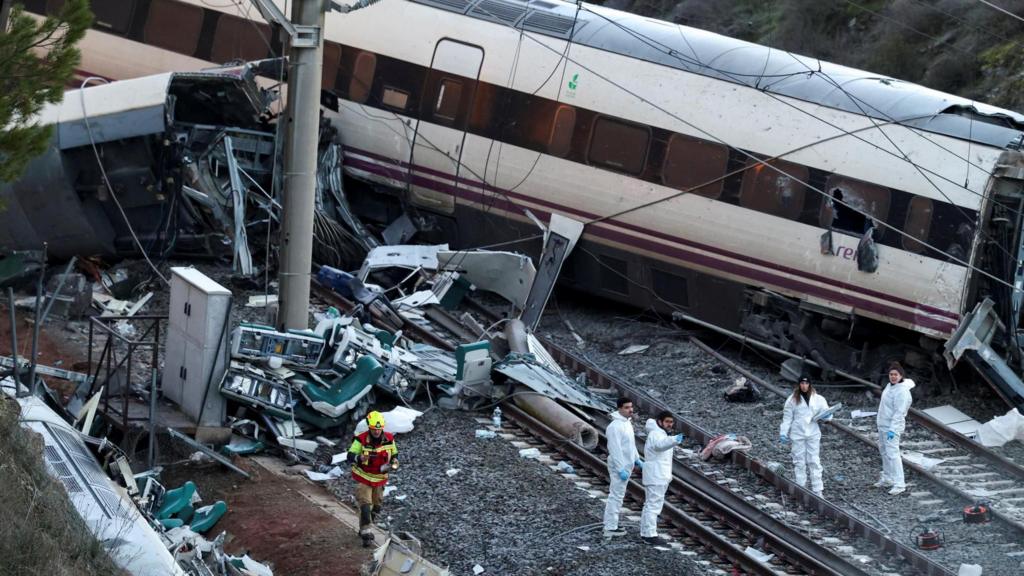
A catastrophic rail accident in southern Spain has shattered the calm of a Sunday evening, leaving at least 39 people dead and dozens more injured after two high-speed trains collided in Adamuz, Córdoba. Emergency crews are continuing rescue operations as the scale of the tragedy becomes clearer and authorities work to support survivors, families, and affected communities. The crash, one of the deadliest in Spain’s modern rail history, has triggered national mourning, statements from world leaders, and urgent calls for answers about what went wrong.
The incident has unfolded rapidly, with information released in stages by Spanish officials, rail operators, and emergency services. It occurred on a stretch of the Madrid–Seville high-speed rail line, a symbol of Spain’s sophisticated rail network, making the human toll all the more sobering.
What Happened: The Sequence of Events
On the evening of January 18, 2026, around 7:45 p.m. local time, a high-speed train operated by the private company Iryo, travelling from Málaga to Madrid, experienced a catastrophic derailment near Adamuz, a town in the province of Córdoba. Within seconds, the derailed carriages crossed onto an adjacent track and were struck head-on by an oncoming Renfe high-speed train bound for Huelva.
According to early assessments, the derailment occurred on a straight section of track that had been completely refurbished the previous year, raising questions about the underlying cause since the line was not known to present unusual operational challenges. Officials have described the accident as “tremendously strange.”
The force of the collision was immense. The Renfe train’s first two carriages were reported to have fallen down an embankment, complicating rescue operations as crews worked at the scene in difficult terrain.
Human Toll and Emergency Response
At least 39 people have been confirmed dead, including the driver of the Renfe train. This figure is expected to remain provisional as search and recovery continue amid the wreckage. Emergency services reported that 122 people were injured, with dozens in intensive care units across hospitals in the region.
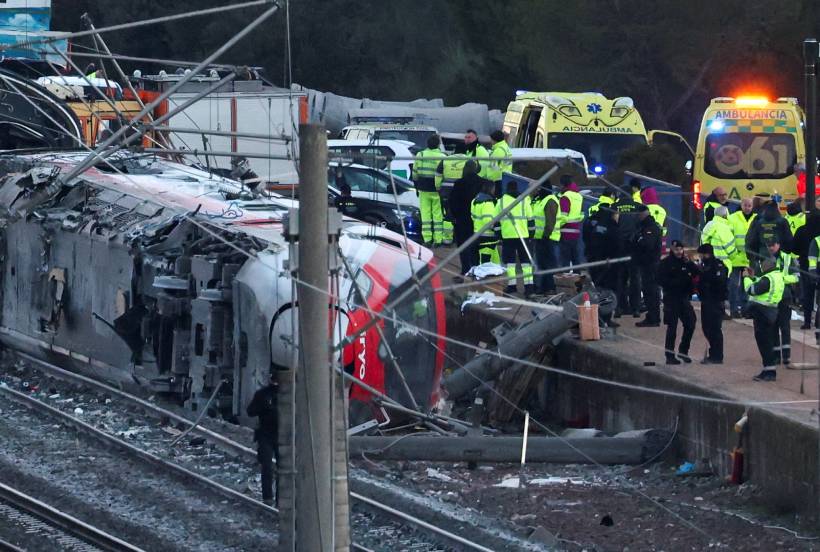
Local and national authorities mobilised rapidly. Spanish Prime Minister Pedro Sánchez visited the crash site, pledging full support from the government and emergency services, and declared three days of national mourning in the wake of the tragedy.
Emergency crews including medical teams, fire brigades, the Guardia Civil, and units from Spain’s Military Emergencies Unit (UME) were deployed to assist with rescue, recovery, and support for families of the victims.
Passenger and Operator Details
The two trains involved in the crash were carrying hundreds of passengers and crew at the time of the accident. The Iryo service that derailed had approximately 300 people onboard, including passengers and crew, while the Renfe train had an estimated 187 people in its carriages. Authorities have worked to relay information to families, establish support centres, and provide psychological assistance to those affected.
Early reports indicate that passengers and first responders worked together in the chaotic moments following the crash, using emergency hammers to break windows and assist others in escaping the wreckage. Such testimonies underscore both the horror of the event and the efforts of those trying to save lives amid confusion and destruction.
What Officials Are Saying
Spanish authorities have been cautious in discussing potential causes, with the Transport Minister describing the circumstances around the derailment as unclear and “extremely strange.” Officials have noted that the automatic braking systems would have had less than 20 seconds to engage after the initial derailment—far too little time to prevent the collision once the first train crossed onto the opposite track.
Renfe and Iryo executives have emphasised cooperation with investigative bodies and emergency services, stressing that the trains and infrastructure were considered to be in good condition. The fact that the derailment occurred on a section of track recently renovated with significant investment has only deepened questions about underlying causes.
Investigation and Technical Analysis
Spanish authorities, including the Comisión de Investigación de Accidentes Ferroviarios (CIAF), have begun formal investigations into the crash. This inquiry is expected to involve forensic analysis of train components, track conditions, signalling data, and operational records. Investigators will also review onboard safety systems and data from the trains’ black boxes to reconstruct the seconds leading up to the crash.
Understanding whether there were pre-existing infrastructure issues, mechanical failures, or software/system faults will be critical. Previous alerts by railway workers about wear and tear on the Adamuz section of the line add further context to the investigation, though official sources have not confirmed any direct link as of now.
Spain’s High-Speed Rail Network in Context
Spain’s high-speed rail network, known as AVE, is among the most extensive in the world, second only to China’s in terms of track length. It has been celebrated for its efficiency, connectivity, and economic impact on regional mobility. Millions of passengers use high-speed services annually, including routes between major cities such as Madrid, Seville, Córdoba, Málaga, and Barcelona.
Despite this, serious fatal accidents are rare. The last major high-speed rail disaster in Spain occurred in 2013 at Santiago de Compostela, when a train derailed on a curve, resulting in 80 deaths. That event led to scrutiny of speed control systems and emergency response protocols. The Adamuz accident is the first high-speed rail crash in Spain with fatalities since that incident.
National Mourning and Public Reaction
The Spanish government’s declaration of national mourning reflects the shock felt across the country. Political leaders from across Europe and other parts of the world have offered condolences, with many acknowledging the bravery of first responders and the deep grief of the families affected.
King Felipe VI and Queen Letizia cut short an official visit abroad to return to Spain and pay their respects, underscoring the symbolic national significance of the disaster. Religious leaders, civic organisations, and transportation unions have also expressed solidarity with the victims and their loved ones.
Broader Implications for Rail Safety
The Adamuz crash raises serious questions about the safety frameworks governing high-speed rail travel—questions that extend beyond Spain to international standards. Investigators will closely examine whether current maintenance practices, real-time monitoring systems, and human-machine interaction protocols are sufficient to prevent such catastrophic outcomes.
How regulators, operators, and manufacturers respond in the coming weeks could influence rail safety policies across Europe. Calls for enhanced inspection regimes, improved sensor technology, and better emergency response coordination are likely to be part of the debate as findings emerge from the ongoing investigation.
The Human Cost and the Path Ahead
As rescue operations continue, families of the deceased and injured face a long period of grief, recovery, and uncertainty. Authorities have urged patience and compassion as they work to identify remains, assist survivors, and provide accurate information. Support centres have been set up in major cities connected to the rail network to assist relatives and friends of those affected.
The tragedy underscores how even the most advanced transportation systems can be vulnerable to rare but devastating failures. Spain’s high-speed rail network has fundamentally transformed travel across the country, yet this disaster is a stark reminder of the need for constant vigilance, investment, and oversight in public infrastructure.


