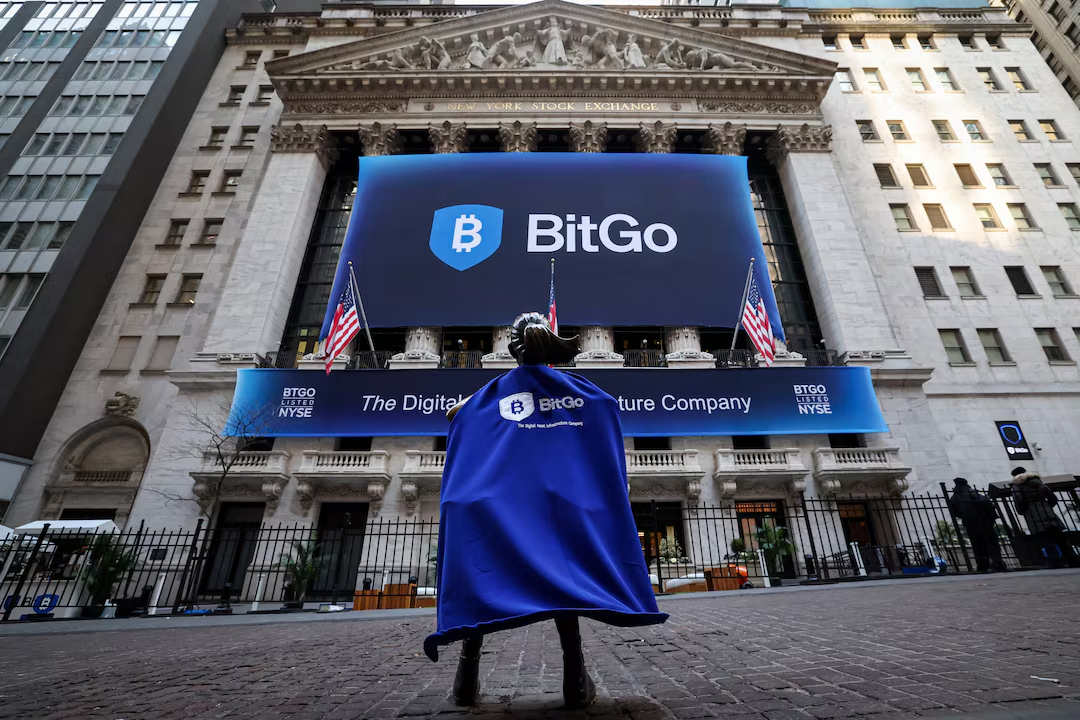
BitGo shares rose in their public market debut, making it the first cryptocurrency company to go public this year. The strong opening offers an early signal of revived investor interest in select crypto infrastructure firms.
BitGo’s market debut has given the crypto industry its first public listing of the year — and an early test of whether investor appetite is returning after a prolonged drought in crypto IPOs.
Shares of the digital asset custody firm climbed on their first day of trading, according to reports, marking a sharp contrast with the caution that has defined public markets for crypto companies since the sector’s downturn. While the rally does not signal a broad reopening of the IPO window, it suggests that investors may be willing to back crypto businesses with institutional customers and clearer revenue models.
For an industry that has spent much of the past two years on the defensive, the optics matter.
Why BitGo matters in the crypto ecosystem
BitGo operates in one of the less volatile corners of the crypto market: custody and infrastructure. Rather than trading or lending, the company provides secure storage and related services for digital assets, primarily serving institutional clients.
That positioning has helped BitGo weather market cycles that proved fatal for more speculative crypto businesses. Custody remains a foundational service, particularly as regulators and large investors emphasize security, segregation of assets, and operational controls.
Those characteristics likely made BitGo a more palatable candidate for public investors compared with consumer-facing crypto firms.
The significance of being first
Being the first crypto IPO of the year carries symbolic weight. Since the collapse of several high-profile crypto companies, public markets have largely shut their doors to the sector.
BitGo’s debut does not mean that door is fully open. Instead, it suggests that investors are selectively reassessing which parts of the crypto stack can support public-market scrutiny.
Infrastructure providers with institutional clients, predictable fees, and compliance-focused narratives appear to be leading that reassessment.
What investors are responding to
Market participants point to several factors behind BitGo’s positive reception. The company benefits from recurring revenue tied to assets under custody rather than trading volumes, which can swing wildly.
It has also leaned into regulatory alignment, operating in jurisdictions with defined rules and positioning itself as a bridge between traditional finance and digital assets.
For investors, that combination reduces exposure to the boom-and-bust dynamics that have defined much of crypto’s public-market history.
Implications for other crypto companies
BitGo’s debut will be closely watched by other crypto firms considering public listings. A sustained post-IPO performance could encourage additional infrastructure-focused companies to test the market later this year.
Conversely, volatility or a pullback would reinforce the view that crypto IPOs remain viable only for a narrow subset of businesses.
Either way, the listing provides new data for bankers, founders, and investors navigating an uncertain capital markets environment.
A cautious reopening, not a wave
It is too early to declare a comeback for crypto IPOs. Broader market conditions, regulatory developments, and risk sentiment will all shape what comes next.
Still, BitGo’s first-day jump suggests that public investors are no longer uniformly dismissing crypto — they are discriminating.
For the industry, that shift may be more important than a flood of listings. It rewards companies that built durable businesses while the hype faded and sets a higher bar for those that want to follow.