

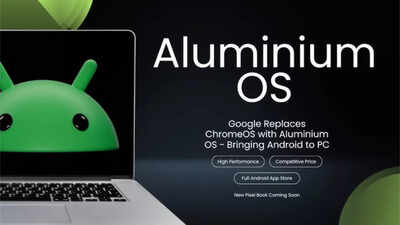
Google’s long-rumored desktop version of Android—internally dubbed “Aluminium OS”—has surfaced in a developer bug report, offering the first concrete glimpse of how Android could evolve into a full PC operating system. Screenshots and recordings show a hybrid environment merging Android’s app ecosystem with traditional desktop elements, signalling a strategic push to unify mobile and desktop computing.
The Leak: Android Desktop in the Wild
A bug report on Google’s Chromium Issue Tracker accidentally exposed the early user interface of A-OS, widely believed to be Google’s next-generation desktop platform. Screenshots captured from an HP Elite Dragonfly 13.5 Chromebook reveal a windowed environment with familiar Android elements—app icons, status indicators, and the Play Store—reimagined for larger screens.
The report, now private but saved by third-party outlets, showed a system running on a build labelled “ALOS,” thought to stand for A-OS, and based on Android 16. This leak is the most tangible confirmation yet of Google’s desktop ambitions after multiple references to the project in internal job listings and past announcements.
What Aluminium OS Looks Like — And Why It Matters
From the leaked footage, A-OS blends desktop and mobile paradigms:
- A centralised taskbar reminiscent of ChromeOS but styled with Android motifs.
- A top status bar showing battery, connectivity, and language indicators—something more common in mobile interfaces.
- Split-screen multitasking and draggable windows that hint at full desktop productivity.
- Integrated Play Store access and mobile-centric UI layers adapted for keyboard and mouse input.
These elements suggest that Google is not simply porting Android’s phone UI to laptops, but adapting it for a desktop context, similar to Samsung’s DeX, yet potentially much broader in scope.
From ChromeOS to Android for PC
The leaked build also reinforces earlier reporting that Google plans to merge ChromeOS with Android under a unified platform, helping reduce fragmentation while expanding Android’s reach. ChromeOS was originally developed as a lightweight web-centric system, but the strategic shift toward an Android foundation appears aimed at delivering richer app compatibility and tighter integration across devices.
Internal listings previously identified Aluminum (or Aluminium) OS as an Android-based desktop platform with AI features at its core, aligning with Google’s broader strategy to incorporate generative intelligence throughout its software stack.
Early Reactions: Opportunity and Risk
Industry early reactions reflect both excitement and caution. On the opportunity side, a unified Android desktop could finally allow developers to build once and run across mobile, tablet, and PC without maintaining multiple codebases—something Apple and Microsoft currently support through their platforms.
However, critics point to possible usability challenges. Observers note that Aluminium OS still retains distinct mobile patterns—such as persistent Android-style top bars and app behaviours—that may not feel fully native to power users accustomed to mature desktop environments like Windows or macOS.
Competitive Context: Entering a Crowded Field
A successful Android desktop OS would thrust Google deeper into competition with Microsoft’s Windows and Apple’s macOS, as well as niche Linux variants. Combining Android’s extensive app ecosystem with native PC capabilities could open new opportunities—especially in emerging markets where affordable hardware and seamless integration matter. However, the success of such a platform will depend on feature parity, application support, and performance expectations among professional users.
What’s Next for Aluminium OS
Google has not formally announced release timelines, but the sophistication of the leaked build—running on existing Chromebook hardware—suggests the project is well past initial prototyping. Analysts link the ongoing development to anticipated announcements at Google’s developer events throughout 2026, where deeper technical details or early betas might be revealed.

The emergence of A-OS underscores a broader shift in how mobile and desktop computing may converge. As devices increasingly blur the line between form factors, a unified operating system rooted in Android could redefine Google’s role in PC ecosystems—if it can balance mobile friendliness with desktop power and flexibility.
In many ways, this leak is not just a preview of an interface, but a window into Google’s evolving operating system strategy in the AI era—one where a single software foundation could span phones, laptops, tablets, and beyond.


