Top 5 eSIM Startup Companies in 2026

Share via:

Top eSIM startup companies to follow include Ohayu – a travel eSIM provider with global coverage, Onomondo that focuses on IoT eSIM, 1Global – a company specializing in remote provisioning, enterprise, and IoT, Kolet – temporary eSIM for trips, and Yesim, a global provider offering virtual numbers and business solutions along with data plans.

The mobile communications market is moving from physical SIM cards to digital eSIMs. Demand is being driven by the needs of remote teams, travelers, and the IoT sector. Next, we will analyze the emerging players, compare their niches and unique offers, and give a forecast for market development. The criteria for selecting technology leaders include network aggregation, API integration, and user-friendly interfaces. 

Top eSIM Startups to Follow 

The embedded SIM market has long moved beyond the usual pursuit of scale and is now focused on delivering valuable features. eSIM startups are now equipped with powerful standards that meet user expectations and can cover a range of requirements, from travel to demanding business tasks. 

Ohayu

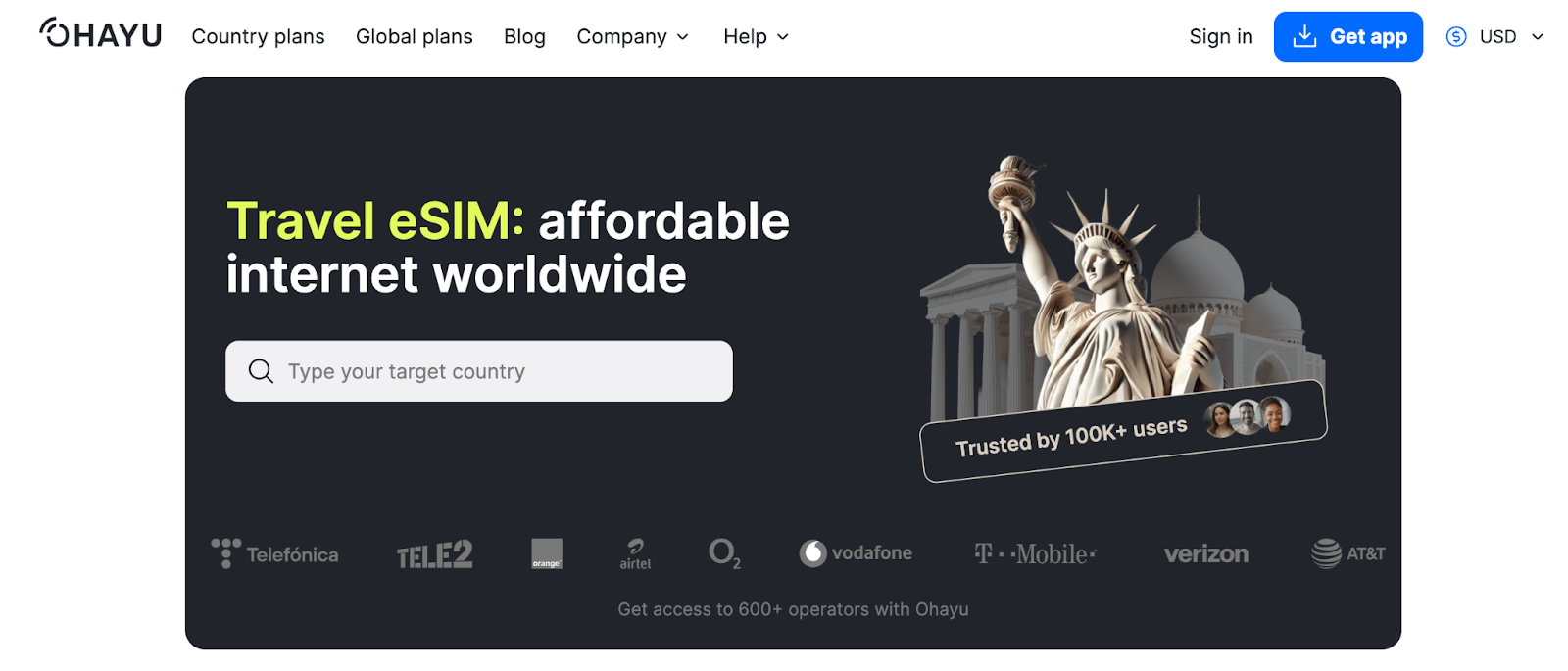
Ohayu eSIM is a travel data plan provider with global coverage (~190+ countries & 600+ networks). The startup is rapidly gathering recognition and positive user feedback on ease of use and reliability, due to multi-network support and an intuitive mobile application. 

The philosophy behind this service is based on maximum convenience for the customer. No complicated schemes, just set it up and forget about it. Travelers and remote workers get the best eSIM here. Everything is organized so that the operator and network with the better signal and channel stability are automatically selected.
Eliminating the routine of choosing a network

The algorithms run in the background, so you don’t have to worry about improving the signal. This is especially valuable for video conferences or business calls. 

Worldwide solution

The company was originally built as a global player, as confirmed by its service availability in nearly 200 countries and a global subscription that covers more than 110 countries from the outset. This coverage makes the platform a solid travel choice, including for unpredictable routes and long-term trips.

Onomondo

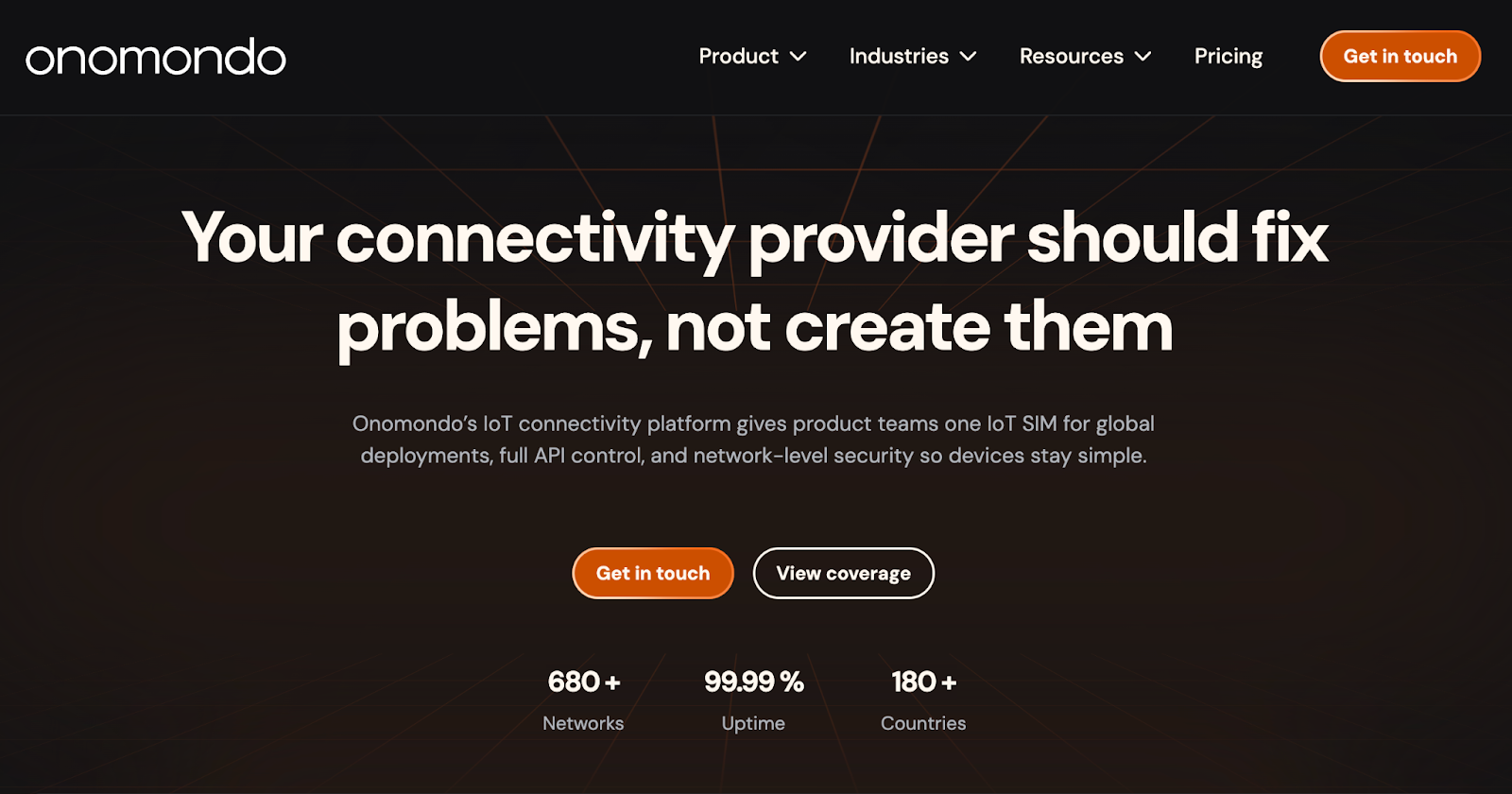
The mission of Danish eSIM startup Onomondo is to provide a completely reliable foundation for the Internet of Things. The company solves a key problem in the industry: network fragmentation and the complexity of managing millions of devices around the world. Onomondo has built its own cellular IoT network, expanded to 680+ networks in 180+ countries, and is showing leadership transition and strong revenue growth in 2025.
Focus on corporate ecosystems

The service has established itself in complex B2B projects. Recent partnerships in the field of smart logistics and telematics confirm the demand for an infrastructure approach.

Unified Network

Onomondo’s vision is to hide the complexity of interacting with hundreds of mobile operators. The device is always online in a single global network.

1Global

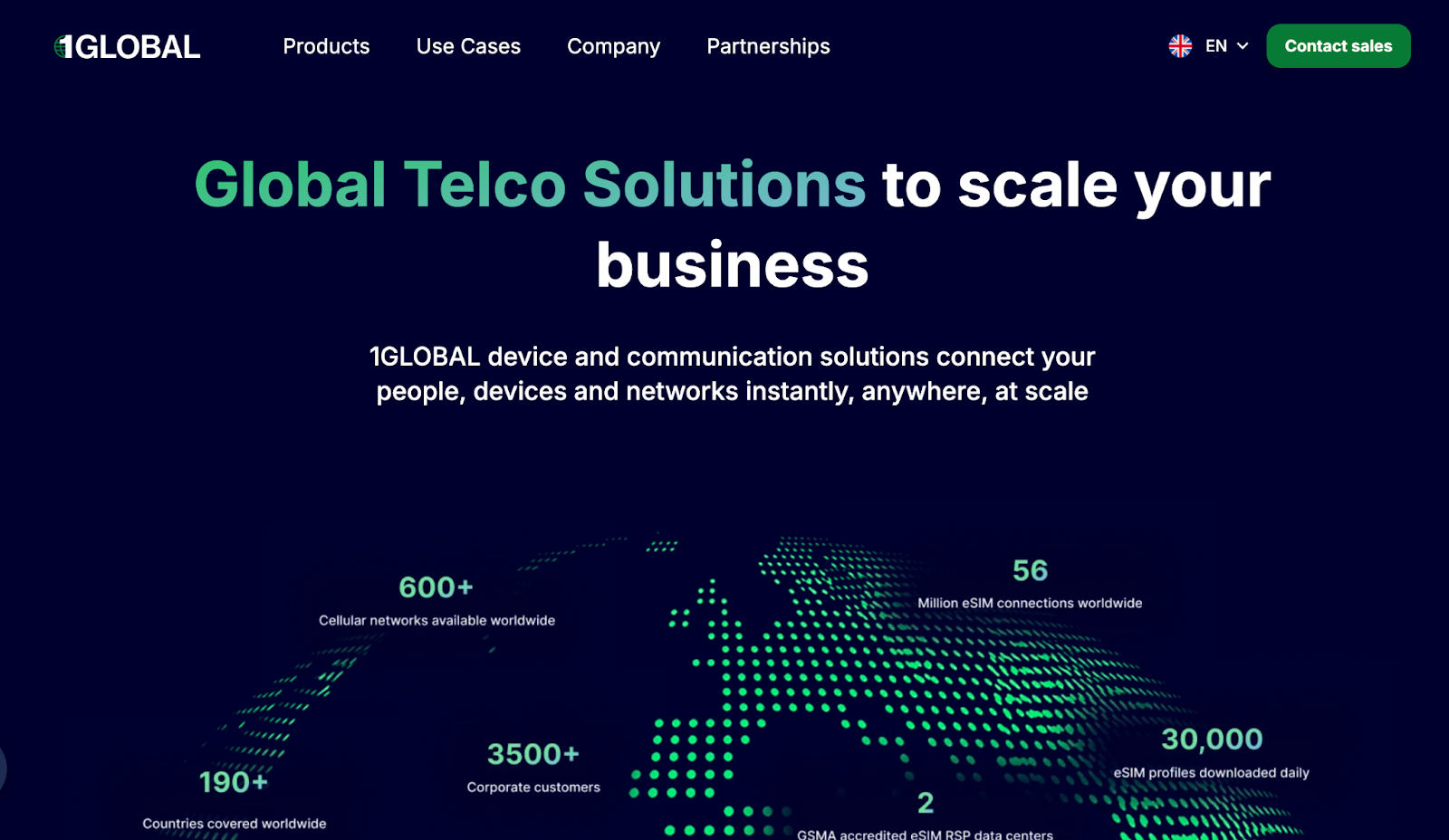
1Global transforms eSIM from a communication tool into a key element of financial and operational management (Telecom Expense Management, TEM) for international corporations. The company transitioned to a new global headquarters and strengthened its governance in 2025. 1Global also has a fully regulated telco status in 42+ countries and broad partner integrations.
Centralization and control

The company sees itself as a bridge between traditional corporate TEM and the new eSIM reality. Their solution allows data to be integrated directly into ERP and billing systems.

Reduction of operational risks

The key value is predictable costs, compliance with local regulatory standards, and a uniform SLA worldwide. This positioning has made them the preferred partner for companies with distributed teams.

Kolet

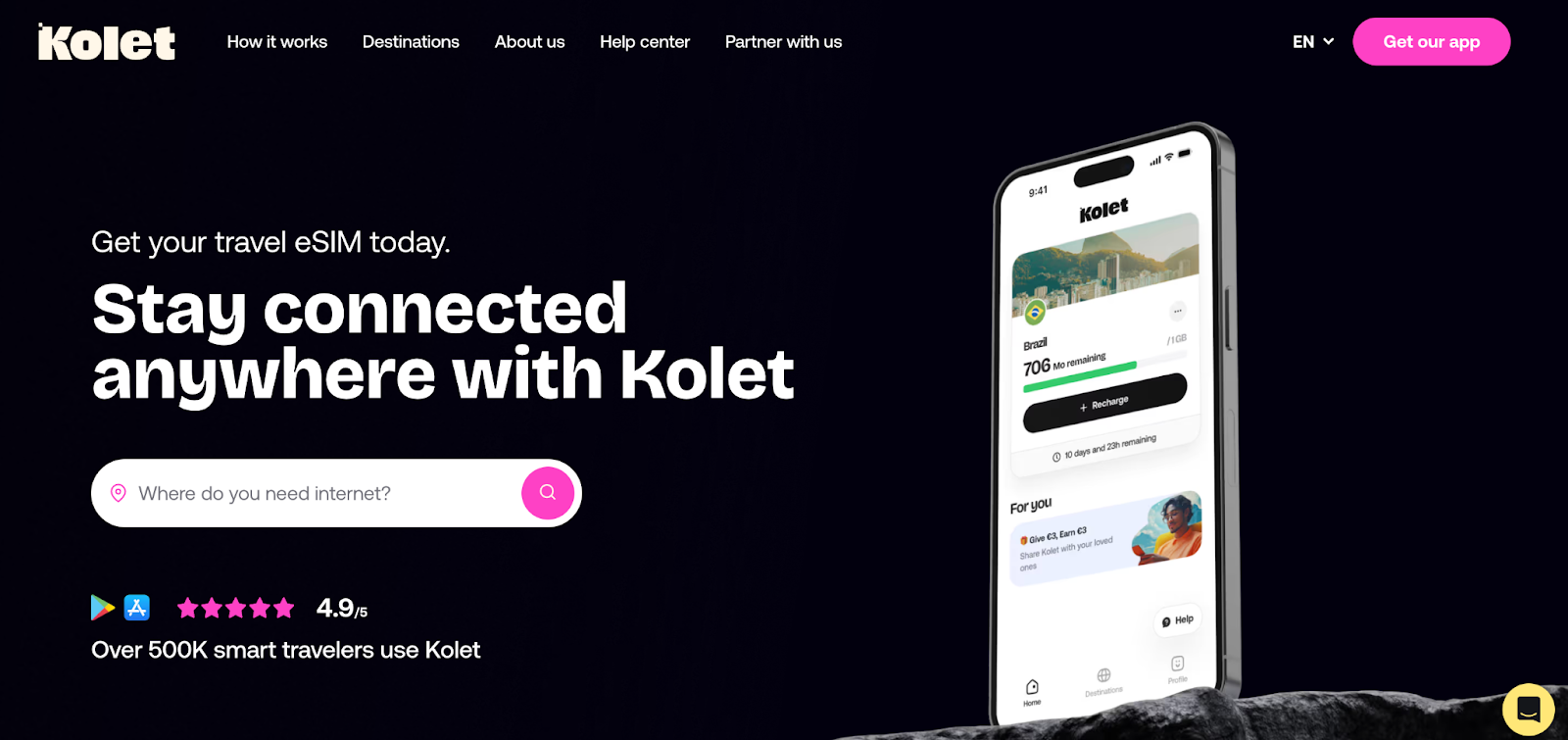
The startup is rethinking the place of eSIM in the customer journey, shifting the point of activation from the telecom operator’s app to the services that the customer already uses. Kolet eliminates unnecessary steps in connecting mobile communications for travelers. The company has established partnerships with travel brands (e.g., KLM) for bundled offers.
Connection as a built-in function

Businesses receive white-label solutions that enable them to offer instant internet to customers under their own brand. 

Growth strategy through partner ecosystems

Success is measured by the number and depth of integrations. The introduction of Kolet as an option for several European low-cost airlines has become a benchmark case study for their B2B2C model.

Yesim

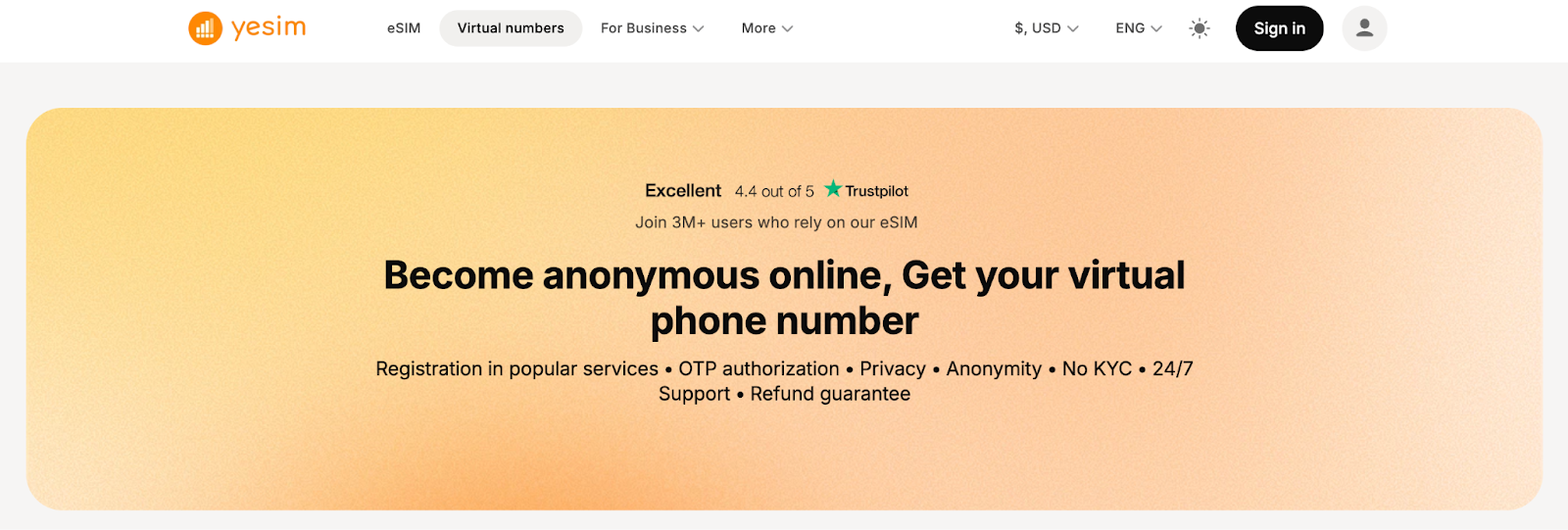
Yesim has transitioned from B2C applications for travelers to the role of a technological enabler for small and medium-sized businesses. Their new mission is to remove technical and operational barriers to launching vMVNOs. Yesim is recognised among notable eSIM providers and has expanded its offerings for travel managers and grown its user base (3M active).
Telecom tools

The project found a niche by offering a “construction set” for businesses. Their positioning is to be a technology partner for companies that have their own customer base but do not want or are unable to build telecom infrastructure from scratch.

Pivot to the SaaS model

Recognizing the limitations of the consumer market, the eSIM startup redirected its development efforts toward creating a platform that allows companies from various sectors (EdTech, telemedicine, call centers) to deploy virtual numbers and mobile internet services under their own brand.

Top Growing eSIM Startup Companies – key data

Below is a snapshot of the top emerging eSIM startups, outlining their approaches, structures, and primary use cases.

StartupFounded yearLocation (HQ)ApproachPrimary Use Cases
Ohayu2024Warsaw, PolandTravel-focused global eSIM with multi-carrier connectivity, simple prepaid plans, and supports multi-network switching for reliability.Travel connectivity, remote work abroad, digital nomads, hybrid workations, and global eSIM data access.
Onomondo2012Copenhagen, DenmarkIoT-centric global connectivity platform unifying 600+ networks through a cloud-native core; strong API controls and network-level securityEnterprise IoT deployments, fleet/asset connectivity, remote diagnostics, global device management
1GLOBAL2022Amsterdam, NetherlandsGlobal MVNO/telecom operator with regulated eSIM, connectivity stack, white-label APIs for partners and enterprisesIntegrated eSIMs in platforms, enterprise mobile/data voice solutions, B2B2C connectivity offerings
Kolet2024Paris, FranceSingle universal travel eSIM that avoids SIM swaps and provides prepaid global data in 190+ countriesTraveler connectivity, remote/outbound work, data-only mobile access abroad
Yesim2019Geneva, SwitzerlandTraveler-oriented eSIM service with multi-network aggregation, built-in VPN, and optional virtual numbersInternational travel, business trips, enterprise travel managers, data, and virtual number support

eSIM Startup Landscape Analysis

The success of eSIM startups is driven by fundamental changes in technology, markets, and regulations. In other words, they meet needs that traditional operators are unable to satisfy.

Implementation Trends

The transition to electronic profiles is accelerating due to two parallel processes. First, the strategy of device manufacturers. Apple, Google, and Samsung are consistently introducing eSIM as a standard, and in their premium lines, they sometimes completely abandon physical slots. The second process reflects the industry support, such as GSMA standardization and simplified activation processes by operators. 

Growth Areas

Demand is clearly segmented here. Therefore, each project finds its niche and successfully settles there. 

  • Travel and remote work require instant activation and good connectivity. Startups win here in terms of convenience, as you no longer need to search for local SIM cards.
  • The Internet of Things (IoT) requires the management of thousands of devices and global SLAs. Digital SIM is the basis for scalable solutions, especially in logistics and telematics.
  • The corporate sector is moving mobility management to the digital realm. Integrating electronic SIMs with ERP systems and billing is the best option for optimizing the communication costs of distributed teams.

Competitive Dynamics

Such projects rarely build their own infrastructure. They are often part of an aggregation on top of traditional operators’ networks. They add value through software, for example, by simplifying network selection, centralizing management, or providing a unified API. Thus, they compete for consumers rather than frequencies. This is how next-generation operators (vMVNO 2.0) are created.

Regulatory and hardware support

Legislative initiatives, such as EU regulations on embedded SIM portability, increase competition by reducing user dependence on a single operator. And the global transition of devices to the new architecture creates a natural competitive advantage for eSIM startups. Their digital, self-service-oriented processes are ideally suited to the new reality, where physical media no longer exists as a class. This is a systemic trend that guarantees long-term growth for the entire sector.

Future Outlook

Industry trends indicate that the current growth in embedded SIMs is only the initial phase of further transformation. GSMA predicts that by 2030, these will account for the majority of new connections. This is confirmed by their own research. This will create two key vectors of development.


The dominance of eSIM-only devices is becoming a regulatory requirement for the market, especially in the premium segment. This will simplify logistics for manufacturers and finally shift the point of operator selection to the digital environment. In such an ecosystem, those who offer seamless, fully digital service will gain a competitive advantage.

Innovation is shifting from infrastructure improvements to service-oriented models. We are already observing a transition from simply providing network access (MNO-led) to comprehensive solutions where the built-in communication module is only part of the value proposition. Examples already exist: integration with fintech services for expats, automatic connection of IoT devices to corporate management systems, and dynamic tariffs based on user behavior.

The future of eSIM paves the way for highly specialized projects that will manage connectivity as a software resource on top of any available physical infrastructure. This will make a specific operator invisible and irrelevant to the end user or business.

Top Growing eSIM Startup Companies – Summing Up

The embedded SIM era is radically transforming mobile communications, and eSIM startups are driving this transformation. Their strength lies not in scale, but in their ability to penetrate specific niches deeply: from hassle-free travel with budget-friendly apps like Ohayu eSIM and Kolet, hybrid work – with Yesim business products, to global IoT and enterprise automation – like Global1 and Onomondo.

Each of these companies proves that innovation today lies in a unique combination of a technological approach and care for and desire to meet the needs of users. Market growth will be determined by the ability to transform standardized technology into specialized, indispensable solutions. 

Disclaimer

We strive to uphold the highest ethical standards in all of our reporting and coverage. We StartupNews.fyi want to be transparent with our readers about any potential conflicts of interest that may arise in our work. It’s possible that some of the investors we feature may have connections to other businesses, including competitors or companies we write about. However, we want to assure our readers that this will not have any impact on the integrity or impartiality of our reporting. We are committed to delivering accurate, unbiased news and information to our audience, and we will continue to uphold our ethics and principles in all of our work. Thank you for your trust and support.

Sreejit
Sreejit Kumar is a media and communications professional with over two years of experience across digital publishing, social media marketing, and content management. With a background in journalism and advertising, he focuses on crafting and managing multi-platform news content that drives audience engagement and measurable growth.

Popular

More Like this

Top 5 eSIM Startup Companies in 2026

Top eSIM startup companies to follow include Ohayu – a travel eSIM provider with global coverage, Onomondo that focuses on IoT eSIM, 1Global – a company specializing in remote provisioning, enterprise, and IoT, Kolet – temporary eSIM for trips, and Yesim, a global provider offering virtual numbers and business solutions along with data plans.

The mobile communications market is moving from physical SIM cards to digital eSIMs. Demand is being driven by the needs of remote teams, travelers, and the IoT sector. Next, we will analyze the emerging players, compare their niches and unique offers, and give a forecast for market development. The criteria for selecting technology leaders include network aggregation, API integration, and user-friendly interfaces. 

Top eSIM Startups to Follow 

The embedded SIM market has long moved beyond the usual pursuit of scale and is now focused on delivering valuable features. eSIM startups are now equipped with powerful standards that meet user expectations and can cover a range of requirements, from travel to demanding business tasks. 

Ohayu

Ohayu eSIM is a travel data plan provider with global coverage (~190+ countries & 600+ networks). The startup is rapidly gathering recognition and positive user feedback on ease of use and reliability, due to multi-network support and an intuitive mobile application. 

The philosophy behind this service is based on maximum convenience for the customer. No complicated schemes, just set it up and forget about it. Travelers and remote workers get the best eSIM here. Everything is organized so that the operator and network with the better signal and channel stability are automatically selected.

Eliminating the routine of choosing a network

The algorithms run in the background, so you don’t have to worry about improving the signal. This is especially valuable for video conferences or business calls. 

Worldwide solution

The company was originally built as a global player, as confirmed by its service availability in nearly 200 countries and a global subscription that covers more than 110 countries from the outset. This coverage makes the platform a solid travel choice, including for unpredictable routes and long-term trips.

Onomondo

The mission of Danish eSIM startup Onomondo is to provide a completely reliable foundation for the Internet of Things. The company solves a key problem in the industry: network fragmentation and the complexity of managing millions of devices around the world. Onomondo has built its own cellular IoT network, expanded to 680+ networks in 180+ countries, and is showing leadership transition and strong revenue growth in 2025.

Focus on corporate ecosystems

The service has established itself in complex B2B projects. Recent partnerships in the field of smart logistics and telematics confirm the demand for an infrastructure approach.

Unified Network

Onomondo’s vision is to hide the complexity of interacting with hundreds of mobile operators. The device is always online in a single global network.

1Global

1Global transforms eSIM from a communication tool into a key element of financial and operational management (Telecom Expense Management, TEM) for international corporations. The company transitioned to a new global headquarters and strengthened its governance in 2025. 1Global also has a fully regulated telco status in 42+ countries and broad partner integrations.

Centralization and control

The company sees itself as a bridge between traditional corporate TEM and the new eSIM reality. Their solution allows data to be integrated directly into ERP and billing systems.

Reduction of operational risks

The key value is predictable costs, compliance with local regulatory standards, and a uniform SLA worldwide. This positioning has made them the preferred partner for companies with distributed teams.

Kolet

The startup is rethinking the place of eSIM in the customer journey, shifting the point of activation from the telecom operator’s app to the services that the customer already uses. Kolet eliminates unnecessary steps in connecting mobile communications for travelers. The company has established partnerships with travel brands (e.g., KLM) for bundled offers.

Connection as a built-in function

Businesses receive white-label solutions that enable them to offer instant internet to customers under their own brand. 

Growth strategy through partner ecosystems

Success is measured by the number and depth of integrations. The introduction of Kolet as an option for several European low-cost airlines has become a benchmark case study for their B2B2C model.

Yesim

Yesim has transitioned from B2C applications for travelers to the role of a technological enabler for small and medium-sized businesses. Their new mission is to remove technical and operational barriers to launching vMVNOs. Yesim is recognised among notable eSIM providers and has expanded its offerings for travel managers and grown its user base (3M active).

Telecom tools

The project found a niche by offering a “construction set” for businesses. Their positioning is to be a technology partner for companies that have their own customer base but do not want or are unable to build telecom infrastructure from scratch.

Pivot to the SaaS model

Recognizing the limitations of the consumer market, the eSIM startup redirected its development efforts toward creating a platform that allows companies from various sectors (EdTech, telemedicine, call centers) to deploy virtual numbers and mobile internet services under their own brand.

Top Growing eSIM Startup Companies – key data

Below is a snapshot of the top emerging eSIM startups, outlining their approaches, structures, and primary use cases.

StartupFounded yearLocation (HQ)ApproachPrimary Use Cases
Ohayu2024Warsaw, PolandTravel-focused global eSIM with multi-carrier connectivity, simple prepaid plans, and supports multi-network switching for reliability.Travel connectivity, remote work abroad, digital nomads, hybrid workations, and global eSIM data access.
Onomondo2012Copenhagen, DenmarkIoT-centric global connectivity platform unifying 600+ networks through a cloud-native core; strong API controls and network-level securityEnterprise IoT deployments, fleet/asset connectivity, remote diagnostics, global device management
1GLOBAL2022Amsterdam, NetherlandsGlobal MVNO/telecom operator with regulated eSIM, connectivity stack, white-label APIs for partners and enterprisesIntegrated eSIMs in platforms, enterprise mobile/data voice solutions, B2B2C connectivity offerings
Kolet2024Paris, FranceSingle universal travel eSIM that avoids SIM swaps and provides prepaid global data in 190+ countriesTraveler connectivity, remote/outbound work, data-only mobile access abroad
Yesim2019Geneva, SwitzerlandTraveler-oriented eSIM service with multi-network aggregation, built-in VPN, and optional virtual numbersInternational travel, business trips, enterprise travel managers, data, and virtual number support

eSIM Startup Landscape Analysis

The success of eSIM startups is driven by fundamental changes in technology, markets, and regulations. In other words, they meet needs that traditional operators are unable to satisfy.

Implementation Trends

The transition to electronic profiles is accelerating due to two parallel processes. First, the strategy of device manufacturers. Apple, Google, and Samsung are consistently introducing eSIM as a standard, and in their premium lines, they sometimes completely abandon physical slots. The second process reflects the industry support, such as GSMA standardization and simplified activation processes by operators. 

Growth Areas

Demand is clearly segmented here. Therefore, each project finds its niche and successfully settles there. 

  • Travel and remote work require instant activation and good connectivity. Startups win here in terms of convenience, as you no longer need to search for local SIM cards.
  • The Internet of Things (IoT) requires the management of thousands of devices and global SLAs. Digital SIM is the basis for scalable solutions, especially in logistics and telematics.
  • The corporate sector is moving mobility management to the digital realm. Integrating electronic SIMs with ERP systems and billing is the best option for optimizing the communication costs of distributed teams.

Competitive Dynamics

Such projects rarely build their own infrastructure. They are often part of an aggregation on top of traditional operators’ networks. They add value through software, for example, by simplifying network selection, centralizing management, or providing a unified API. Thus, they compete for consumers rather than frequencies. This is how next-generation operators (vMVNO 2.0) are created.

Regulatory and hardware support

Legislative initiatives, such as EU regulations on embedded SIM portability, increase competition by reducing user dependence on a single operator. And the global transition of devices to the new architecture creates a natural competitive advantage for eSIM startups. Their digital, self-service-oriented processes are ideally suited to the new reality, where physical media no longer exists as a class. This is a systemic trend that guarantees long-term growth for the entire sector.

Future Outlook

Industry trends indicate that the current growth in embedded SIMs is only the initial phase of further transformation. GSMA predicts that by 2030, these will account for the majority of new connections. This is confirmed by their own research. This will create two key vectors of development.


The dominance of eSIM-only devices is becoming a regulatory requirement for the market, especially in the premium segment. This will simplify logistics for manufacturers and finally shift the point of operator selection to the digital environment. In such an ecosystem, those who offer seamless, fully digital service will gain a competitive advantage.

Innovation is shifting from infrastructure improvements to service-oriented models. We are already observing a transition from simply providing network access (MNO-led) to comprehensive solutions where the built-in communication module is only part of the value proposition. Examples already exist: integration with fintech services for expats, automatic connection of IoT devices to corporate management systems, and dynamic tariffs based on user behavior.

The future of eSIM paves the way for highly specialized projects that will manage connectivity as a software resource on top of any available physical infrastructure. This will make a specific operator invisible and irrelevant to the end user or business.

Top Growing eSIM Startup Companies – Summing Up

The embedded SIM era is radically transforming mobile communications, and eSIM startups are driving this transformation. Their strength lies not in scale, but in their ability to penetrate specific niches deeply: from hassle-free travel with budget-friendly apps like Ohayu eSIM and Kolet, hybrid work – with Yesim business products, to global IoT and enterprise automation – like Global1 and Onomondo.

Each of these companies proves that innovation today lies in a unique combination of a technological approach and care for and desire to meet the needs of users. Market growth will be determined by the ability to transform standardized technology into specialized, indispensable solutions. 

Disclaimer

We strive to uphold the highest ethical standards in all of our reporting and coverage. We StartupNews.fyi want to be transparent with our readers about any potential conflicts of interest that may arise in our work. It’s possible that some of the investors we feature may have connections to other businesses, including competitors or companies we write about. However, we want to assure our readers that this will not have any impact on the integrity or impartiality of our reporting. We are committed to delivering accurate, unbiased news and information to our audience, and we will continue to uphold our ethics and principles in all of our work. Thank you for your trust and support.

Website Upgradation is going on for any glitch kindly connect at office@startupnews.fyi

Sreejit
Sreejit Kumar is a media and communications professional with over two years of experience across digital publishing, social media marketing, and content management. With a background in journalism and advertising, he focuses on crafting and managing multi-platform news content that drives audience engagement and measurable growth.

More like this

SC Sets Aside NCLAT Order On Flipkart, Sends Dominance...

SUMMARY Supreme Court has reportedly set aside NCLAT probe...

Elon Musk merges xAI with SpaceX; combined valuation pegged...

Elon Musk said ⁠on Monday that SpaceX has...

Walmart hits $1 trillion market value, joins club dominated...

Walmart became the first retailer ever to hit...

Popular

iptv iptv iptv iptv iptv iptv iptv iptv iptv iptv iptv iptv iptv iptv iptv iptv iptv iptv iptv iptv iptv iptv iptv iptv melhor iptv portugal lista melhor iptv portugal lista melhor iptv portugal lista melhor iptv portugal lista melhor iptv portugal lista melhor iptv portugal lista melhor iptv portugal lista melhor iptv portugal lista melhor iptv portugal lista melhor iptv portugal lista melhor iptv portugal lista melhor iptv portugal lista melhor iptv portugal lista melhor iptv portugal lista melhor iptv portugal lista melhor iptv portugal lista melhor iptv portugal lista melhor iptv portugal lista melhor iptv portugal lista melhor iptv portugal lista melhor iptv portugal lista melhor iptv portugal lista melhor iptv portugal lista melhor iptv portugal lista melhor iptv portugal lista melhor iptv portugal lista melhor iptv portugal lista melhor iptv portugal lista melhor iptv portugal lista melhor iptv portugal lista melhor iptv portugal lista melhor iptv portugal lista melhor iptv portugal lista melhor iptv portugal lista melhor iptv portugal lista melhor iptv portugal lista melhor iptv portugal lista melhor iptv portugal lista melhor iptv portugal lista melhor iptv portugal lista melhor iptv portugal lista melhor iptv portugal lista melhor iptv portugal lista melhor iptv portugal lista melhor iptv portugal lista melhor iptv portugal lista melhor iptv portugal lista melhor iptv portugal lista melhor iptv portugal lista melhor iptv portugal lista melhor iptv portugal lista melhor iptv portugal lista melhor iptv portugal lista melhor iptv portugal lista melhor iptv portugal lista melhor iptv portugal lista melhor iptv portugal lista melhor iptv portugal lista melhor iptv portugal lista melhor iptv portugal lista melhor iptv portugal lista melhor iptv portugal lista melhor iptv portugal lista melhor iptv portugal lista melhor iptv portugal lista melhor iptv portugal lista best iptv best iptv best iptv best iptv best iptv best iptv best iptv best iptv best iptv best iptv best iptv best iptv best iptv best iptv best iptv best iptv best iptv best iptv best iptv best iptv best iptv best iptv best iptv best iptv best iptv best iptv best iptv best iptv best iptv best iptv best iptv best iptv best iptv best iptv best iptv best iptv best iptv best iptv best iptv best iptv best iptv best iptv best iptv best iptv best iptv best iptv best iptv best iptv best iptv best iptv best iptv best iptv best iptv best iptv best iptv best iptv best iptv best iptv best iptv best iptv best iptv best iptv best iptv best iptv best iptv best iptv best iptv best iptv best iptv best iptv best iptv best iptv best iptv best iptv best iptv best iptv best iptv best iptv best iptv best iptv best iptv best iptv best iptv best iptv best iptv best iptv best iptv best iptv best iptv best iptv best iptv best iptv best iptv best iptv best iptv best iptv best iptv best iptv best iptv best iptv best iptv best iptv best iptv best iptv best iptv best iptv best iptv best iptv best iptv best iptv best iptv best iptv best iptv best iptv best iptv best iptv best iptv best iptv best iptv best iptv best iptv best iptv best iptv best iptv best iptv best iptv best iptv best iptv best iptv best iptv best iptv best iptv best iptv best iptv best iptv best iptv best iptv best iptv best iptv best iptv best iptv best iptv best iptv best iptv best iptv best iptv best iptv best iptv best iptv best iptv best iptv best iptv best iptv best iptv best iptv best iptv best iptv best iptv best iptv best iptv best iptv best iptv best iptv best iptv best iptv best iptv best iptv best iptv best iptv best iptv best iptv best iptv best iptv best iptv best iptv best iptv best iptv best iptv best iptv best iptv best iptv best iptv best iptv best iptv best iptv best iptv best iptv best iptv best iptv best iptv best iptv best iptv best iptv best iptv best iptv best iptv best iptv best iptv best iptv iptv iptv iptv iptv iptv iptv iptv iptv iptv iptv iptv iptv iptv portugal iptv portugal iptv portugal iptv portugal iptv portugal iptv portugal iptv portugal iptv portugal iptv portugal iptv portugal iptv portugal iptv portugal iptv iptv iptv iptv iptv iptv iptv iptv iptv iptv iptv iptv
