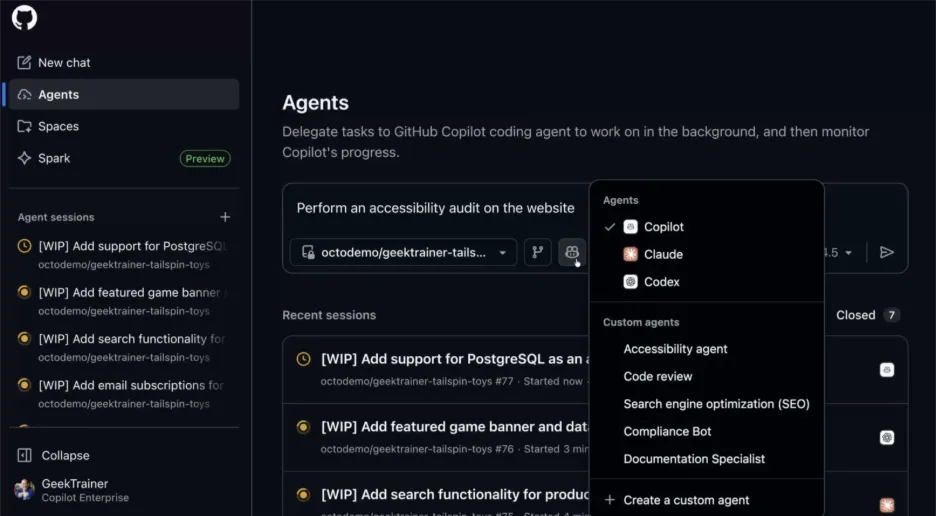
GitHub has integrated Anthropic’s Claude and OpenAI Codex as first-class coding agents, giving developers multiple AI options to generate, refactor, and review code within its platform.
GitHub has added Claude from Anthropic and Codex from OpenAI as integrated coding agents, expanding its AI-assisted development stack and intensifying competition in what is quickly becoming an agent-driven era of software creation.
The move reflects GitHub’s strategy to remain the default hub for developers as AI shifts from autocomplete-style assistance toward autonomous agents capable of planning, writing, testing, and maintaining code.
From suggestions to agents
Early AI coding tools focused on inline suggestions and code completion. GitHub’s latest integrations push further, enabling agentic workflows where models can take higher-level instructions and execute multi-step tasks.
With Claude and Codex available as coding agents, developers can:
- Generate features from natural language prompts
- Refactor or debug large codebases
- Review pull requests and suggest improvements
- Execute iterative changes across files
This marks a transition from “help me write this line” to “own this task.”
Why GitHub is expanding model choice
GitHub’s decision to support multiple AI models reflects a pragmatic recognition: no single model is best for every developer or use case.
Claude is often favoured for:
- Long-context reasoning
- Safer handling of complex instructions
- Clear explanations alongside code
Codex, meanwhile, benefits from deep integration with OpenAI’s developer ecosystem and long-standing optimisation for programming tasks.
By offering both, GitHub avoids locking developers into a single AI provider and positions itself as a neutral platform layer.
Competitive pressure in AI coding
The AI coding space has become intensely competitive. Startups and incumbents alike are racing to define how software is built in an AI-first world.
GitHub’s move comes as:
- IDEs integrate native AI agents
- Cloud platforms bundle coding assistants
- Startups market “AI software engineers”
Adding Claude alongside Codex helps GitHub defend its central role as the collaboration layer where code actually lives.
Implications for developers
For developers, the immediate impact is choice and flexibility. Teams can experiment with different agents depending on:
- Project complexity
- Language and framework
- Security and governance requirements
This is particularly important for enterprises, which often need fine-grained control over how AI interacts with proprietary code.
GitHub’s approach suggests that AI coding will not be one-size-fits-all, but configurable and context-aware.
Enterprise adoption and governance
Large organisations remain cautious about AI agents making autonomous changes to production systems.
By integrating multiple agents within GitHub’s existing permission and review workflows, the platform offers a controlled environment where AI actions remain auditable.
This addresses common enterprise concerns around:
- Code provenance
- Security vulnerabilities
- Compliance and accountability
Agentic AI becomes an assistant within established processes, rather than a rogue automation layer.
The economics of agentic coding
While AI agents promise productivity gains, they also introduce new cost considerations. Running advanced models continuously can be expensive, especially for large teams.
GitHub’s integrations raise strategic questions:
- Will agent usage be bundled or metered?
- How will costs scale with autonomy?
- Who pays for compute-heavy workflows?
The answers will shape adoption, particularly among startups and open-source contributors.
A broader shift in how software is built
The addition of Claude and Codex is less about specific models and more about signalling where GitHub sees the future of development.
Software creation is moving toward:
- Intent-based programming
- Continuous AI participation
- Smaller human teams overseeing larger codebases
In this model, developers increasingly act as architects and reviewers, while agents handle implementation details.
Risks and limitations remain
Despite rapid progress, agentic coding is far from foolproof. Models can introduce subtle bugs, misunderstand requirements, or generate insecure patterns.
GitHub’s emphasis on integration rather than full automation reflects a cautious stance: agents assist, but humans remain responsible.
This balance will be critical to maintaining trust as autonomy increases.
What comes next
GitHub is expected to continue expanding its AI ecosystem, potentially adding:
- More model providers
- Custom fine-tuned agents
- Deeper integration with CI/CD pipelines
As AI reshapes development, GitHub’s role is evolving from repository host to orchestration layer for human and machine collaboration.
By adding Claude and Codex as coding agents, GitHub is making a clear bet: the future of software will be written with AI, but coordinated on its platform.