
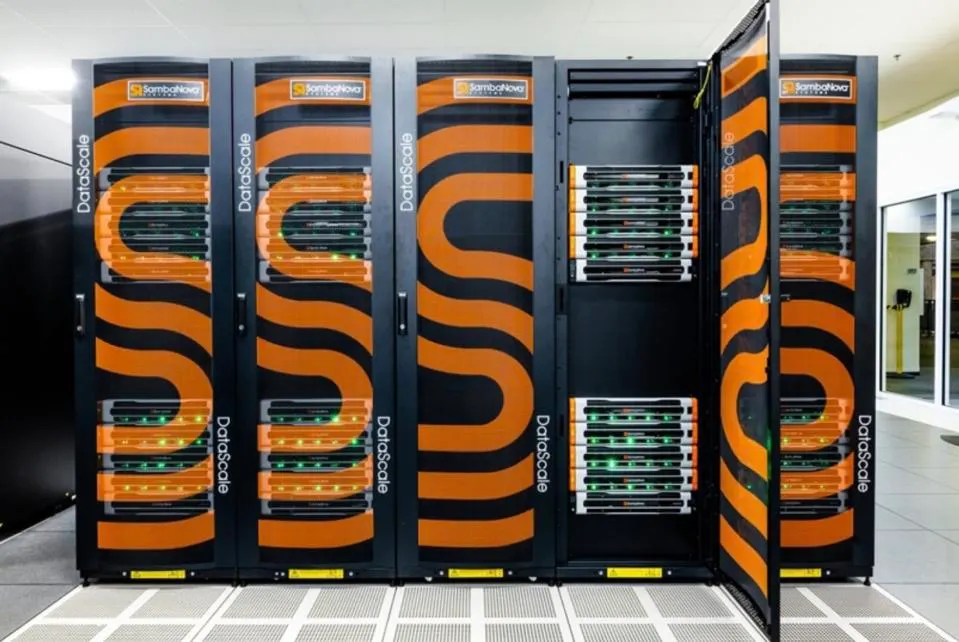
AI chip startup SambaNova has raised $350 million in Series E funding, signaling continued investor interest in non-GPU approaches to AI infrastructure.
Despite Nvidia’s dominance, investors are still willing to fund challengers—if they offer a credible technical alternative.
This week, SambaNova announced a $350 million Series E funding round, underscoring sustained confidence in specialized AI hardware aimed at enterprise and data center customers.
The raise comes amid an intense global race to build AI accelerators capable of handling increasingly large and complex workloads, as demand for generative and enterprise AI continues to expand.
Betting beyond GPUs
Nvidia’s GPUs remain the default choice for AI training and inference, but their success has also created bottlenecks: supply constraints, high costs, and growing energy demands.
SambaNova’s pitch is that purpose-built architectures can deliver better efficiency for certain workloads, particularly those tied to enterprise deployments rather than massive consumer-facing models.
That distinction matters. While hyperscalers dominate headlines, many companies are now focused on running AI inside their own infrastructure, where predictability, cost control, and integration matter as much as raw performance.
Why investors are still backing chip startups

Hardware startups are notoriously difficult, capital-intensive, and slow to scale. Yet AI has changed the calculus.
Unlike previous chip cycles, AI demand is being driven by multiple sectors simultaneously—cloud providers, enterprises, governments, and research institutions. That breadth makes the market large enough to support more than one dominant architecture, at least in theory.
SambaNova’s latest funding suggests investors believe there is room for specialized players that can carve out defensible niches, even if Nvidia retains overall leadership.
Enterprise focus as a differentiator
Rather than competing head-on for hyperscaler training clusters, SambaNova has emphasized turnkey systems and software-hardware integration tailored for enterprise customers.
That strategy may limit upside compared to mass-market chips, but it also reduces exposure to the most brutal segments of the competition. Enterprises value reliability, support, and predictable performance—areas where integrated systems can compete effectively.
What comes next
The funding will likely be used to scale production, improve software tooling, and expand customer deployments. Execution will matter more than vision.
For the broader AI hardware ecosystem, the round sends a clear message: capital is still available for companies that offer genuine differentiation, not just incremental improvements.
As AI infrastructure spending continues, the question is not whether alternatives to GPUs will exist—but which of them can survive long enough to matter.



