
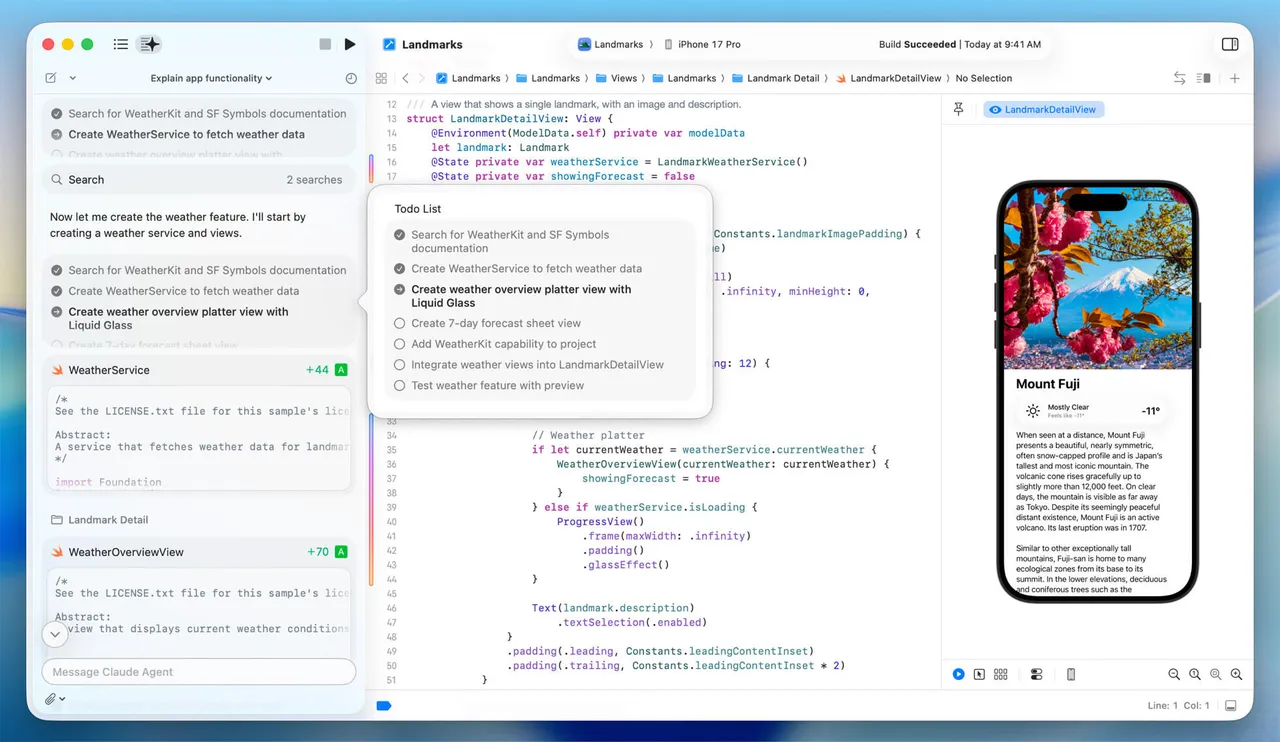
Xcode 26.3 introduces features that make agentic coding practical inside Apple’s development environment, moving AI assistance beyond autocomplete and into multi-step workflows.
For years, AI coding tools have promised more than they delivered. Autocomplete improved. Error messages got friendlier. But the core workflow of software development remained stubbornly manual.
With Xcode 26.3, that balance is starting to shift.
Apple’s latest update to Xcode brings agentic coding closer to the center of everyday development—less as a novelty, more as infrastructure. The change is subtle, but its implications are not.
From suggestions to systems
Earlier AI-assisted coding tools focused on isolated moments: finishing a line of code, generating a function, or explaining an error. Xcode 26.3 moves beyond that by enabling tools that can reason across files, track intent, and execute multi-step tasks.
That is the defining trait of agentic coding. Instead of responding to a single prompt, the system can plan, act, verify, and revise—often without constant human intervention.
Inside Xcode, this manifests as tighter integration between code generation, testing, refactoring, and debugging. Developers are no longer just asking for snippets; they are delegating objectives.
Why Apple’s approach matters
Apple has historically been conservative about developer tooling changes, especially those that risk unpredictability. That caution shows in how agentic features are framed.
Rather than positioning AI as an autonomous coder, Apple is embedding it as a controlled collaborator—one that operates within clear boundaries and developer oversight. Actions are inspectable. Changes are reversible. The human remains accountable.
This design philosophy may limit flashiness, but it lowers friction for adoption in professional environments where reliability matters more than spectacle.
Productivity without chaos
The most immediate impact of agentic coding in Xcode is not speed, but continuity. Tasks that once required context switching—searching documentation, writing tests, fixing regressions—can now be handled in a single conversational loop.
For teams maintaining large codebases, that matters. Agentic systems reduce the cognitive overhead of remembering every dependency and edge case, allowing developers to focus on architecture and intent.
It also changes how junior engineers learn. Instead of copying patterns blindly, they can observe how an agent reasons through problems step by step.
The limits are still visible

Xcode 26.3 does not eliminate the need for strong engineering judgment. Agents can still misunderstand intent, overgeneralize, or introduce subtle bugs. Review remains essential.
But the threshold has shifted. Agentic coding is no longer a speculative future or a third-party experiment. It is now part of Apple’s core development stack.
That makes it harder to ignore—and easier to build on.
A quiet inflection point
Apple did not market Xcode 26.3 as a revolution. It does not need to.
By making agentic workflows feel native rather than bolted on, Apple is signaling how it expects software to be built over the next decade. Not by replacing developers, but by changing what their time is spent on.
For the Apple ecosystem, this may be the moment when AI-assisted development stops being optional and starts becoming assumed.



