

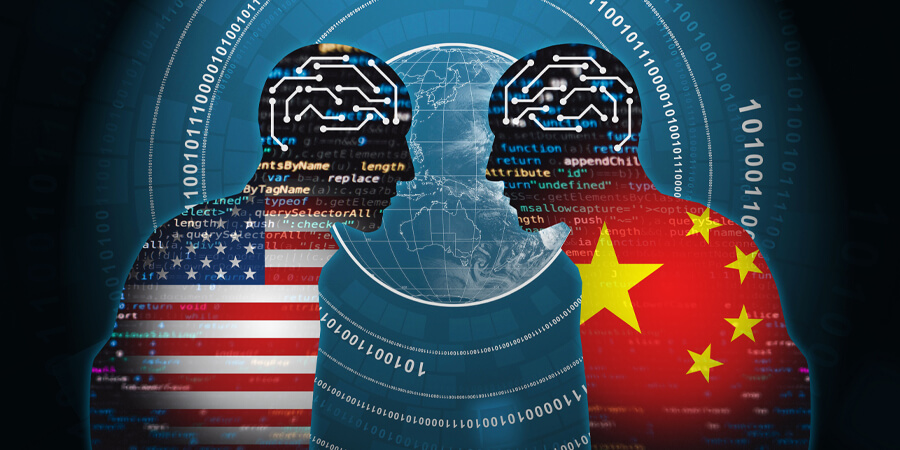
China’s rapid advances in artificial intelligence are intensifying competition with the United States, raising questions about long-term dominance in AI infrastructure, semiconductors, and digital ecosystems. The shift signals a new phase in the global technology rivalry.
For much of the past decade, the United States has set the pace in advanced AI systems, backed by leading cloud providers, semiconductor innovators, and frontier research labs.
That assumption is being tested.
China’s accelerated investment in Artificial Intelligence infrastructure, domestic chip development, and state-supported model research is reshaping the competitive landscape. While U.S. firms still dominate many segments of generative AI and large-scale compute, China’s progress suggests the era of unilateral technological leadership may be narrowing.
The implications extend well beyond software.
Infrastructure, not just algorithms
The AI race is increasingly defined by physical capacity.
Data centers, advanced GPUs, interconnect bandwidth, and energy supply are as strategically significant as model architecture breakthroughs.
China has moved aggressively to expand domestic compute capabilities, reducing reliance on foreign suppliers amid tightening export controls. Investments in semiconductor fabrication, Artificial Intelligence accelerator chips, and vertically integrated cloud ecosystems aim to create a more self-sufficient stack.
For U.S. policymakers, this shift complicates efforts to restrict high-end chip exports while maintaining a competitive edge.
Monopoly concerns and market concentration
In the United States, a small group of technology firms controls much of the frontier AI ecosystem.
Cloud hyperscalers provide infrastructure. A limited number of labs develop foundation models. Semiconductor supply chains remain concentrated.
China’s parallel development path raises two intertwined concerns:
- Whether U.S. dominance could erode faster than anticipated.
- Whether AI markets risk becoming bifurcated along geopolitical lines.
A fragmented global AI ecosystem could reduce interoperability and increase compliance complexity for multinational firms.
Capital and state coordination
China’s AI expansion benefits from coordinated state support.
Industrial policy initiatives have directed capital toward strategic sectors including semiconductors and AI. Regional governments have also incentivized data center construction and research clusters.
In contrast, the U.S. system relies more heavily on private capital markets and corporate R&D spending, though public funding initiatives have expanded in recent years.
The structural difference may influence speed of deployment and resilience under trade restrictions.
Enterprise and startup ripple effects
For startups globally, a bifurcated Artificial Intelligence environment introduces strategic dilemmas.
Companies operating across U.S. and Chinese markets may need to:
- Maintain separate compliance frameworks
- Adjust cloud provider partnerships
- Navigate export control boundaries
Investors must also assess geopolitical exposure when backing Artificial Intelligence infrastructure firms.
A multipolar AI ecosystem could create regional champions but complicate global scaling strategies.
Semiconductor geopolitics remains central
Advanced chips remain the backbone of AI progress.
Export controls targeting high-performance GPUs and semiconductor manufacturing equipment have aimed to slow China’s access to cutting-edge compute.
However, China’s domestic chip initiatives signal an effort to mitigate those constraints.
If local chip design and fabrication capabilities continue to mature, export controls may have diminishing leverage over time.
A long-term competition
The U.S.-China AI rivalry is unlikely to be resolved through a single breakthrough.
Instead, it will unfold across multiple dimensions:
- Hardware innovation
- Model development
- Talent mobility
- Energy infrastructure
- Regulatory frameworks
Short-term fluctuations in model performance or product launches may obscure deeper structural shifts.
Artificial Intelligence recalibration moment
China’s AI momentum does not necessarily imply imminent U.S. displacement.
American firms retain strong advantages in software ecosystems, venture capital depth, and global market reach.
However, the pace of China’s investment challenges assumptions of unassailable dominance.
The global AI race is entering a more competitive, multipolar phase.
For policymakers, investors, and enterprises alike, the question is no longer whether China will compete — but how sustained and self-sufficient that competition will become.



