
Artociti, a Bokaro-based 3D wall art manufacturer, has raised ₹1 crore for a 7.5% equity stake on Shark Tank India, placing its post-money valuation at approximately ₹13.33 crore. The investment came from Namita Thapar and Vineeta Singh, marking the company’s first institutional funding.
The deal signals growing investor interest in vertically integrated, design-led consumer brands emerging from India’s Tier-2 cities.
Manufacturing scale at the core
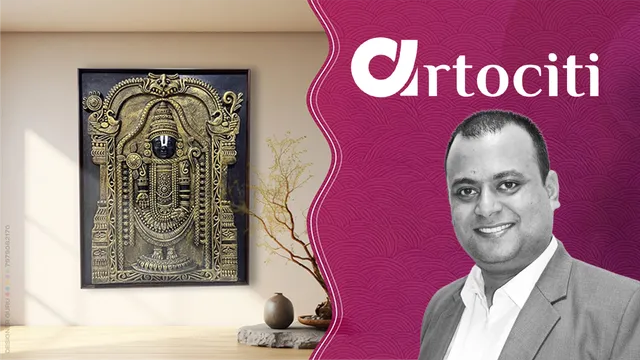
Artociti positions itself as a mass-premium luxury 3D wall art brand, specializing in large-format, high-relief décor pieces with depths of up to 12 inches.
Unlike many décor brands that outsource production, the company operates a vertically integrated model, manufacturing entirely in-house. It currently employs over 80 people and plans to use the fresh capital to establish a state-of-the-art manufacturing facility in Bokaro, Jharkhand.
According to the founders, the new unit aims to:
- Increase production capacity
- Standardize quality control processes
- Improve delivery timelines
- Support national retail expansion
Manufacturing control is central to its value proposition, especially in a segment where customization and finish consistency are key differentiators.
From garage startup to experience retail
Founded during the pandemic in a Bokaro garage, Artociti’s origin reflects a broader wave of design-first startups emerging outside India’s traditional startup hubs.
The brand currently operates a 3,000 sq. ft. Experience Centre in Kirti Nagar, Delhi — a furniture and interior design hub known for premium home brands. The showroom format emphasizes immersive, large-scale installations rather than catalogue-driven retail.
The company now plans to replicate this experience-driven retail model in:
- Pune
- Bengaluru
- Chennai
It is also evaluating international export opportunities over the medium term.
Investor alignment with consumer scale
Namita Thapar, Executive Director at Emcure Pharmaceuticals, and Vineeta Singh, Co-founder and CEO of SUGAR Cosmetics, both bring experience in scaling consumer brands through manufacturing discipline and retail distribution.
Their backing suggests confidence in Artociti’s positioning within India’s growing premium home décor segment, which is benefiting from rising disposable incomes and increased interest in interior personalization.
The segment has seen structural tailwinds as homeowners invest more in experiential spaces rather than purely functional furnishings.
Category creation in décor
India’s wall décor market has historically leaned toward:
- Printed canvases
- Wallpapers
- Modular art panels
Artociti is attempting to carve out a niche in high-relief, engineered 3D wall installations — effectively blending art with architectural depth.
Founder Indrajeet Kumar has described the brand as a “design-manufacturing company,” emphasizing industrial scalability rather than artisanal limitation.
Co-founder Swatiki Prakash, who leads technology and finance, highlighted the decision to keep production fully in-house as a way to maintain precision while generating local employment.
Tier-2 manufacturing narrative
Artociti’s Bokaro base adds another dimension to its story.
India’s startup ecosystem has increasingly spotlighted Tier-2 and Tier-3 manufacturing hubs as cost-efficient alternatives to metro-based production.
By building infrastructure in Jharkhand, the company aligns with broader policy goals around regional industrialization and job creation.
The founders frame their ambition around building a national brand “Made in Bokaro,” positioning quality manufacturing outside traditional industrial clusters.
Competitive landscape
The premium décor space includes both legacy furniture houses and new-age D2C brands.
Artociti’s differentiation hinges on:
- High-relief design depth
- Large-scale installations
- Vertically integrated manufacturing
- Experience-led retail
However, scaling physical showrooms across cities requires capital discipline and consistent demand.
Home décor is often discretionary spending, making economic cycles relevant to growth trajectories.
What comes next
The ₹1 crore funding round is modest in absolute terms but meaningful in signaling investor validation.
The key execution priorities now include:
- Commissioning the new manufacturing facility
- Expanding showroom presence
- Building national brand awareness
- Managing working capital across cities
For India’s consumer startup ecosystem, Artociti reflects a hybrid model: industrial manufacturing combined with lifestyle branding.
As the premium home décor segment matures, investors appear willing to back founders who combine design ambition with operational control.
The success of Artociti’s expansion will likely depend less on artistic novelty and more on manufacturing consistency and retail economics.
For now, the Shark Tank deal provides both capital and credibility.
And for a startup born in a Bokaro garage, that represents a significant milestone.