
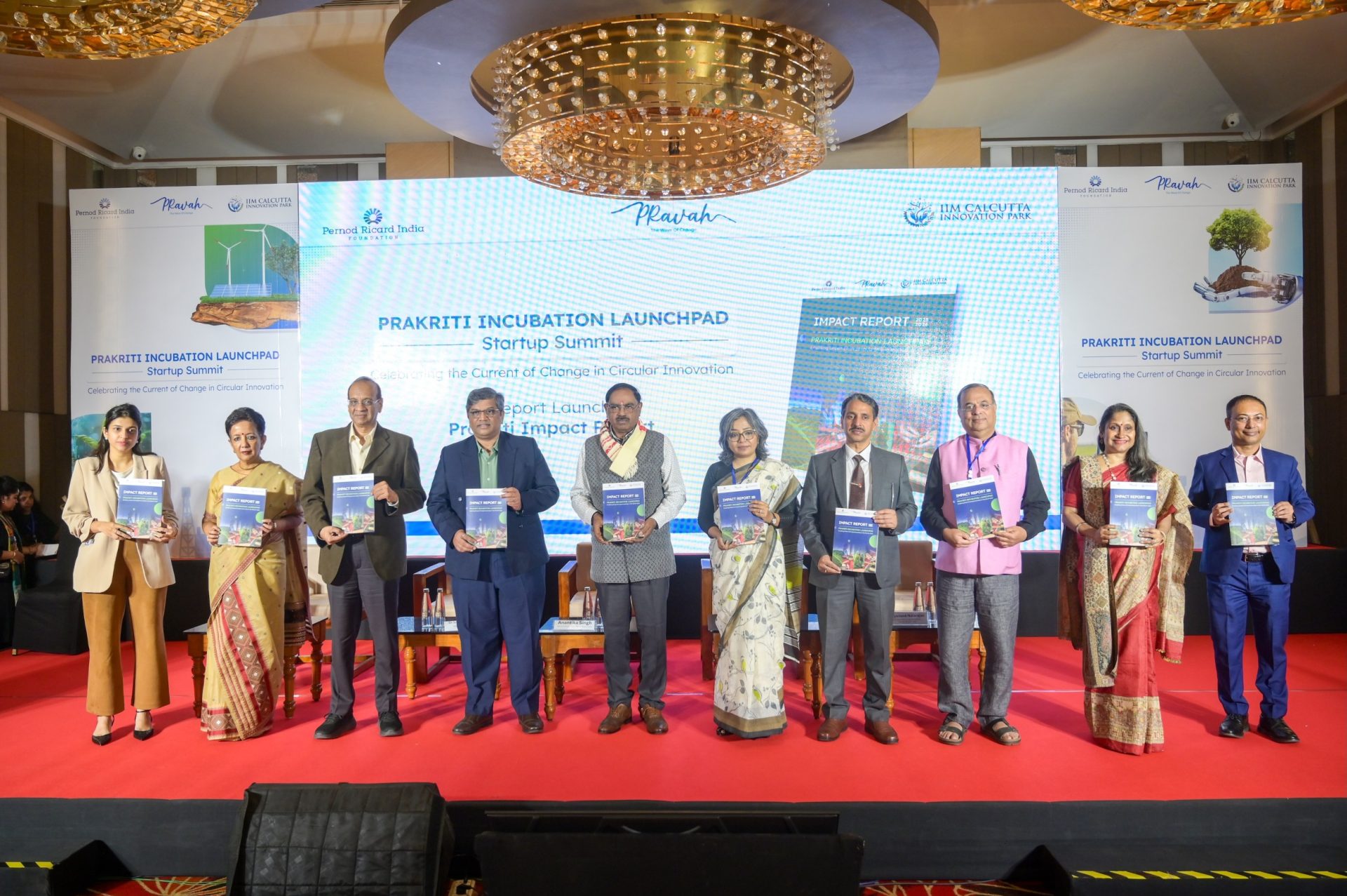
North-East India’s sustainability-focused startup ecosystem received a structured boost this week as 12 circular economy ventures were recognised at the Prakriti Incubation Launchpad – Startup Summit in Guwahati.
The year-long initiative was led by Pernod Ricard India Foundation and implemented by IIM Calcutta Innovation Park (IIMCIP). From an initial pool of 36 shortlisted ventures, 12 startups were selected through a jury-led evaluation process.
Together, these startups currently employ 295 people, including 185 women, and are targeting cumulative revenues of more than ₹15 crore over the next three years.
Structured Incubation Meets Corporate CSR
The programme combined mentorship, capacity building, fellowship grants, and market access support. The top six startups received reward grants totaling ₹70 lakh to accelerate commercialisation, along with buyer-seller connects and ecosystem partnerships.
The initiative reflects a growing shift in corporate social responsibility (CSR) strategy in India — from grant-based philanthropy to structured incubation frameworks aimed at measurable economic outcomes.
Ajay Jain, Chairman of IIM Calcutta Innovation Park, described North-East India as a “strategic frontier” for sustainability-led growth, noting that biodiversity and indigenous knowledge systems offer advantages in building circular enterprises.
Circular Economy as Economic Strategy
The selected startups operate across sustainability-driven verticals, including waste upcycling, eco-friendly materials, natural products, and community-based value chains.
Rather than positioning circularity purely as environmental stewardship, speakers at the summit framed it as a business imperative.
“Circularity today is not a moral choice; it is an economic imperative,” Jain said, emphasizing that viable business models underpin long-term resilience.
This framing aligns with India’s broader push toward a green economy, where entrepreneurship plays a central role in translating climate ambition into jobs and revenue.
Employment and Gender Impact
The employment profile of the cohort stands out.
Of the 295 jobs created across the 12 startups, 185 are held by women. For a region historically underserved in formal venture capital flows, structured incubation programmes can act as catalysts for inclusive entrepreneurship.
North-East India has long been recognised for strong community networks and traditional knowledge systems, particularly in agro-based and biodiversity-linked enterprises. However, scaling these into formal market-facing businesses has required institutional support.
Funding Challenges and Market Linkages
A panel discussion at the summit focused on the financing gap facing green startups in the region.
While indigenous products and sustainability-driven solutions carry premium potential, founders face hurdles including:
- Limited access to early-stage capital
- Weak investor networks
- Marketing capability constraints
- Distribution bottlenecks
The summit highlighted the need for stronger buyer-seller linkages and improved investor readiness to unlock growth.
A Model for Regional Ecosystem Building
IIMCIP, a Section 8 not-for-profit entity established under the aegis of Indian Institute of Management Calcutta, has mentored more than 2,000 startups and seed-funded 124 ventures to date. Those ventures have collectively raised over ₹2,000 crore and built portfolio valuations approaching ₹8,000 crore, based on publicly available figures.
By combining institutional incubation with corporate CSR backing, the Prakriti Launchpad offers a template for ecosystem development in underserved regions.
Dr. VK Rai, CEO of IIM Calcutta Innovation Park, said the North-East is uniquely positioned for sustainability-led entrepreneurship rooted in biodiversity and community strength.
Corporate Foundations and Measurable Impact
Pernod Ricard India Foundation operates as the CSR arm of Pernod Ricard India under Section 135 of the Companies Act.
Its CSR Vision 2030 aims to impact one million lives by 2030 through initiatives aligned with national development priorities and the UN Sustainable Development Goals.
The partnership with IIMCIP reflects an emerging pattern: corporate foundations collaborating with academic incubators to drive structured, metrics-driven entrepreneurship rather than standalone grant distribution.
The Bigger Economic Signal
North-East India has often been described as a peripheral market in India’s startup narrative. Events like the Prakriti Incubation Launchpad suggest a reframing — positioning the region as a sustainability innovation hub rather than an outlier.
As climate-linked entrepreneurship gains policy and investor traction, biodiversity-rich regions could become laboratories for circular economy business models.
The 12 startups recognised this week represent early-stage ventures. But collectively, their employment footprint, revenue projections, and structured support ecosystem point to a broader shift: green entrepreneurship in India’s North-East is moving from pilot projects to scalable enterprise.


