
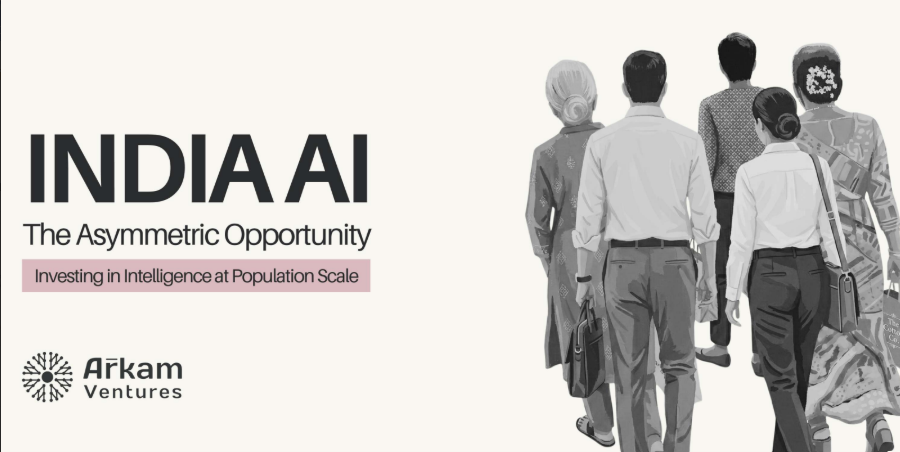
A new report by Arkam Ventures, titled India AI: The Asymmetric Opportunity, argues that the country’s combination of large-scale digital adoption, low customer acquisition costs, and deep engineering talent is creating fertile ground for globally competitive AI-native companies.
Released following Arkam’s Annual Meet 2026, the report outlines bold predictions: the first AI consumer app in India to reach 200 million users is likely to be voice-led rather than English prompt-driven, and at least three AI-native services companies from India could surpass $1 billion in revenue within five years.
A Population-Scale AI Market
India today has more than 850 million digital users and one of the world’s largest developer ecosystems.
The report notes that India is not merely adopting global AI platforms but actively contributing to their growth. It cites India as:
- The third-largest market for OpenAI
- A contributor of roughly 20% of Gemini’s global user base
- The third-largest market for Anthropic
- The second-largest enterprise revenue contributor for ElevenLabs
This level of usage, Arkam argues, creates a feedback loop of product iteration and data depth that can support large-scale AI-native applications.
Unlike Western markets, India’s growth is expected to be voice-led, reflecting linguistic diversity and mobile-first internet access patterns.
Billion-Dollar AI Services and Lending Platforms
The report also forecasts that three or more AI-native services companies built from India could cross $1 billion in revenue within five years.
India’s cost arbitrage — estimated at a 3–4x advantage over global markets — combined with access to global revenue pools, makes capital deployment more productive.
Perhaps most striking is its prediction that AI-native lending platforms could originate more consumer credit than all private banks combined within the next decade. This reflects the belief that AI-driven underwriting and workflow automation can unlock credit penetration at population scale.
Infrastructure Bottlenecks — and Opportunity
The report acknowledges structural constraints:
- Limited access to high-end GPUs
- Dependence on global cloud providers
- Gaps in AI-optimized data center cooling
However, Arkam frames these bottlenecks as opportunity zones for founders building indigenous compute infrastructure.
More than $2.5 billion has reportedly been committed to AI-focused data center infrastructure in India, signaling a push toward sovereign, locally optimized compute capacity.
Rahul Chandra, Managing Director at Arkam Ventures, emphasized that India’s second-largest developer ecosystem globally positions founders to build both consumer-scale and enterprise AI platforms.
Four Pillars of India’s AI Outlook
Arkam identifies four structural pillars shaping India’s AI future:
- Population-Scale Consumer AI – Voice-first, Indic-language AI products targeting the next 500 million users.
- B2B AI for India – Enterprise solutions focused on efficiency and competitiveness.
- India-to-the-World AI – Globally competitive products and AI-native services built by Indian engineering teams.
- Indigenous Infrastructure – Sovereign data centers, foundation models, and compute capacity.
Portfolio companies cited in alignment with this thesis include Anuvaya Labs, AI Se, Ringg AI, Spotdraft, Hyperbots, and KuhlTherm.
Structural Cost and Talent Advantage
India’s engineering workforce and lower operational costs create an asymmetric advantage, according to the report.
With global markets accessible digitally, Indian AI startups can deploy capital more efficiently than Western peers while targeting international revenue streams.
Bala Srinivasa, Managing Director at Arkam Ventures, said the combination of demographic scale and engineering talent makes this moment particularly significant for Indian founders.
From Adoption to Origination
India was initially seen as a downstream consumer of global technology waves.
The report argues that AI may mark a structural turning point — where Indian startups originate globally relevant AI products rather than merely localizing international ones.
Key enablers include:
- Rapid digital payment adoption
- A large domestic testing ground
- Developer density
- Increasing institutional capital availability
However, sustained progress will depend on reducing reliance on offshore compute and strengthening indigenous infrastructure.
The Broader Implication
If Arkam’s predictions materialize, India could move from being one of the largest user markets for global AI platforms to a leading exporter of AI-native services and infrastructure.
The combination of 850 million digital users, growing sovereign compute investment, and developer depth presents a rare convergence.
Whether that translates into 200 million–user voice apps and billion-dollar AI-native firms will depend on execution, infrastructure maturity, and regulatory alignment.
But the thesis is clear: India’s AI opportunity is not incremental — it is asymmetric.kyroot Aerospace, Jar, KreditBee, Wint Wealth, SpotDraft, Mirana Toys, Optimist, Ringg AI and TransBnk, among others, building long-term technological infrastructure for India’s growth. Arkam supports founders from early-stage through scale, helping them build products that solve real problems and impact millions of users.


