
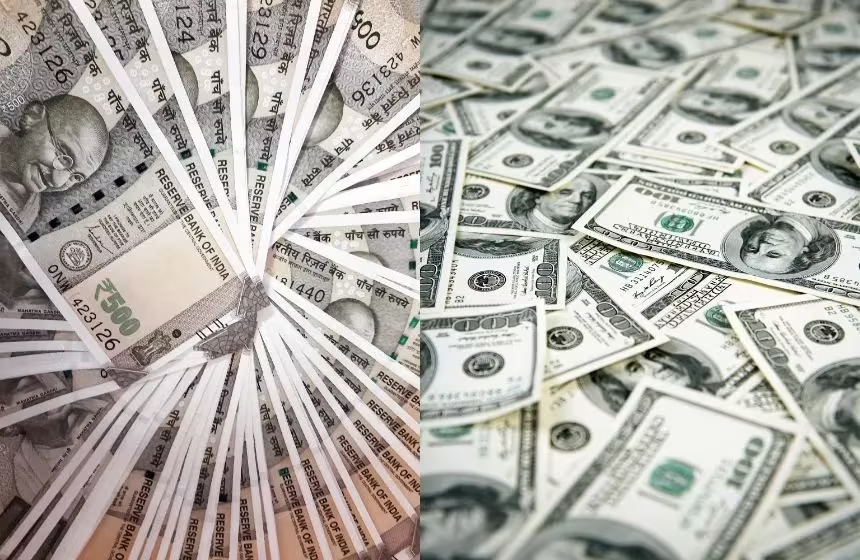
Indian Rupee Slips Beyond 88.80 per Dollar, Marking a New All-Time Low
Mumbai — The Indian rupee continued its downward spiral on Thursday, hitting a record low against the US dollar, as investors weighed the impact of strained US-India trade relations and a stronger greenback fueled by shifting Federal Reserve rate expectations.
According to Reuters, the USD to INR exchange rate dropped past ₹88.80 per dollar, surpassing its previous lifetime low set in early September. The decline marks the fourth consecutive month of weakness for the rupee, underscoring growing macroeconomic pressures amid global uncertainty.
Rupee Hits Record Low Despite RBI’s Interventions
Traders reported that the Reserve Bank of India (RBI) intervened intermittently in the foreign exchange market to limit further depreciation, but the rupee still closed weaker at ₹88.76 per US dollar.
Market analysts noted that persistent dollar strength, driven by upbeat US economic data and fading expectations of a near-term Fed rate cut, continues to pressure emerging market currencies, including the rupee.
“The rupee is under sustained pressure from both external and domestic fronts. The dollar index remains firm above 107, while India’s widening current account deficit is adding further stress,” said a Mumbai-based currency strategist quoted by Reuters.
The USD to INR pair has now depreciated over 4% in the past three months, making it one of Asia’s worst-performing currencies this quarter.
US-India Trade Limbo Deepens
One of the key triggers behind the rupee’s recent slide is the trade limbo between the United States and India. Washington’s decision to maintain tariffs on select Indian exports and tighten visa fee structures has strained relations between the two nations.
Analysts suggest that uncertainty surrounding trade negotiations could continue to affect investor confidence. “As long as the US-India trade dialogue remains unresolved, foreign portfolio inflows will likely stay subdued,” said an economist at HDFC Securities.
Foreign investors withdrew nearly $1.2 billion from Indian equity markets over the past month, data from the National Securities Depository Ltd. (NSDL) showed.
This capital flight has further weakened the rupee, especially as the USD to INR exchange rate remains sensitive to global risk sentiment.
Fed Rate Outlook Adds to Rupee’s Woes
The Federal Reserve’s monetary policy remains a central factor behind the rupee’s current weakness. Stronger US employment and inflation data have diminished the likelihood of a December rate cut, prompting renewed demand for the dollar.
Market expectations now price the first Fed rate reduction only by March 2026, shifting investor appetite toward US assets. The resulting capital outflows from emerging economies, including India, have amplified the downward pressure on the rupee-dollar pair.
“The rupee could face more volatility if the Fed maintains its restrictive stance for longer,” said a senior trader with a private bank in Mumbai. “USD to INR could test new record levels near ₹89 if global conditions remain unfavorable.”
RBI’s Balancing Act
While the Reserve Bank of India has repeatedly intervened to stabilize the rupee, experts say its efforts are aimed more at managing volatility rather than defending a specific level.
The central bank is believed to have sold nearly $1.5 billion in the spot market this week alone, drawing from its foreign exchange reserves, which currently stand at around $645 billion.
“The RBI will likely remain active as long as the rupee faces speculative pressure, but its tolerance for depreciation has gradually increased,” noted a senior forex analyst.
Market Outlook: More Pain Ahead for the Rupee
Currency strategists expect continued weakness in the USD to INR rate through the year-end, especially if crude oil prices remain elevated and global capital flows stay uncertain.
However, some analysts believe the rupee could find support near the ₹88.90–₹89.00 range, provided that US inflation cools and the Fed signals policy easing in 2026.
India’s economic fundamentals — including steady GDP growth and manageable fiscal deficits — are expected to prevent a sharp, uncontrolled decline.
Still, traders warn that any further escalation in US-India trade disputes or renewed strength in the dollar index could keep the rupee under pressure in the short term.
Conclusion: A Crucial Test for the Rupee and Policy Makers
The latest USD to INR developments highlight a crucial balancing act for Indian policymakers as they navigate external shocks and domestic economic priorities. With the rupee hovering at record lows, investors will closely monitor the RBI’s next moves and upcoming trade discussions between New Delhi and Washington.
Until then, the rupee’s recovery remains uncertain, tethered to both global monetary trends and the evolving dynamics of US-India trade relations.For more breaking financial updates and market insights, visit StartupNews.fyi.


