
Supermicro has announced a new portfolio of AI systems designed to deliver enterprise-class performance beyond data centers. The company aims to serve client, edge, and consumer markets with powerful, energy-efficient AI platforms built for developers, enterprises, and real-time applications.
Introduction
Super Micro Computer, Inc., commonly known as Supermicro, has unveiled a new range of AI-focused systems that extend enterprise-grade performance to client devices, edge deployments, and consumer-oriented workstations.
The announcement reflects Supermicro’s strategy to broaden access to high-performance AI computing as demand grows outside traditional data centers. The company positions these systems as solutions for developers, startups, enterprises, researchers, and organizations requiring local AI processing with low latency and strong data control.
Supermicro is known for its building-block approach to server and storage infrastructure, allowing customers to scale performance while optimizing power efficiency. This same philosophy underpins its latest AI offerings.
Expanding Enterprise-Class AI Beyond the Data Center
Historically, enterprise-grade AI workloads were limited to large cloud providers and hyperscale data centers. Supermicro’s latest portfolio aims to change that dynamic.
The new systems are designed to support:
- Local AI model training and inference
- Edge computing for real-time decision-making
- High-performance AI workstations for developers and creators
By bringing server-class components into compact and desktop-friendly designs, Supermicro is targeting users who need advanced AI capabilities without relying entirely on cloud infrastructure.
Super AI Station Targets Developers and Power Users
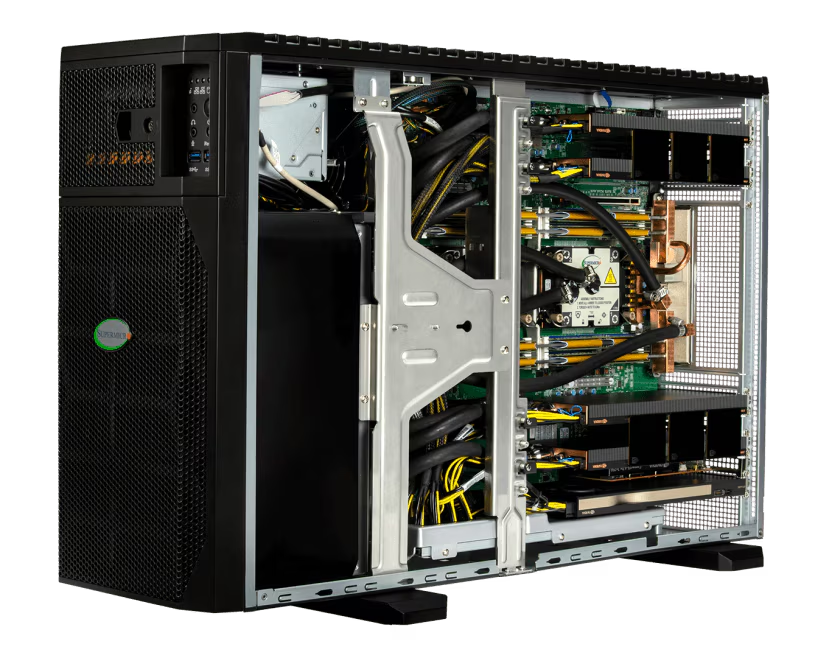
One of the flagship products in the announcement is the Super AI Station, a deskside AI platform engineered to deliver server-grade performance in a workstation form factor.
Key characteristics highlighted by the company include:
- Support for large AI models and complex workloads
- Substantially higher AI performance compared with traditional GPU workstations
- High memory capacity to handle data-intensive AI tasks
The Super AI Station is positioned for AI developers, startups, research labs, and creative professionals who require powerful local compute for training, fine-tuning, and inference.
This approach addresses growing concerns around cloud costs, latency, and data sovereignty, particularly for organizations handling sensitive or proprietary data.
Edge AI Systems for Real-Time Applications
Supermicro’s portfolio also emphasizes edge AI, where computing occurs closer to the source of data rather than in centralized data centers.
Edge AI systems are increasingly used in:
- Industrial automation
- Retail analytics
- Smart cities and transportation
- Robotics and computer vision
Supermicro’s edge platforms are designed to operate in space-constrained or rugged environments while delivering reliable AI inferencing performance. These systems enable real-time decision-making where milliseconds matter.
The company highlights that edge AI reduces reliance on constant cloud connectivity and helps organizations process data locally, improving responsiveness and resilience.
Technology Partnerships Powering the Portfolio
Supermicro’s AI systems are built using technologies from major semiconductor partners, ensuring compatibility with widely adopted AI software ecosystems.
The portfolio integrates platforms from:
- NVIDIA, supporting advanced GPU-accelerated AI workloads
- Intel, enabling efficient edge and enterprise processing
- AMD, supporting client and workstation-focused AI use cases
These partnerships allow Supermicro to offer flexibility across different performance, power, and cost requirements, depending on customer needs.
Addressing a Broader AI Market
The announcement reflects a broader industry shift toward democratizing AI infrastructure. As AI adoption accelerates, more organizations require access to powerful compute without the complexity of building full data center environments.
Supermicro’s client, edge, and consumer-focused AI systems are aimed at:
- Small and mid-sized enterprises adopting AI
- Academic and research institutions
- Independent developers and startups
- Enterprises deploying AI at the edge
By offering enterprise-class performance in smaller, more accessible systems, Supermicro seeks to lower barriers to entry for advanced AI development and deployment.
Industry Context and Competitive Landscape
The move places Supermicro in closer competition with workstation vendors, edge computing specialists, and cloud-adjacent hardware providers. However, the company’s strength lies in its ability to customize systems and rapidly integrate the latest processors and accelerators.
Analysts note that demand for localized AI computing is rising as organizations balance cloud usage with on-premises and edge solutions. Factors such as regulatory compliance, data privacy, and predictable costs are driving this trend.
Supermicro’s expansion into these segments aligns with that market shift.
Conclusion
Supermicro’s latest announcement marks a significant step in extending enterprise-class AI performance to client, edge, and consumer markets. By leveraging partnerships with leading chipmakers and applying its modular design philosophy, the company aims to serve a wider range of AI users beyond traditional data centers.
As AI workloads continue to diversify, Supermicro’s expanded portfolio positions it to play a key role in enabling scalable, efficient, and accessible AI infrastructure across industries.
Key Highlights
- Supermicro launches AI systems for client, edge, and consumer markets
- Super AI Station brings server-grade AI to a deskside platform
- Edge AI systems support real-time, low-latency applications
- Portfolio built on NVIDIA, Intel, and AMD technologies
- Strategy aligns with growing demand for localized AI computing


