
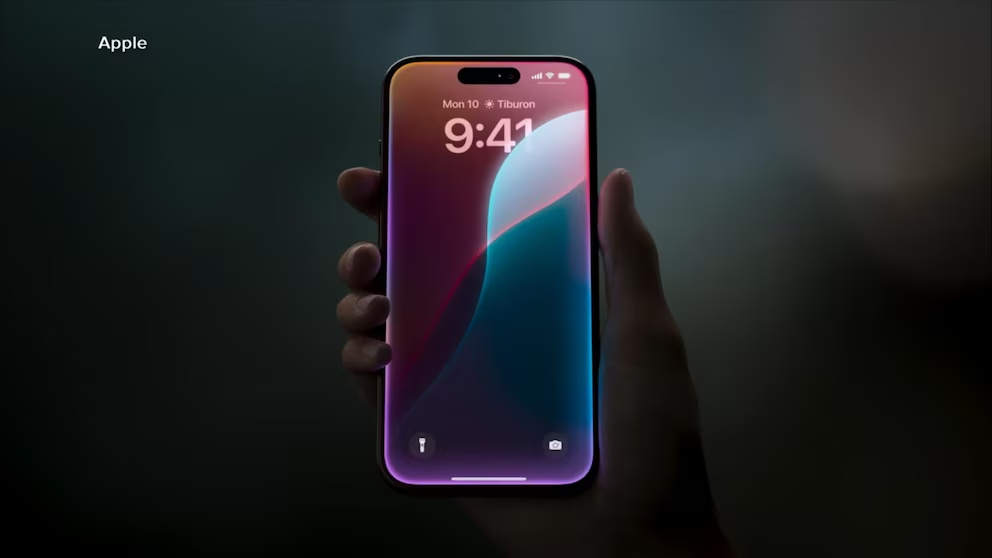
Apple’s long-awaited reinvention of Siri may have just gained its strongest endorsement yet. Veteran technology analyst Gene Munster has publicly praised Apple’s reported decision to move away from OpenAI’s ChatGPT and instead align more closely with Google’s Gemini, calling it a move that “significantly raises the chances” of Apple delivering a successful next-generation Siri. Munster’s reaction, described succinctly as “nice job,” reflects a growing belief among analysts that Apple’s AI strategy is finally crystallizing after years of uncertainty.
The shift, first detailed in reporting by Yahoo Finance, is more than a change of AI partners. It represents a strategic recalibration of how Apple plans to compete in the rapidly evolving AI assistant landscape—one where context, scale, and ecosystem integration now matter more than novelty.
Why Apple’s AI Partner Choice Matters So Much
Apple’s AI challenge has never been about ambition. It has been about alignment. While competitors raced ahead with large language models and conversational assistants, Apple hesitated, constrained by privacy principles and a culture that prioritizes polish over speed.
Early reports suggested Apple might rely on OpenAI’s ChatGPT to fill gaps in Siri’s intelligence. While ChatGPT is powerful, Munster and other analysts argue that it was never an ideal long-term fit for Apple’s ecosystem-first philosophy.
Gemini, by contrast, operates at massive scale and is deeply embedded across Google’s services. That breadth, Munster suggests, makes Gemini a better complement to Apple’s needs at this stage.
Gene Munster’s Perspective Carries Weight
Gene Munster is not known for impulsive praise. His career has been defined by long-term analysis of Apple’s strategy, often with a focus on how seemingly small decisions shape multi-year outcomes.
When Munster says Apple’s Gemini move improves Siri’s odds of success, he is not talking about short-term demos. He is talking about structural advantages: access to a mature AI platform, faster iteration, and a clearer path to delivering competitive intelligence without starting from scratch.
In Munster’s view, Apple is choosing pragmatism over pride.
Why ChatGPT Was Always a Transitional Solution
ChatGPT’s strengths lie in conversation, creativity, and general reasoning. However, Apple’s challenge with Siri is not simply answering questions. It is delivering system-level intelligence that understands what users are doing across devices and apps.
Integrating ChatGPT deeply enough to achieve that vision would require extensive data sharing and cloud dependence—two areas where Apple remains cautious. Gemini’s architecture, already designed to operate as an ambient intelligence layer across Google’s products, aligns more naturally with Apple’s long-term goals.
Munster’s assessment suggests Apple recognized this mismatch early enough to pivot.
Gemini’s Scale Changes the Equation
One of Gemini’s biggest advantages is scale. Google has decades of experience operating AI across billions of users, handling everything from search to email to navigation.
For Apple, tapping into that scale—selectively and strategically—offers a shortcut to parity. It allows Apple to focus on integration and user experience rather than rebuilding foundational AI capabilities under intense time pressure.
Munster sees this as a critical accelerant for Siri’s evolution.
Why This Is About Siri, Not Siri Alon
The future Siri is not just a voice assistant. It is expected to become a personal intelligence layer embedded across iOS, macOS, and Apple’s broader ecosystem.
That vision requires:
• Strong language understanding
• Multimodal reasoning
• Context awareness across apps
• Reliability at massive scale
Gemini already operates in this paradigm. ChatGPT, while impressive, is still largely experienced as a standalone service.
Munster’s approval reflects an understanding that Apple needs infrastructure-level AI, not just conversational brilliance.
Apple’s Privacy Model Still Shapes Everything
Importantly, moving toward Gemini does not mean Apple is abandoning its privacy stance. Apple is expected to retain strict control over what data is shared, how queries are processed, and when on-device intelligence is prioritized.
This hybrid approach—combining external AI strength with Apple’s privacy guardrails—is where Munster sees real potential. It allows Apple to deliver competitive AI experiences without betraying user trust.
In that sense, Gemini becomes a tool, not a takeover.
Why Timing Is Crucial for Appl
Apple is under growing pressure. User expectations have shifted rapidly, shaped by Gemini, ChatGPT, and other generative AI tools. Siri’s limitations are no longer abstract—they are visible daily.
Munster’s comments suggest Apple’s leadership recognizes that waiting longer was not an option. The Gemini pivot accelerates Apple’s timeline at a moment when relevance is at stake.
This is not about winning headlines. It is about avoiding long-term erosion.
A Rare Moment of Strategic Flexibility
Apple is famously insular. It prefers to build rather than borrow. That makes this decision notable.
Choosing Gemini signals a willingness to adapt—a recognition that partnerships can be strategic assets rather than compromises. Munster’s praise highlights this flexibility as a positive evolution rather than a weakness.
In competitive AI markets, adaptability often determines survival.
What This Means for the New Siri Experience
If Munster’s assessment proves correct, users should expect a Siri that feels fundamentally different:
• More context-aware
• Better at multi-step tasks
• Less dependent on rigid commands
• More proactive, less reactive
These improvements are not guaranteed, but the Gemini partnership makes them far more plausible within a realistic timeframe.
Munster’s optimism hinges on execution—but the foundation, he argues, is now stronger.
Why This Helps Apple Compete With Google and OpenAI
Ironically, partnering with Google may be the best way for Apple to compete with Google.
By leveraging Gemini’s intelligence while wrapping it in Apple’s design, hardware, and privacy model, Apple can deliver a differentiated experience rather than a direct clone.
Munster views this as a classic Apple move: let others define the technology, then redefine the experience.
Market and Investor Implication
From an investor perspective, Munster’s endorsement matters. Siri has long been viewed as a weak link in Apple’s ecosystem narrative.
A credible path to AI relevance strengthens Apple’s long-term story, particularly as services and AI-driven features become more central to revenue growth.
Munster’s “nice job” comment is subtle—but bullish.
Why This Is Not an Admission of Defeat
Some critics interpret Apple’s AI partnerships as evidence it has “lost” the AI race. Munster disagrees.
In his view, Apple has lost time, not relevance. The Gemini move repositions Apple for the next phase of the race, where integration, trust, and everyday usefulness matter more than raw model size.
This reframing is central to his optimism.
The Real Test Still Lies Ahead
Munster’s praise does not imply guaranteed success. Siri’s reinvention will still require:
• Deep OS-level integration
• Clear user benefits
• Consistent performance
• Careful communication
The Gemini partnership increases the odds—but execution remains everything.
Apple’s margin for error is shrinking.
Why This Could Redefine Apple’s AI Narrative
For years, Apple’s AI story has been defensive. The Gemini move offers a chance to make it proactive again.
If Apple can demonstrate meaningful improvements to Siri within a year, perception could shift rapidly—from laggard to thoughtful late mover.
Munster believes this pivot gives Apple its best chance yet.
Conclusion: A Pragmatic Move With Real Upside
Gene Munster’s reaction to Apple’s reported shift from ChatGPT to Gemini captures a broader industry sentiment. Apple’s AI future does not depend on building everything alone. It depends on making smart, timely choices that align with its strengths.
By choosing Gemini, Apple gains scale, maturity, and momentum—three things Siri desperately needs. The move does not guarantee success, but as Munster puts it, it meaningfully raises the odds.
In the high-stakes race to define personal AI, Apple may finally be running the right race at the right pace.


