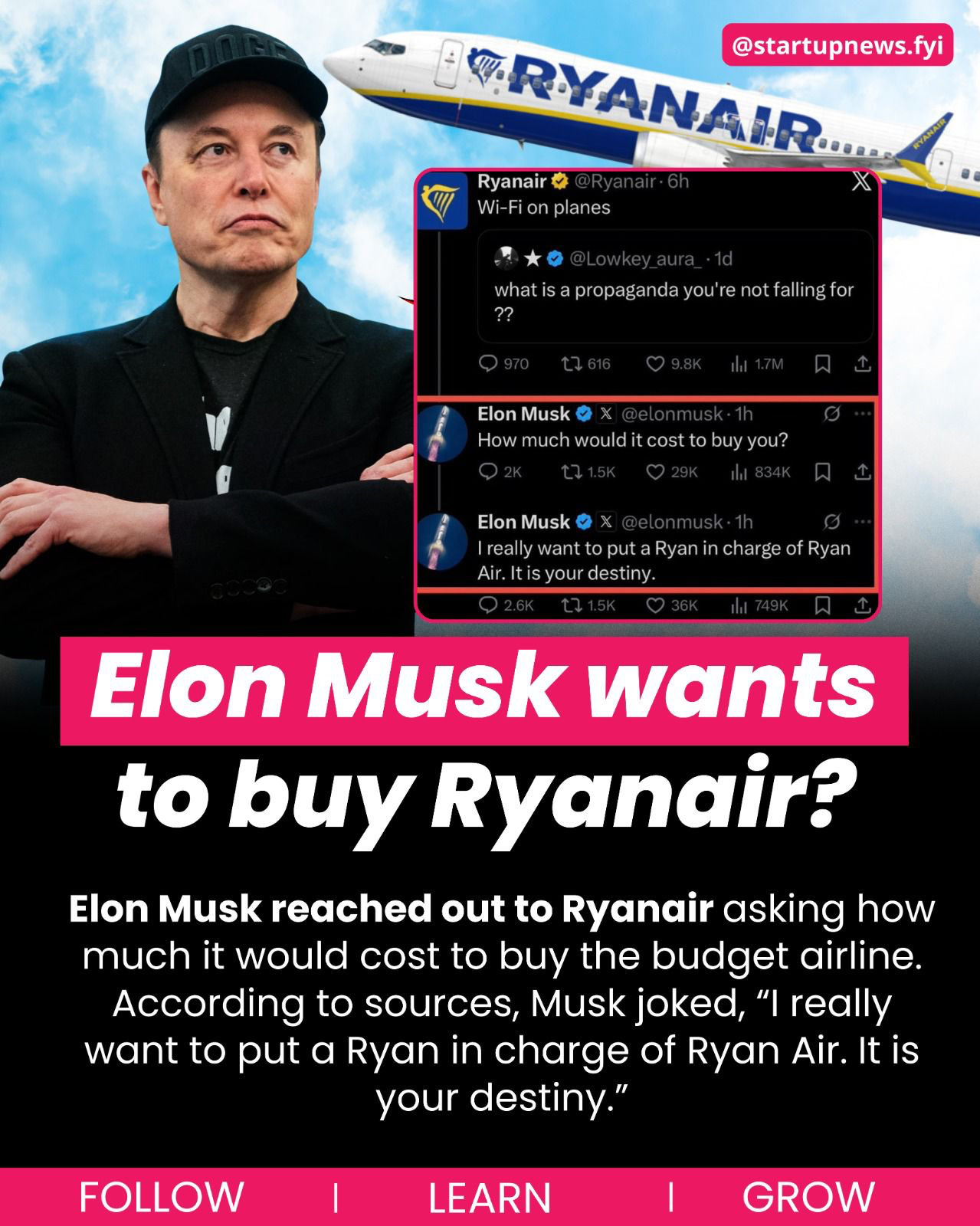
Elon Musk has once again floated the idea of buying Ryanair, prompting fresh analysis of what such a deal might cost and whether it is realistic. While no formal bid exists, the discussion reflects broader interest from tech capital in legacy transportation industries.
Elon Musk is no stranger to ambitious ideas, but his latest comments revisiting a potential acquisition of Ryanair have reignited debate about whether the world’s most prominent tech entrepreneur could—or would—buy Europe’s largest low-cost airline.
According to Forbes, Elon Musk recently again referenced the idea of purchasing Ryanair, reviving a concept he has casually mentioned in the past. There is no indication of an active negotiation or formal offer. Still, the renewed attention has prompted analysts to revisit a key question: how much would Ryanair actually cost, and what would a tech-led takeover of a major airline signal for the broader market?
The answer reveals less about Musk’s immediate intentions and more about the growing intersection between technology wealth and traditional transportation sectors.
How much Ryanair would likely cost
Ryanair is one of Europe’s most profitable airlines, built on a no-frills model, aggressive cost control, and scale. As of early 2026, Ryanair’s market capitalization places its valuation in the tens of billions of dollars, depending on share price fluctuations and broader market conditions.
Any acquisition would almost certainly require a premium above market value, pushing the theoretical cost significantly higher. That figure does not include regulatory hurdles, debt considerations, or the complexity of acquiring a publicly traded airline with strong institutional ownership.
For context, such a purchase would rank among the largest aviation acquisitions in history—well beyond the scale of experimental or strategic investments typically seen from technology founders.
Musk’s track record with capital-intensive industries
Elon Musk has repeatedly demonstrated a willingness to engage with capital-heavy sectors traditionally avoided by Silicon Valley. Electric vehicles, space launch, satellite networks, and large-scale manufacturing all feature prominently in his portfolio.
Aviation, however, presents a different challenge. Airlines operate on thin margins, face intense regulation, and are highly exposed to fuel costs, labor negotiations, and macroeconomic shocks. Unlike rockets or cars, airlines offer limited room for vertical integration or proprietary technology advantages.
That reality makes a Ryanair acquisition far less straightforward than Elon Musk previous ventures, even if the idea captures public imagination.
Why Ryanair attracts attention anyway
Ryanair stands apart from many legacy carriers. Its disciplined cost structure, standardized fleet, and point-to-point model have allowed it to remain profitable through cycles that devastated competitors.
From a technology or systems perspective, Ryanair resembles a logistics company as much as an airline—optimized for efficiency, turnaround speed, and utilization. That operational rigor may explain why it occasionally surfaces in speculative conversations involving tech-minded investors.
However, Ryanair’s success is also tightly bound to European aviation regulations, labor agreements, and airport access policies that leave little room for radical disruption.
Regulatory and geopolitical barriers
Even if Elon Musk were serious, regulatory approval would be a major obstacle. European aviation authorities, competition regulators, and national governments would scrutinize any takeover by a non-European individual or entity.
Ownership rules, national security considerations, and market concentration concerns would all come into play. Unlike consumer tech acquisitions, airline ownership remains deeply political.
These constraints make a hostile or rapid acquisition highly unlikely, regardless of financial capacity.
What this means for startups and investors
The renewed discussion is less about Ryanair itself and more about a broader trend: tech capital is increasingly comfortable engaging with legacy industries once seen as unattractive or “undisruptable.”
For startups operating at the intersection of aviation, logistics, automation, and software, this convergence matters. It signals growing investor appetite for operational efficiency, infrastructure modernization, and data-driven optimization in sectors long dominated by incumbents.
However, airlines remain a cautionary example. Scale and efficiency alone do not guarantee the outsized returns typical of technology platforms.
Speculation versus strategy
There is no evidence that Elon Musk is actively pursuing Ryanair, and past comments suggest his interest has been speculative rather than strategic. Ryanair’s leadership has not indicated openness to a sale, and the airline continues to execute independently.
Still, the recurring nature of the idea reflects something real: the boundaries between technology, transportation, and infrastructure investment are blurring.
Whether or not Elon Musk ever bids for Ryanair, the conversation itself highlights how tech wealth is reshaping expectations about who can own—and attempt to transform—global transportation assets.
This article is based on publicly available reporting from Forbes and market analysis. There is no confirmation of an active acquisition effort, and any valuation estimates are illustrative rather than indicative.