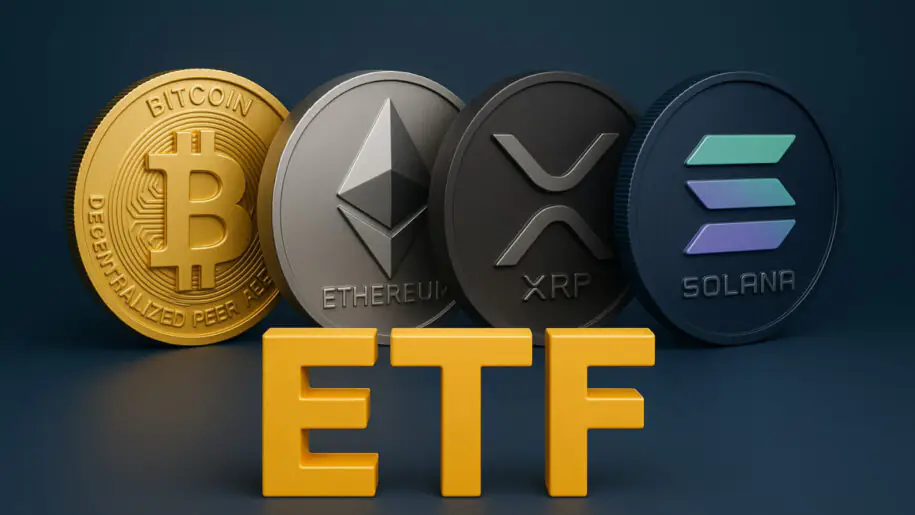
Bitcoin and Ethereum exchange-traded funds recorded net outflows as investors shifted capital into Solana- and XRP-linked products. The moves suggest a change in risk appetite toward faster-growing or event-driven crypto assets.
Investor money is moving again inside crypto markets — but not evenly. Exchange-traded funds tracking Bitcoin and Ethereum have posted net outflows in recent sessions, while products tied to Solana and XRP attracted fresh inflows, according to market data cited this week.
The shift matters because ETF flows are increasingly treated as a barometer of institutional sentiment. After months in which Bitcoin and Ethereum dominated regulated inflows, the rotation suggests some investors are looking beyond the two largest cryptocurrencies in search of higher upside or nearer-term catalysts.
The divergence also highlights how fragmented crypto demand remains, even as broader market conditions stabilize.
What the latest ETF flows show
Bitcoin and Ethereum ETFs recorded withdrawals as prices consolidated following earlier gains. Analysts say the pullback appears less like a broad exit from crypto and more like a tactical reallocation.
At the same time, Solana- and XRP-linked investment products saw net inflows, signaling renewed interest in alternative layer-1 networks and payment-focused tokens. Those assets have recently benefited from improving technical performance and speculation around ecosystem growth and regulatory developments.
While the absolute dollar amounts involved are smaller than peak Bitcoin ETF inflows, the directional change is notable.
Why investors are rotating
Market participants point to several factors driving the rotation. Bitcoin and Ethereum have already absorbed a large share of institutional capital through ETFs, making near-term gains more incremental. In contrast, smaller networks are perceived to offer greater volatility — and potentially greater returns.
Solana has attracted attention for its growing developer activity and consumer-facing applications, while XRP continues to draw interest tied to its role in cross-border payments and ongoing regulatory narratives.
For traders and allocators, ETFs provide a relatively clean way to express those views without holding tokens directly.
What this says about institutional crypto demand
The ETF market has changed how institutions interact with crypto. Rather than a binary decision to be “in” or “out,” investors can now rotate exposure much like they do across equity sectors.
That behavior suggests crypto is slowly being treated less as a monolithic asset class and more as a set of differentiated networks with distinct risk profiles.
Still, analysts caution against overinterpreting short-term flows. ETF demand can be volatile, especially when driven by momentum or event speculation rather than long-term conviction.
Implications for the broader market
For Bitcoin and Ethereum, outflows do not necessarily signal weakening fundamentals. Both assets remain core holdings for many long-term investors, and their ETFs continue to hold substantial assets under management.
For Solana and XRP, inflows provide short-term validation but also raise expectations. Sustaining investor interest will depend on network usage, developer traction, and clarity around regulation and real-world adoption.
The rotation also underscores a familiar pattern in crypto markets: capital tends to move quickly once narratives shift.
What to watch next
Investors will be watching whether the flow divergence persists or reverses. A return of inflows to Bitcoin and Ethereum would suggest consolidation rather than trend change, while continued rotation could indicate a broader search for growth across the crypto spectrum.
Macro conditions, regulatory headlines, and price action will all play a role. For now, ETF data shows a market in motion — not retreat.