
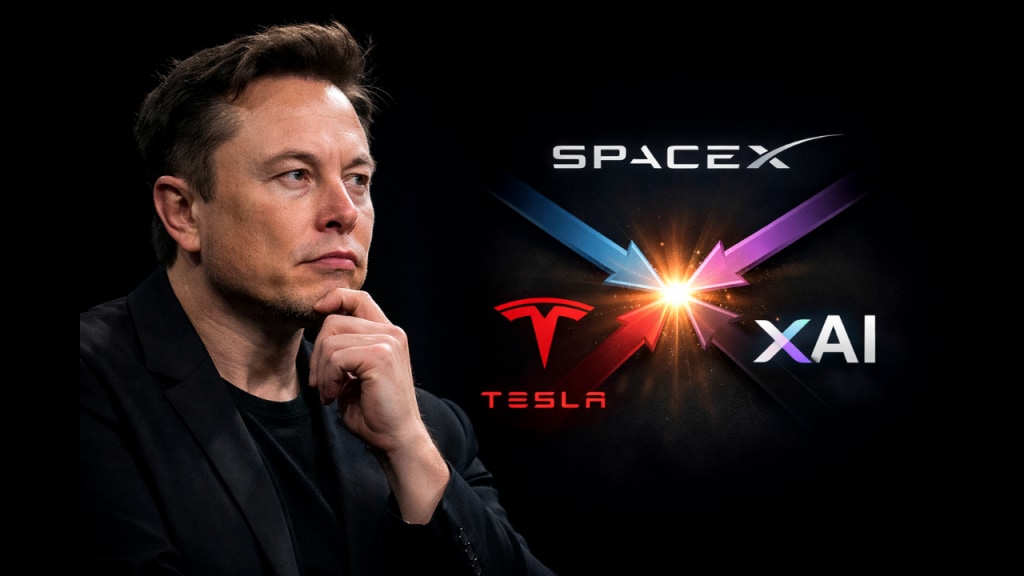
Elon Musk is exploring a potential strategic merger between SpaceX, Tesla, and xAI, signaling a deeper alignment between aerospace, electric vehicles, and artificial intelligence. The discussions remain exploratory, with no formal structure or timeline disclosed.
A Cross-Company Alignment Takes Shape
Elon Musk is considering one of his most ambitious corporate alignments yet, holding early-stage discussions around a potential merger between SpaceX, Tesla, and xAI, according to reports cited by Tech in Asia. The talks, described as exploratory, reflect Musk’s long-standing vision of integrating his companies more tightly around shared technological infrastructure, particularly artificial intelligence and advanced computing. No formal proposal has been presented, and the companies have not commented publicly on the specifics of the discussions.
Why These Three Companies, and Why Now
The rationale for examining a merger rests in the growing overlap between the three businesses. Tesla’s autonomous driving roadmap increasingly depends on large-scale AI model training, SpaceX operates one of the world’s most advanced satellite and communications infrastructures through Starlink, and xAI has been positioned as Musk’s answer to frontier AI labs building general-purpose models. Combining assets could allow shared access to data, compute, and talent at a scale that would be difficult for each entity to achieve independently. The timing is notable as competition in AI infrastructure intensifies globally, and capital requirements for training large models continue to rise.
AI as the Unifying Layer
At the center of the potential merger is artificial intelligence. Tesla’s Full Self-Driving systems, SpaceX’s autonomous navigation and satellite management, and xAI’s large language and reasoning models all rely on increasingly similar AI architectures and training pipelines. A unified structure could enable tighter feedback loops between real-world data collected by Tesla vehicles, satellite data from SpaceX, and model development at xAI. This convergence would mark a shift from Musk’s historically federated empire toward a more vertically integrated AI-centric organization.
Structural and Regulatory Complexity
Despite the strategic logic, executing such a merger would be complex. Tesla is a publicly listed company, while SpaceX and xAI remain private, introducing valuation, governance, and regulatory hurdles. Any transaction involving Tesla would likely require shareholder approval and careful navigation of disclosure requirements. There are also competition and national security considerations, particularly given SpaceX’s defense contracts and Tesla’s global manufacturing footprint. These factors make it far from certain that exploratory discussions will translate into a formal deal.
What It Signals to Markets and Competitors
Even without a completed merger, the discussions send a clear signal to competitors and investors about Musk’s priorities. The move underscores a belief that future advantage will come from tightly integrated ecosystems spanning hardware, data, and AI models rather than standalone companies. For rivals in electric vehicles, aerospace, and AI, the prospect of a Musk-led super-platform raises the stakes around vertical integration and long-term capital commitments.
Looking Ahead
For now, the talks remain informal, and Musk is known for floating bold ideas long before they solidify. Still, the possibility of aligning SpaceX, Tesla, and xAI under a shared strategic framework highlights how central AI has become to Musk’s industrial vision. Whether or not a merger materializes, the direction of travel is clear: deeper coordination between space, mobility, and artificial intelligence is moving from concept to boardroom conversation.



