
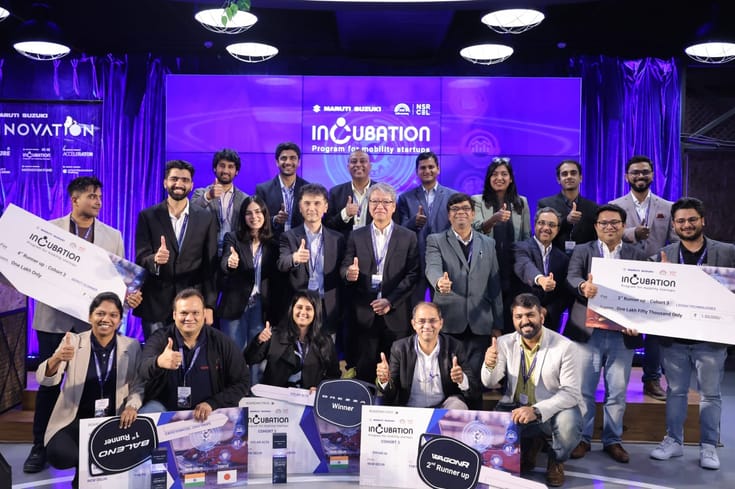
Maruti Suzuki has inducted five early-stage startups into its incubation programme, signalling a continued push into mobility technology, manufacturing innovation, and data-led solutions. The cohort reflects India’s auto major’s strategy to tap startup-led innovation to future-proof its core business.
A Strategic Bet on Startup-Led Innovation
India’s largest carmaker Maruti Suzuki has onboarded five startups into the latest cohort of its incubation programme, reinforcing its long-term strategy to collaborate with early-stage companies building solutions for the future of mobility.
Rather than positioning the initiative as a standalone CSR or innovation lab exercise, Maruti Suzuki has steadily integrated its startup programmes into core business priorities—from manufacturing efficiency and supply chain digitisation to connected vehicles and sustainability.
The new cohort underlines that approach, with startups spanning deep tech, automotive software, data analytics, and industrial solutions.
Why Incubation Matters to Maruti Suzuki
As the automotive industry faces simultaneous disruption—from electrification and software-defined vehicles to changing ownership models—incumbents like Maruti Suzuki are under pressure to move faster than traditional R&D cycles allow.
Startup partnerships offer a way to experiment without committing large internal resources upfront. Through incubation, Maruti Suzuki gains early access to emerging technologies while startups benefit from pilot opportunities, domain expertise, and exposure to real-world manufacturing and mobility challenges.
This symbiotic model has become a key pillar of the company’s innovation roadmap.
The Five Startups in Focus
While the startups operate across different problem statements, they share a common thread: each addresses a specific operational or strategic gap within the automotive value chain.
The cohort includes ventures working on advanced analytics, mobility intelligence, manufacturing process optimisation, and next-generation digital tools for the auto ecosystem. These solutions are designed to plug into existing enterprise systems rather than disrupt them outright—a pragmatic approach aligned with Maruti Suzuki’s scale-driven business.
By selecting startups with clear enterprise use cases, the company is signalling that incubation is not about experimentation alone, but about deployable outcomes.

From Proof of Concept to Production
A defining feature of Maruti Suzuki’s incubation programme is its emphasis on proof-of-concept (PoC) deployments. Startups are given access to real operational environments—factories, dealer networks, or data systems—allowing them to validate their products under production-grade conditions.
This accelerates learning on both sides. Startups gain credibility and feedback that would otherwise take years to acquire, while Maruti Suzuki can assess viability before committing to deeper partnerships or commercial rollouts.
In past cohorts, several incubated startups have gone on to secure long-term engagements, either with Maruti Suzuki directly or with partners across its ecosystem.
Strengthening India’s Automotive Startup Stack
The programme also reflects a broader trend in India’s industrial sector, where large incumbents are increasingly acting as anchors for startup ecosystems. For mobility and manufacturing startups, access to a player of Maruti Suzuki’s scale can be transformational—opening doors to customers, suppliers, and investors.
At a time when venture funding has become more selective, such corporate-backed programmes offer startups not just capital, but relevance and validation.
Alignment With Industry Shifts
Maruti Suzuki’s focus areas mirror larger shifts underway in the automotive sector. Data-led decision-making, efficiency gains in manufacturing, and digitalisation of operations are becoming as critical as powertrain innovation.
By backing startups in these domains, the company is hedging against uncertainty—ensuring it is not solely reliant on internal development to respond to rapid technological change.
This is particularly relevant as global auto majors race to redefine vehicles as platforms, where software, data, and services increasingly drive value.
What Success Looks Like
For Maruti Suzuki, success is not measured by equity stakes alone, but by how effectively startup solutions translate into measurable operational or strategic gains. Cost reductions, productivity improvements, and faster decision cycles matter more than headline innovation.
For startups, the programme’s value lies in validation. Being incubated by India’s largest automaker can significantly de-risk future fundraising and customer acquisition.
A Long-Term Play, Not a One-Off Initiative
Maruti Suzuki’s incubation efforts are best understood as a long-term capability-building exercise. Rather than chasing buzzwords, the company is methodically building a pipeline of external innovation that complements its internal strengths.
As the automotive industry continues to evolve, such programmes may prove decisive in determining which incumbents adapt—and which struggle to keep pace.
For now, the five startups in this cohort represent the next set of bets in Maruti Suzuki’s broader attempt to stay ahead of disruption by working with, rather than competing against, India’s startup ecosystem.


