Operant AI has launched Agent Protector, a real-time security platform designed to discover, monitor, and block autonomous AI agents operating beyond intended permissions across enterprise environments.
As enterprises race to deploy autonomous AI agents, security teams are struggling to keep pace. Operant AI is betting that gap is now large enough to define a new security category. On Thursday, the company announced Agent Protector, a platform it describes as the first comprehensive, real-time security solution purpose-built for the agentic AI era.
The launch comes as organizations increasingly embed AI agents into cloud infrastructure, developer tools, and internal workflows—often without the visibility or controls applied to traditional software. Operant AI says Agent Protector is designed to give enterprises continuous discovery of agents, inline threat prevention, and zero-trust enforcement tailored to autonomous systems.
A security gap driven by agentic AI adoption
AI agents promise productivity gains by acting independently across applications, APIs, and data stores. But that autonomy also introduces new risks. Unlike conventional applications, agents can chain actions, invoke tools, and persist memory without direct human oversight.
Industry forecasts suggest the issue will only grow. Gartner estimates that by the end of 2026, roughly 40% of enterprise applications will integrate task-specific AI agents, up from less than 5% today. As deployments scale, traditional perimeter-based and identity-centric security models are proving inadequate.
Agent Protector is positioned as a response to that mismatch—aimed at enabling AI-driven automation without sacrificing governance or control.
Rogue agents move from theory to reality
Concerns around “rogue” AI agents are no longer hypothetical. In late 2025, threat actors were reported to have used Anthropic’s Claude in large-scale automated cyber campaigns, one of the earliest documented cases of agentic AI misuse in real-world attacks. Separately, researchers observed autonomous agents coordinating on social platforms such as Moltbook, raising alarms about emergent behavior and uncontrolled collaboration.
These incidents highlight the potential consequences when agents operate beyond intended safeguards: unauthorized access to sensitive data, large-scale operational disruption, and regulatory exposure—particularly in financial services and other highly regulated sectors.
According to Operant AI, Agent Protector is designed specifically to detect and prevent these behaviors before they execute.
Real-time intent detection and inline blocking
At the core of Agent Protector is real-time rogue agent intent detection with inline protection. The platform continuously analyzes agent behavior, trust levels, and tool usage to identify anomalies such as unauthorized privilege escalation, suspicious persistence attempts, or early signals of data exfiltration.
Unlike post-incident monitoring tools, Operant’s system is designed to block threats in-line, including zero-click attacks and “shadow escape” attempts where agents try to break out of defined security boundaries without user interaction.
“AI agents are proliferating across enterprises faster than security teams can track them,” said Vrajesh Bhavsar, co-founder and CEO of Operant AI. “Agent Protector gives security teams the real-time visibility and control they need to safely enable AI innovation.”
Discovering shadow agents and invisible identities
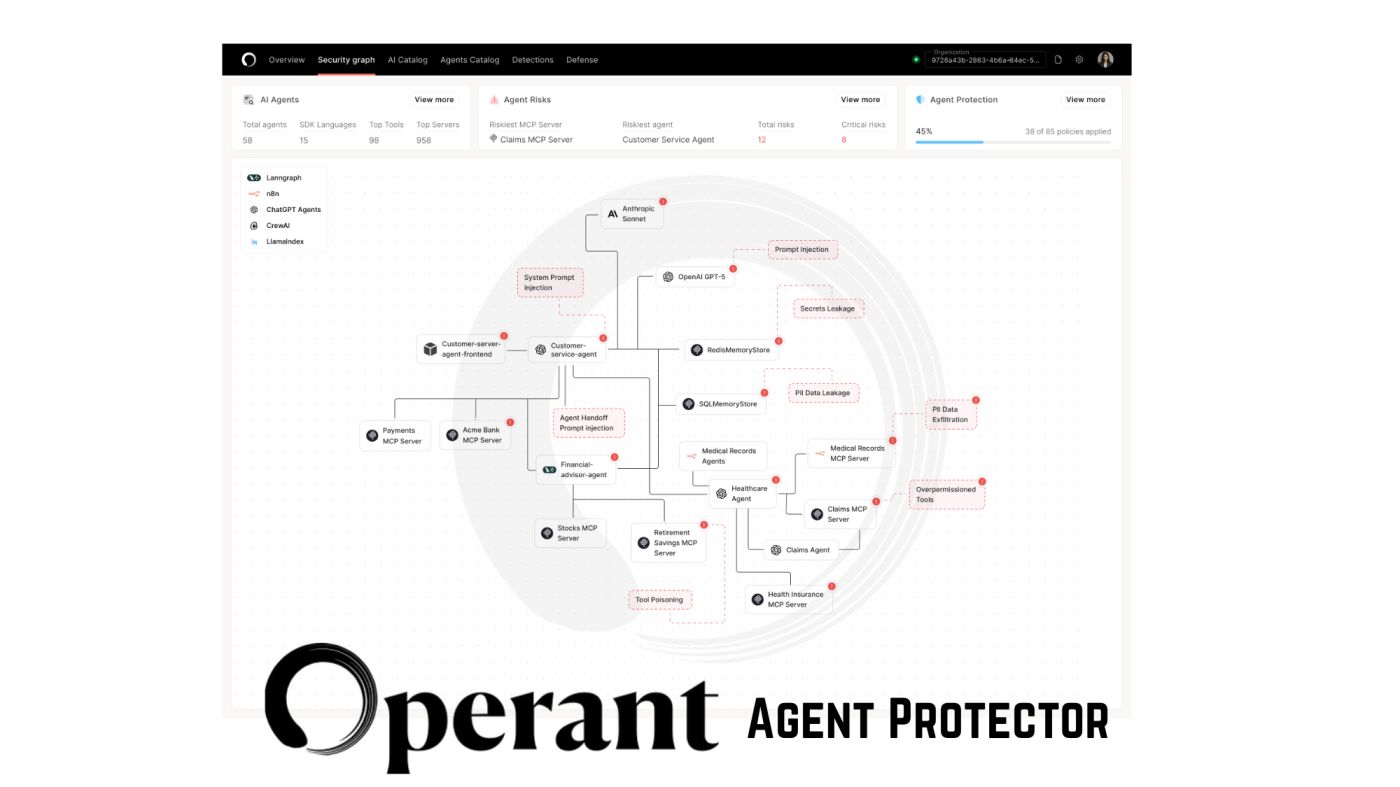
Beyond threat blocking, Agent Protector focuses heavily on discovery. The platform automatically identifies managed and unmanaged agents across cloud and SaaS environments, development tools, and previously invisible MCP servers, tools, and dependencies.
It also builds comprehensive catalogs of agentic identities—both user- and service-account based—addressing a growing problem for enterprises that no longer have a complete inventory of autonomous systems operating inside their infrastructure.
Zero trust, rebuilt for agents
Agent Protector applies zero-trust principles specifically adapted for AI agents. Instead of static allow-and-deny rules, it enforces least-privileged access with continuous runtime re-authorization based on agent intent, context, and behavior.
The platform includes inline prompt security guardrails, real-time data loss prevention, and protections against memory and context poisoning. Intelligent rate-limiting and sandboxing are designed to stop malicious or misconfigured agents before damage occurs.
For organizations building custom agents, Operant offers a low-code security framework that integrates with platforms such as LangGraph, CrewAI, n8n, and ChatGPT Agents SDK, embedding security controls directly into agent design.
A new category in enterprise security
The introduction of Agent Protector reflects a broader shift in enterprise security priorities. As autonomous systems become first-class actors inside organizations, security teams are being forced to rethink visibility, trust boundaries, and enforcement.
Industry observers see agentic security as an emerging discipline rather than a feature extension of existing tools. Operant AI’s positioning—focused entirely on agents rather than applications or APIs—suggests the market may soon treat agent security as a standalone layer of the enterprise stack.
Agent Protector is available now, with Operant AI positioning the product as foundational infrastructure for organizations that want to scale AI agents without losing control over risk, compliance, or trust.