
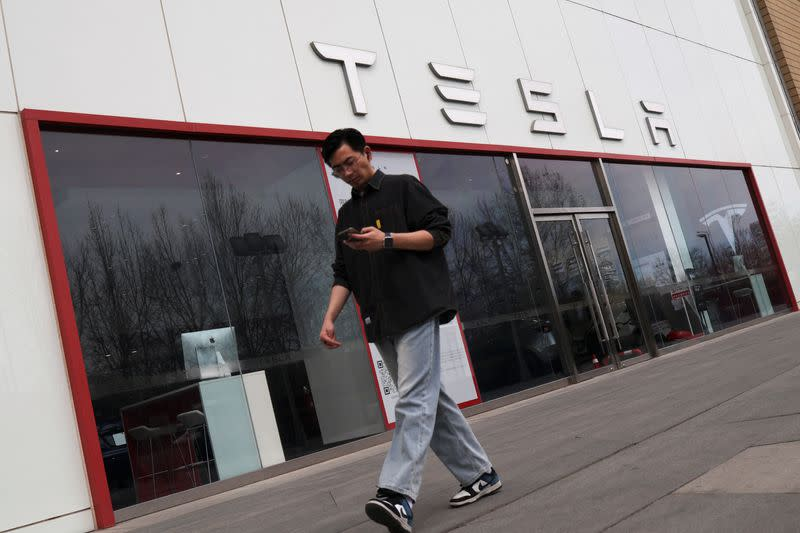
Tesla has launched an AI hub in China focused on improving its self-driving software, underscoring China’s role as both a data-rich market and a strategic testing ground.
Tesla is deepening its reliance on China—not just as a manufacturing base, but as a center for artificial intelligence development.
This week, Tesla confirmed the launch of a dedicated AI hub in China aimed at accelerating improvements to its self-driving software. The move formalizes what has already been happening informally: China’s roads, drivers, and regulatory environment are shaping how Tesla’s autonomy stack evolves.
The decision reflects both technical necessity and market pressure.
Why autonomy work is moving closer to China
China presents one of the most challenging real-world environments for autonomous systems. Dense urban traffic, complex road layouts, and highly variable driving behavior generate data that is difficult to replicate elsewhere.
By basing AI development closer to those conditions, Tesla can tailor its models more precisely, rather than adapting software built primarily on U.S. or European driving patterns.
Local development also helps Tesla navigate China’s data governance rules, which restrict how vehicle data can be transferred and processed overseas.
Competitive pressure is intensifying
The company’s move comes as Chinese automakers and technology companies invest heavily in advanced driver-assistance and autonomy features. Many of those systems are designed specifically for domestic conditions, giving local players an edge in perceived reliability and usability.
In that context, relying solely on globally trained models becomes a disadvantage. A China-based AI hub allows Tesla to close that gap and remain competitive in one of its most important markets.
Regulatory pragmatism over centralization

Autonomous driving software is increasingly shaped by regulation as much as by code. Local engineering teams can respond faster to policy changes, pilot programs, and compliance requirements.
That represents a shift from Tesla’s earlier preference for centralized development. Instead of one global autonomy brain, the company appears to be moving toward regional specialization layered on top of a shared core.
A broader signal for global AI development
The company’s China AI hub reflects a wider trend in AI: proximity to data matters. As models become more context-dependent, companies are placing talent and infrastructure closer to the environments they are trying to understand.
Autonomy is no longer just a software challenge—it is a geopolitical and operational one.
China is where that reality is most visible.



