
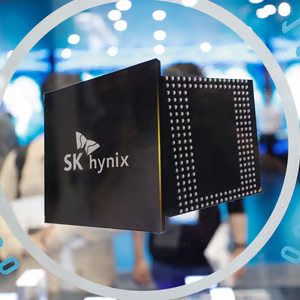
SK Group’s chairman has met Nvidia’s CEO to discuss high-bandwidth memory supply, underscoring how memory has become a critical constraint in AI hardware.
As demand for AI accelerators surges, attention is shifting to a less visible—but equally critical—component: memory.
The chairman of SK Group has met with Nvidia’s chief executive to discuss supply of high-bandwidth memory (HBM), according to people familiar with the talks. The meeting highlights how memory availability is shaping the pace of AI infrastructure expansion.
For AI systems, compute without memory is a bottleneck.
Why HBM matters so much
High-bandwidth memory is essential for modern AI accelerators, enabling rapid data movement between processors and memory stacks. Training large models depends on sustained throughput that conventional memory cannot deliver efficiently.
As Nvidia’s GPUs dominate AI workloads, demand for HBM has surged in parallel. Supply, however, is concentrated among a small number of manufacturers, creating structural constraints.
SK’s strategic position
SK Group, through its semiconductor operations, plays a central role in the global HBM market. That position has turned memory makers into gatekeepers of AI scaling, not just suppliers.
Discussions with Nvidia signal coordination rather than competition—aligning roadmaps, volumes, and timelines to avoid mismatches between chip production and memory availability.
Such alignment is becoming standard as AI hardware ecosystems grow more interdependent.
Supply chains under strain

HBM production is complex, capital-intensive, and difficult to ramp quickly. Even with aggressive investment, capacity expansions take time.
That lag has ripple effects: delayed server deployments, constrained cloud capacity, and higher costs for AI services.
Meetings at the highest corporate levels reflect how strategically important these components have become.
Beyond a single partnership
While the talks involve SK and Nvidia, the implications extend across the industry. Other chip designers, cloud providers, and governments are watching memory supply closely as a potential choke point.
AI’s future performance gains depend not just on faster processors, but on balanced systems where memory keeps pace.
A quiet determinant of AI progress
HBM rarely features in public AI narratives, but it increasingly determines what can be built—and when.
The SK–Nvidia discussion is a reminder that the AI boom is constrained by physical realities as much as algorithms.
In the race to scale AI, memory may prove just as decisive as compute.


