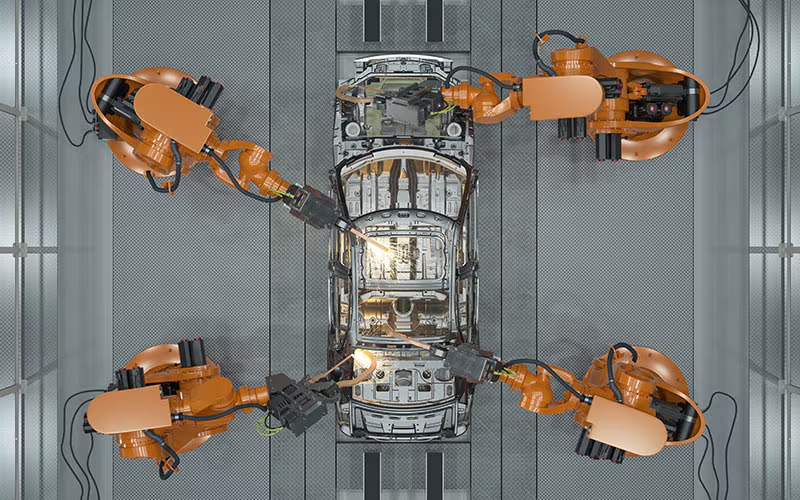
According to the Infosys Manufacturing Tech Index: AI Pulse, 75% of manufacturers now embed Artificial intelligence into enterprise strategy, with more than half spending over $2 million per implementation.
Artificial intelligence is no longer a pilot project inside manufacturing firms. It is becoming embedded in enterprise strategy.
A new global study from the Infosys Knowledge Institute, the research arm of Infosys, finds that 75% of manufacturers have formally integrated AI into their enterprise roadmaps. The findings reflect a structural shift from experimentation toward operational dependence.
The report, based on responses from 650 senior manufacturing executives worldwide, captures the state of AI adoption in late 2025 — a period marked by accelerating digital transformation across industrial sectors.
From experimentation to necessity
Manufacturers face rising operational complexity driven by:
- Supply chain volatility
- Workforce shortages
- Faster product innovation cycles
- Sustainability pressures
Artificial intelligence is increasingly positioned as a response to these constraints, particularly in areas such as predictive maintenance, production optimization, quality inspection, and supply forecasting.
The survey suggests this transition is no longer exploratory. Three-quarters of respondents describe Artificial intelligence as embedded in enterprise-level strategy rather than confined to isolated initiatives.
Investment intensity rises
More than half of surveyed manufacturers reported spending over $2 million per Artificial intelligence implementation.
Unlike cloud software rollouts, industrial Artificial intelligence requires integration across physical systems, including:
- Operational technology (OT) infrastructure
- Machine sensors and industrial IoT devices
- Legacy enterprise resource planning systems
These deployments often involve significant data engineering, workforce retraining, and cybersecurity hardening, increasing total project costs.
The capital intensity underscores how Artificial intelligence in manufacturing differs from consumer or office productivity use cases.
Cybersecurity: top use case and top barrier
The report highlights a paradox: cybersecurity and operational technology systems represent the most common Artificial intelligence adoption area (57%), yet cybersecurity is also cited as the biggest barrier to scaling Artificial intelligence (23%).
As IT and OT environments converge, manufacturers face expanded attack surfaces. Artificial intelligence -driven automation introduces additional complexity, particularly when real-time systems control physical machinery.
Data challenges rank closely behind cybersecurity. Persistent issues around:
- Data quality
- Access controls
- Governance
- Lineage and traceability
continue to slow enterprise-wide scaling.
Strategy alone is insufficient
While executive commitment to Artificial intelligence is high, the report emphasizes that ambition must be matched with disciplined execution.
Organizations seeing meaningful progress typically invest in:
- Unified data architectures
- Cross-functional AI governance models
- Workforce enablement programs
- Clear use-case prioritization frameworks
This reflects a broader lesson emerging across enterprise Artificial intelligence adoption: technology readiness is often outpacing organizational readiness.
The next phase of industrial AI
The next maturity stage for manufacturing Artificial intelligence is likely to be defined by deeper integration across core production workflows rather than incremental efficiency gains.
Key themes shaping 2026 and beyond include:
- AI-assisted factory orchestration
- Autonomous quality control
- Cyber-resilient digital twins
- Enterprise-scale deployment of proven pilots
For manufacturers, the shift signals a structural transformation rather than a temporary technology cycle.
As capital spending increases and regulatory scrutiny around industrial cybersecurity intensifies, Artificial intelligence role in manufacturing is evolving from innovation experiment to operational backbone.