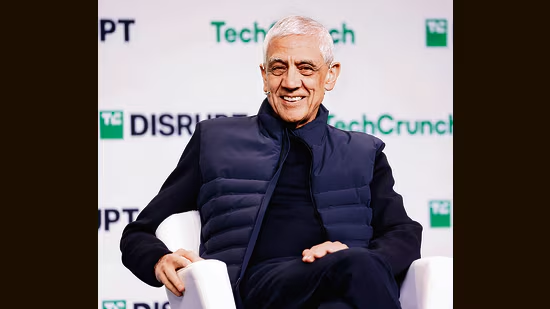
Vinod Khosla has warned that traditional IT services and BPO operations could largely disappear within five years due to rapid advances in artificial intelligence and automation.
A stark prediction from Silicon Valley is reigniting debate across India’s technology sector.
Vinod Khosla, the venture capitalist known for backing transformative technology companies, has warned that traditional IT and business process outsourcing (BPO) services could largely disappear within five years as AI systems automate core functions.
For countries like India, where IT and BPO exports form a significant economic pillar, the claim carries macroeconomic implications.
The automation thesis
Khosla’s argument rests on rapid advances in generative AI and autonomous agents.
Modern AI systems can now:
- Write and debug software code
- Handle customer support queries
- Process financial documents
- Automate compliance reporting
Tasks that previously required large offshore teams may increasingly be handled by AI-driven systems supervised by smaller human teams.
If accuracy and reliability improve further, labor-intensive outsourcing models could face structural compression.
India’s IT services at a crossroads
India’s IT services industry has historically thrived on scale and cost efficiency.
Large firms built global reputations by delivering software development, infrastructure management, and BPO services to multinational clients.
However, AI changes the equation.
Instead of billing for labor hours, companies may shift toward:
- AI integration consulting
- Workflow automation deployment
- Model customization and governance
- Outcome-based pricing models
The transformation would be significant but not necessarily terminal.
Disappearance or reinvention?
Industry leaders have largely framed AI as an augmentation tool rather than a replacement engine.
The distinction matters.
Routine tasks — such as ticket resolution or basic coding — are more susceptible to automation. Higher-order consulting, architecture design, and strategic integration may expand.
Khosla’s timeline of five years reflects aggressive technological optimism.
In practice, enterprise adoption cycles, regulatory considerations, and client risk tolerance often slow abrupt transitions.
BPO sector vulnerability
The BPO industry may face sharper exposure.
Customer service, back-office processing, and standardized workflows are increasingly automatable through conversational AI and robotic process automation.
Companies relying heavily on transactional services could face margin pressure unless they pivot toward AI-enabled offerings.
Workforce implications
The potential disruption raises questions about reskilling at scale.
Countries dependent on IT services employment may need to accelerate:
- AI literacy programs
- Higher-value engineering skill development
- Entrepreneurial ecosystem expansion
Governments and corporations alike face the challenge of preparing workforces for a more automated digital economy.
Investor perspective
From an investor standpoint, automation-driven margin expansion represents opportunity.
Companies deploying AI internally may reduce operational costs while improving speed.
However, systemic workforce displacement carries political and social risk.
Balancing efficiency gains with employment stability will shape policy debates.
A cautionary forecast by Vinod Khosla
Khosla’s warning is not a policy statement but a technological projection.
Historically, automation has displaced certain job categories while creating new ones.
Whether IT services “disappear” or evolve into AI-centric consultancies depends on how quickly firms adapt.
The next five years will likely determine whether India’s IT backbone transforms or contracts.
AI may not erase the sector.
But it may fundamentally redefine what IT services mean.
The industry now faces a choice: defend legacy models or accelerate reinvention.
In the AI era, inertia may be the greater risk.