
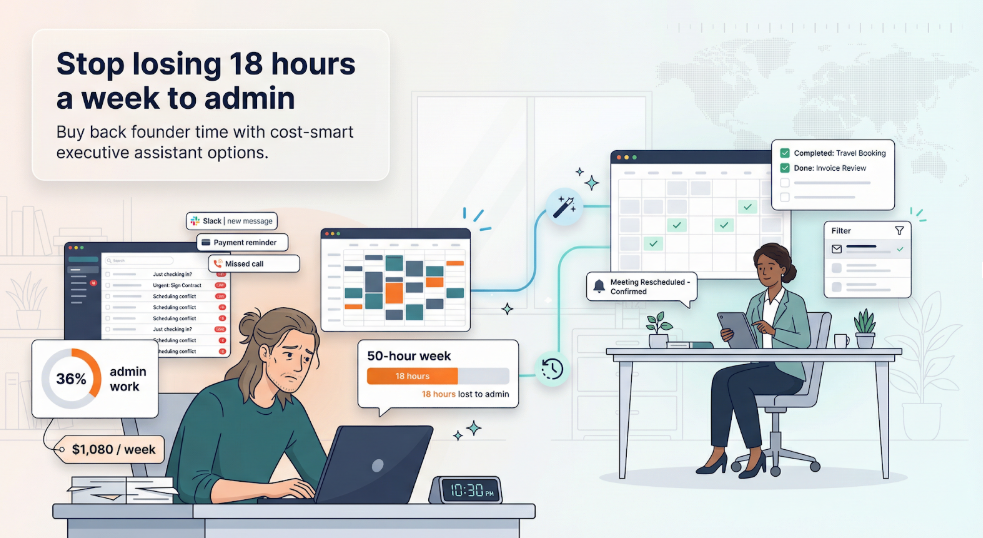
You juggle product sprints, investor decks, and late-night inbox triage. Founders clock 50-hour weeks and sink 36 percent of that into administrative busywork—about 18 hours lost to scheduling and follow-ups each week, according to Forbes.
At an estimated founder value of $60 per hour, that’s $1,080 of growth time traded for chores every seven days.
The solution isn’t working harder; it’s bringing on an executive assistant sooner and smarter. This guide ranks 11 cost-savvy EA services so you can reclaim the hours that push your startup forward.
Why startups are hiring executive assistants sooner
Startups run on speed. The instant your inbox stalls or a calendar mix-up derails a pitch, momentum disappears. Founders know that, yet still spend late nights replying to “just checking in” emails instead of shipping product.
The price tag is real. Studies show founders lose more than one-third of each week to low-value admin, equal to about four full workdays every month that could have fueled growth. When investors expect relentless focus, that drag is unacceptable.
Cost is no longer a blocker. A new mix of hiring options, including fractional assistants, on-demand virtual agencies, and AI copilots, lets you buy back time without a six-figure salary. Pre-vetted overseas talent starts under $15 an hour, while top-tier U.S. fractional assistants run $35 to $45. You can start lean and expand support only when workload demands it.
Location is finally an advantage. Modern collaboration tools and rigorous vetting mean a founder in Austin can work with an assistant in Bogotá or Manila through the same Slack ping. Global rates can reduce overhead by up to 70 percent, freeing budget for engineering or ads.
AI compounds the benefit. Calendar bots now suggest meeting times automatically, and email triage engines sort noise for pennies a day. Many executives prefer human EAs who handle these tools fluently, blending judgment with automation for around-the-clock coverage.
Hiring an EA early is no longer a luxury. It is the fastest upgrade to your startup’s operating system.
How we selected and ranked these EA solutions
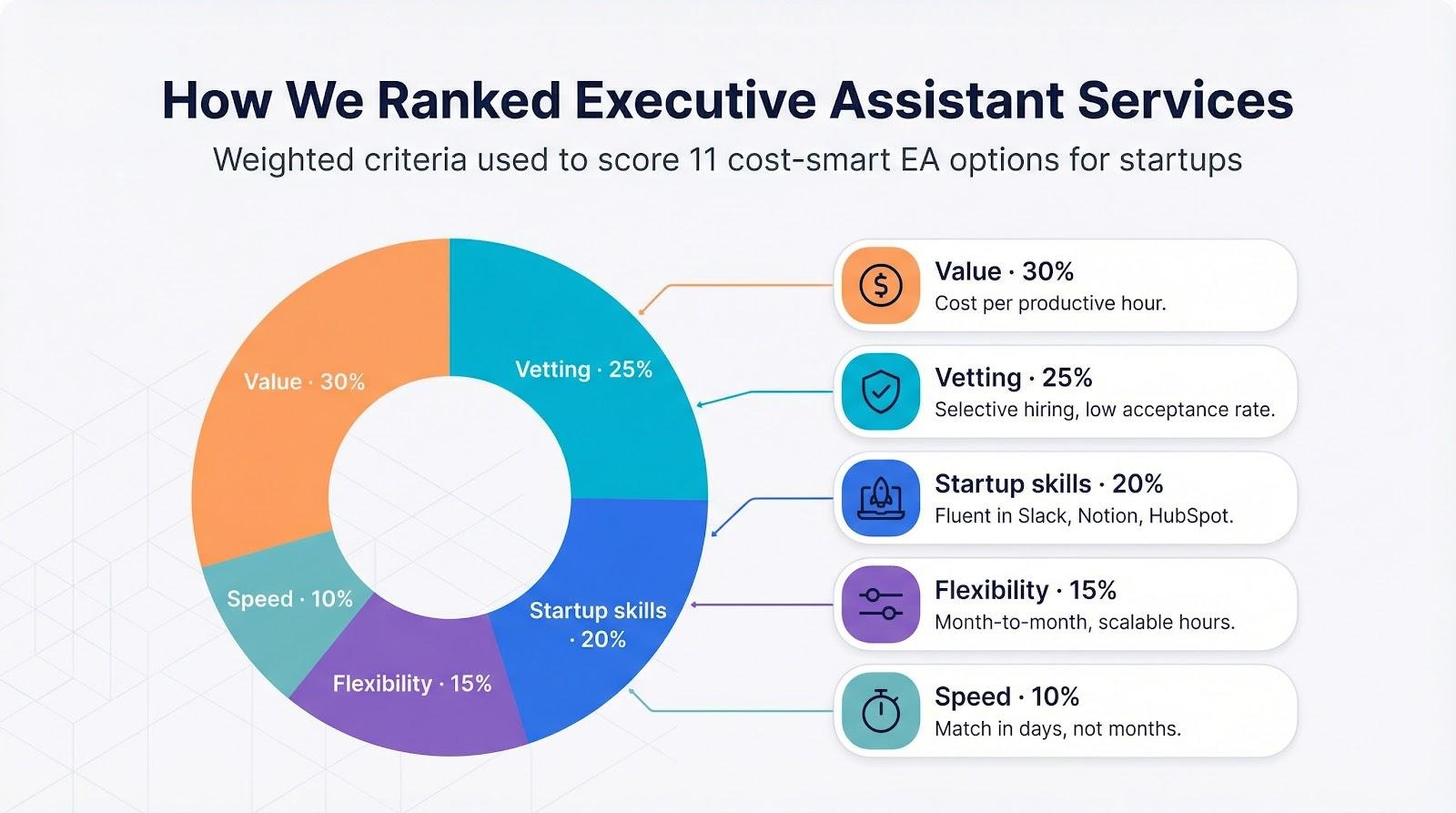
We compared every service through the eyes of a time-strapped founder and scored each one on 5 factors that predict real-world impact.
First, price had to work for a lean budget. We ignored headline hourly rates and calculated cost per productive hour, rewarding flexible, month-to-month plans.
Next, we scrutinized vetting. Services that accept only a small fraction of applicants rose to the top because a bad hire costs more than no hire at all.
Startup fluency mattered just as much. Assistants who already live in Slack, Notion, or HubSpot need almost zero ramp-up, so those providers earned extra weight.
Scalability and speed completed the model. We favored platforms that match you with talent in days and let you dial hours up or down as funding ebbs and flows.
Each factor carried a clear weight: value 30 percent, vetting 25, startup skills 20, flexibility 15, and speed 10. That breakdown keeps the rankings data driven, not gut feel.
Recruiter-style placements: when you want a career EA, not just hourly help
Some founders outgrow piecemeal support and need a single lieutenant who learns the business as deeply as they do. A recruiter-led search solves that challenge. You pay a one-time placement fee and bring on a full-time employee who can grow into chief-of-staff territory. Two specialists stand out.
C-Suite Assistants
Think of C-Suite Assistants as an executive search firm focused on a single role. Their team conducts a detailed intake, maps how you work, and delivers a shortlist of vetted candidates in about 3 weeks. Because they recruit solely within the EA talent pool, the hit rate is high and cultural fit often feels precise.

C-Suite Assistants executive assistant recruiting homepage screenshot
Pricing is simple: roughly 25 percent of the hire’s first-year salary, payable only if you sign an offer. Compare that with 4 months of founder time lost to interviews, and the math makes sense. Founders also praise C-Suite for coaching them on the job description itself. Their startup-focused guide to defining responsibilities for executive assistants suggests listing core duties like calendar control and travel first, then outlining strategic projects the EA will own, so your posting attracts candidates comfortable with both tiers of work. If you have never managed an assistant, that front-end clarity is gold. Expect scheduling, background checks, and reference calls handled without pulling you away from product work.
Ideal when: you have Series A funding, a Slack channel that pings every minute, and need trusted support immediately.
Pocketbook Agency
Pocketbook applies a matchmaking approach to executive support. Where C-Suite prioritizes skills, Pocketbook centers on chemistry. Recruiters profile your communication style, stress triggers, and sense of humor, then surface candidates who match on tempo as well as talent.
The process runs 3 to 6 weeks. Fees mirror C-Suite at about a quarter of salary, with a 90-day guarantee that protects against misalignment. Pocketbook’s roster often includes assistants from entertainment and high-touch client services, so if your startup handles press, events, or VIP customers, their network fits.
Founders report strong retention. Many assistants placed in seed-stage companies remain on deck two funding rounds later, evolving into operations managers. That longevity turns a one-time fee into a bargain.
Ideal when: cultural fit matters as much as calendaring precision, and you need an EA who can guide investors, media, and the occasional celebrity client without missing a beat.
Fractional U.S. subscription services: premium help at part-time pricing
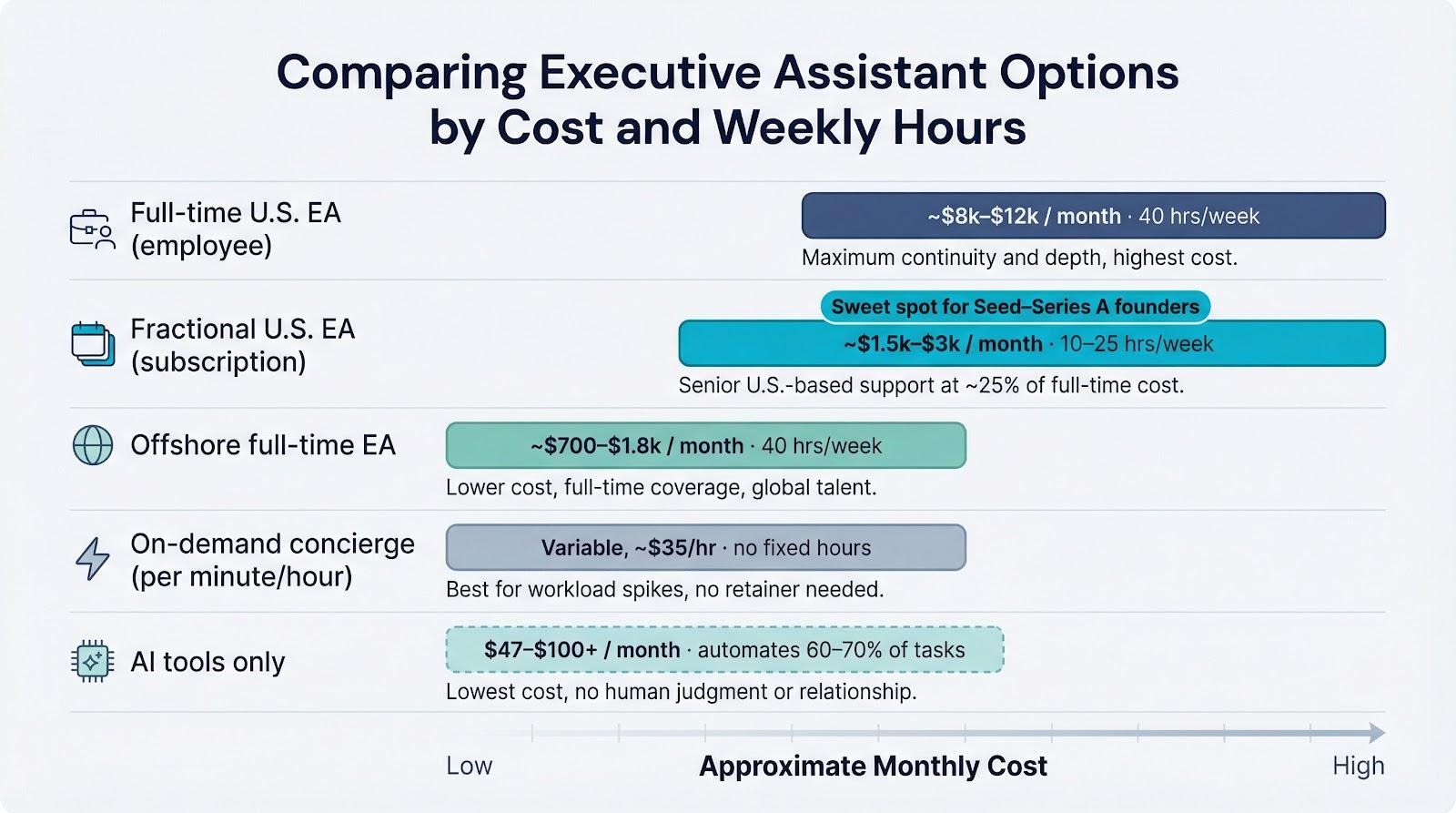
You want senior-level polish but do not need 40 hours a week. Fractional EA subscriptions solve that tension by pairing you with seasoned, stateside assistants on a flexible retainer. You pay only for the slice of their week you use, yet you still gain continuity, confidentiality, and context that gig platforms rarely deliver.
Boldly
Boldly is a standout in this model. The company hires under 5 percent of applicants, so every assistant arrives battle tested. Plans start at about 10 hours per week and scale up with a click. Founders say their Boldly EA feels like a Fortune 500 staffer who just happens to work in Slack. Turnaround from signup to first intro call is usually under a week, so relief lands fast without a long recruiting slog.
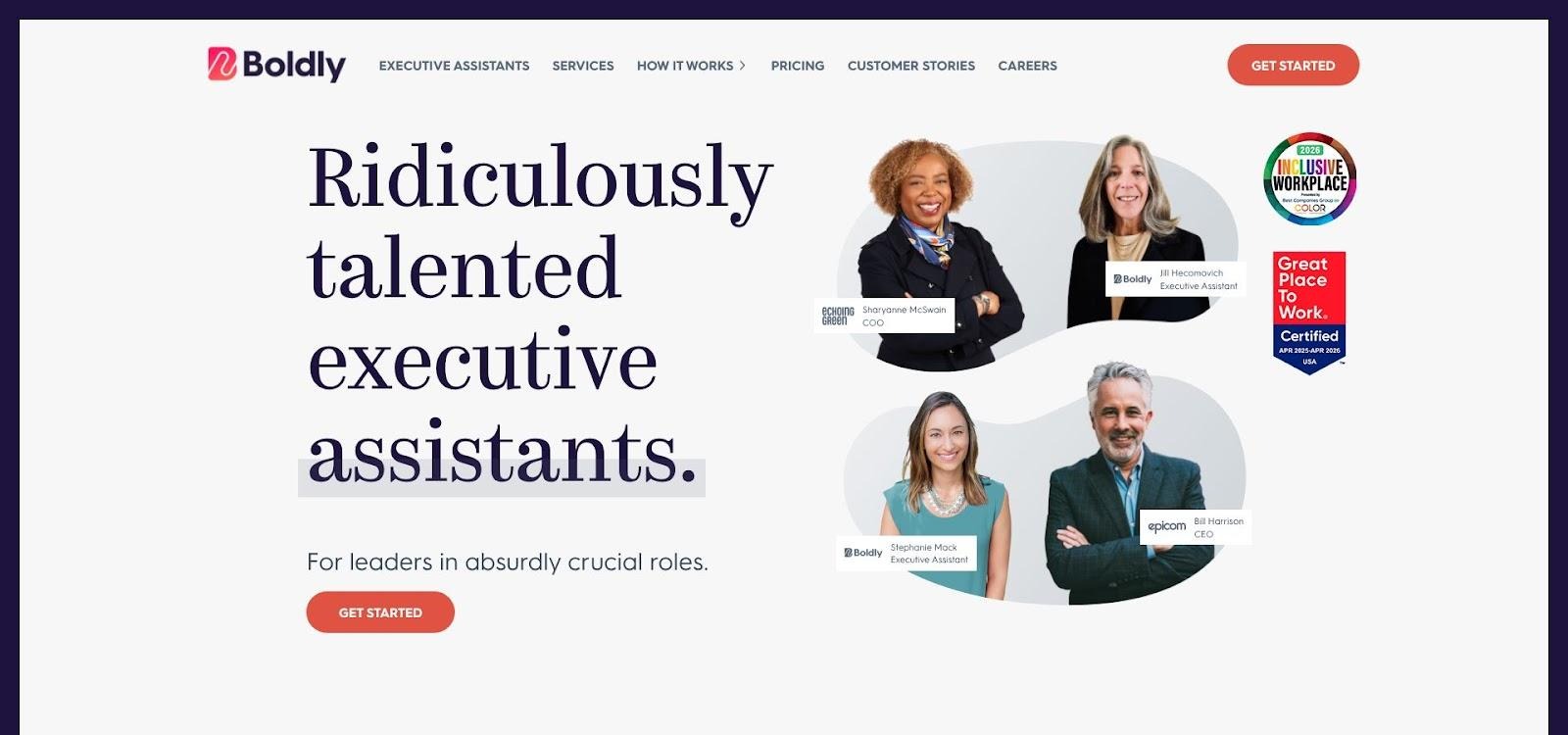
Boldly premium fractional executive assistant service homepage screenshot
BELAY
BELAY pairs high standards with guided delegation. A client success consultant shadows the first month, helping you decide what to hand off and how to measure wins. That coaching is priceless for first-time delegators who fear “it’s faster if I do it myself.” Assistants are U.S. based, college educated, and vetted through multistage interviews. Packages begin around 45 hours a month, and you can adjust hours once rhythms settle.
Double
Double adds tech flair to the fractional concept. Record a voice memo or forward an email, and the Double app routes it to your dedicated assistant in seconds. Because the platform tracks tasks and preferences automatically, your EA spends more time executing and less time asking clarifying questions. Hourly rates sit at the high end of the segment, but speed plus app-level visibility makes the premium feel justified for founders who live on their phones.
In short, fractional subscriptions give you an experienced partner at roughly 25 percent of the cost of a full-time hire, without sacrificing quality or continuity. For many Seed to Series A teams, this is the sweet spot between burning out and going on a hiring binge.
Offshore horsepower: full-time support at a startup price
Hiring offshore is often the fastest way to secure 40 hours of coverage without draining runway. These services recruit in lower-cost regions yet embed assistants so closely in your workflow they feel in-house. We will unpack 4 contenders, starting with a proven option.
MyOutDesk
MyOutDesk converts overseas talent into a plug-and-play employee. Outline the role, and 2 weeks later a college-educated assistant in the Philippines is logging into your Slack channel.
Cost is about $1,800 a month for a full-time hire, roughly one-third of a comparable U.S. salary once taxes and benefits are included. That gap alone can fund an extra engineer.
A dedicated 40-hour block lets you offload deep-work killers such as CRM cleanup, investor research, or light project management. Because the assistant works only for you, context compounds daily.
Quality control matters across time zones, so MyOutDesk supplies equipment, office-grade internet, and ongoing training on U.S. business etiquette. If a match falters, they swap talent without charging a second placement fee, keeping momentum intact.
The trade-offs are predictable. You must hold daily stand-ups and document SOPs or risk drifting deliverables. Cultural nuance may need coaching, especially in external emails. Founders who spend a week on playbooks report saving 6 to 8 hours every day, a return that eases burn rate pressure.
Wing Assistant
Wing blends human talent with an AI backbone. You get a dedicated assistant, often in the Philippines or South Asia, plus a task-routing platform that slots overnight requests into a global queue. Work continues while you sleep, and a status report lands at 7 am.
Pricing starts near $700 a month for part-time help and about $1,100 for full-time. The effective hourly cost can dip below $7, yet the service still includes perks such as password-manager integration and built-in SOP templates.
The AI layer tackles repetitive chores like email sorting and data extraction before a human reviews and ships the final product. Turnaround averages 2 hours, allowing your assistant to focus on nuance instead of clicks.
Founders appreciate the “unlimited task” promise: queue as many requests as you like, and Wing works through them by priority. The model encourages you to clear mental clutter, which is half the delegation battle.
Downsides exist. Because your assistant leans on a broader team for after-hours coverage, voice and style can drift unless you provide clear brand notes. Time-zone overlap also requires planning; a quick back-and-forth may span a day unless you book real-time slots.
For startups chasing 24/7 momentum on a tight budget, Wing offers a strong mix of scale, speed, and cost control.
Persona
Persona positions itself as the premium choice in remote executive assistance. The company scouts globally for former Fortune 500 or high-growth startup EAs, then prices them below a U.S. equivalent at roughly $2,000 to $3,000 a month for full-time dedication.
That rate sits above other offshore options, yet founders often justify the premium after week one. Persona assistants anticipate needs rather than wait for tickets. They draft investor updates, assemble board decks, and build Notion dashboards without hand-holding. The result feels like a strategic partner, not a task robot.
Matching is meticulous. Persona’s intake interview explores your leadership style, preferred tools, and calendar philosophy. The platform then runs skills and personality tests before presenting a single candidate. Ninety-five percent of clients say the first match “exceeded expectations,” explaining the firm’s near-zero churn.
Because assistants work across time zones, Persona guarantees at least 4 shared hours with U.S. daylight so you can huddle live while still gaining overnight progress. A standby EA shadows your workflows, providing seamless coverage during vacations.
Persona shines when you want Silicon Valley polish on a lean burn. If you are ready to delegate higher-order projects but want to avoid a six-figure domestic salary, this is your path.
Prialto
Prialto delivers a managed micro-team instead of a single assistant. You receive a primary EA, a backup, and an engagement manager who documents every process in a living playbook. For startups that prize execution at scale, that redundancy protects continuity.
Packages start near $1,500 a month for about 55 hours, placing the hourly cost around $27. You pay more than for a solo VA, yet you gain near-zero downtime. Sick days, vacations, and turnover trigger automatic coverage from Prialto’s bench.
Security is another benefit. Assistants work from monitored offices on company hardware under strict access protocols. Fintech and health-tech founders who handle sensitive data often choose Prialto for this compliance layer alone.
The service thrives on structure. Daily update emails, weekly KPI snapshots, and quarterly process reviews keep everyone aligned. That rigor can feel corporate to scrappy teams, but it prevents task drift as headcount and complexity rise.
If you plan to support multiple executives over the next year, Prialto scales without new searches or contract changes. It becomes an extension of operations, not just an individual assistant, and the premium often proves worthwhile for growth-stage teams aiming for enterprise muscle.
On-demand concierge hybrids: tap to task, no commitment
Sometimes you do not need a steady rhythm of hours; you need a safety valve during a hectic week. Enter Magic, a service that feels less like an assistant and more like a command line for the real world.
Magic
Magic began as a text-me-anything concierge and evolved into a platform that blends AI routing with a global bench of human assistants. You fire off a request such as “schedule investor coffees next Thursday,” “compare HubSpot and Pipedrive pricing,” or “find a last-minute dog-walker,” and Magic assigns it to the best-suited operator within minutes.
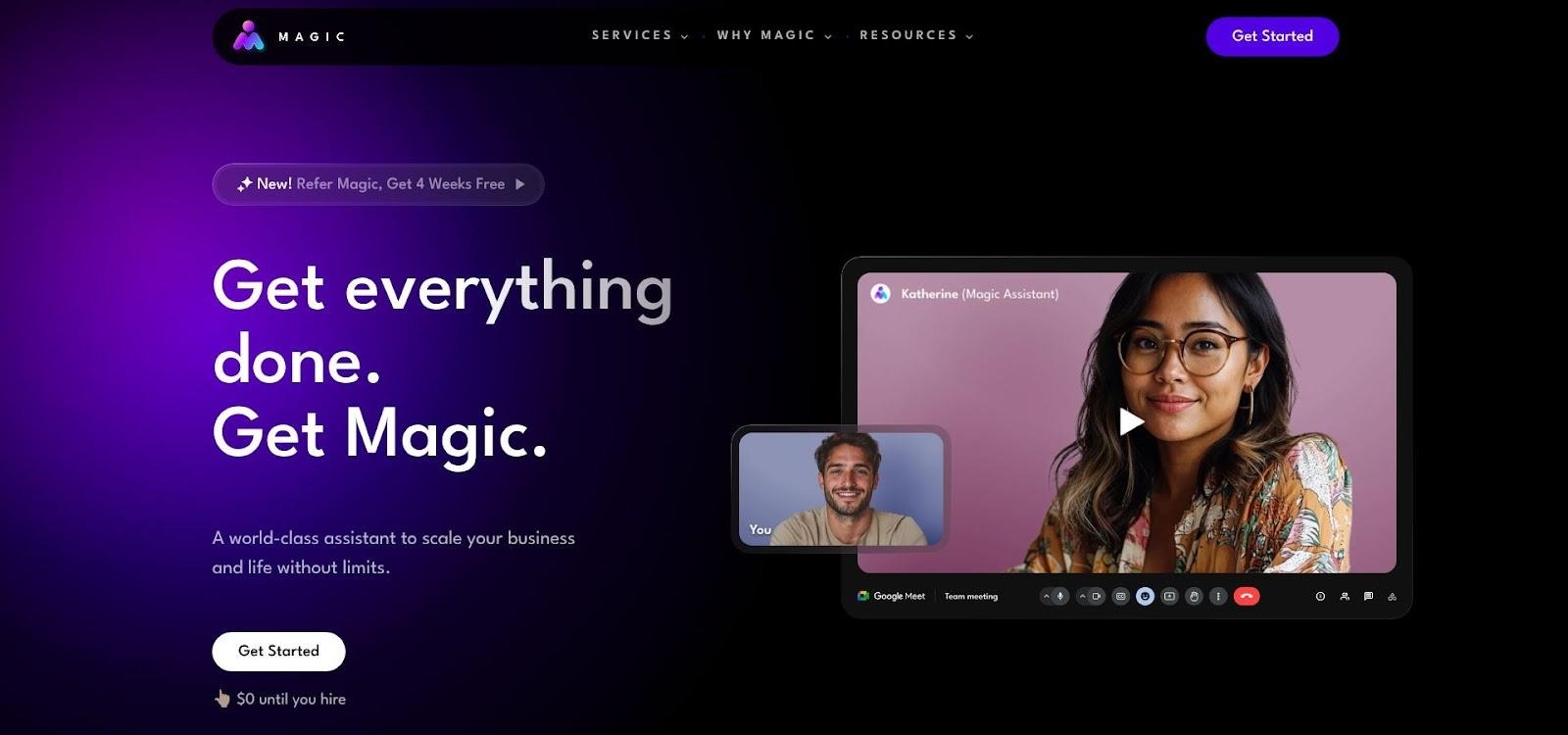
Magic on-demand concierge virtual assistant service homepage screenshot
Flexibility is the draw. You can buy a dedicated EA plan at about $2,100 for 40 hours a week or stay pay-as-you-go and get billed by the minute at roughly $35 an hour. That à la carte model fits pre-seed founders who face workload spikes but cannot justify a retainer.
Speed rivals anything on this list. Magic says 70 percent of tasks close inside 1 hour. The platform’s hybrid queue lets an AI layer parse intent, fetch data, and draft emails before a human polishes and sends, so you wake up to finished work instead of follow-up questions.
Coverage is global and operates 24/7, making Magic a useful bridge when your regular EA sleeps or when weekend errands pile up. The trade-off is consistency. Unless you pay for a dedicated plan, different people handle different tasks, so voice and style can vary. Clear brand notes help, but review key client-facing messages before they go out.
Use Magic when your startup swings between calm and chaos, and you need relief that costs nothing on quiet days yet scales instantly during crunch time.
AI executive assistant tools: the low-cost autopilot for repeatable tasks
Before you hire any human, squeeze every drop of automation out of software. Modern AI assistants can draft emails, propose meeting slots, and summarise unread threads for less than the cost of a daily coffee.
Consider Mr. Delegate’s “AI chief of staff.” For $47 a month it triages your inbox, suggests polite replies, and flags urgent messages so nothing vital gets lost. Calendar bots such as Reclaim and Motion manage time zones, reschedules, and buffer rules automatically. Add ChatGPT with a few custom instructions and you have a virtual analyst ready to digest investor memos or draft job descriptions in seconds.
The business case is clear. These tools cost about 90 percent less than a fractional EA, yet they handle roughly 60 to 70 percent of repetitive tasks: filing receipts, pulling data, scheduling calls. Install them today, and a large share of admin work disappears overnight.
Conclusion
Limits remain. AI misses nuance, relationships, and judgment calls. It will not read subtext in a board email or coach a nervous sales lead before a demo. That is where a human EA excels. By letting algorithms clear rote work, you can delay a hire or free your assistant to tackle strategic projects.
Start small. Connect an AI scheduler, let it run for 1 week, and track the hours you reclaim. When workload demands it, bring in a human who can partner with the tech instead of competing with it. That pairing represents the next phase of executive leverage.


