
The growing intensity of climate change and rapid urbanisation is reshaping how governments and enterprises think about environmental monitoring. Traditional Earth observation systems, largely built on visible-spectrum imaging, often fail to capture the underlying thermal dynamics that signal risk — from urban heat islands to industrial emissions and infrastructure stress.
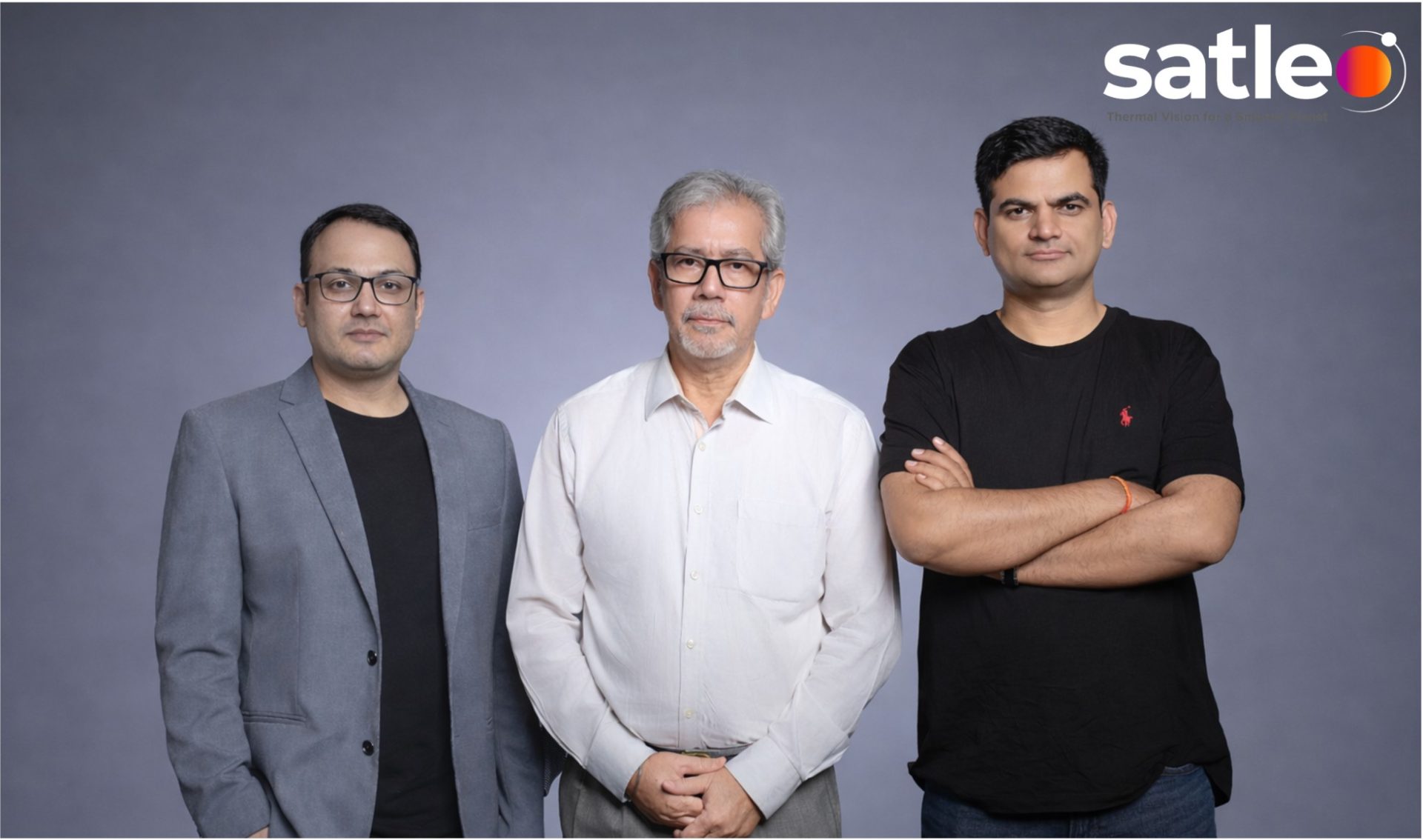
SatLeo Labs is building its core thesis around that gap. The company is developing a thermal intelligence platform that combines satellite-based infrared imaging with AI-driven analytics, aiming to deliver insights that go beyond surface-level observation. Its latest funding round, led by Unicorn India Ventures, reflects increasing investor interest in space-tech systems that can translate raw data into actionable intelligence.
Building a dual-layer satellite intelligence system
Integrating thermal and visible imaging
At the center of SatLeo’s approach is a multi-spectral satellite architecture that integrates thermal and visible data streams. This allows for continuous monitoring of Earth’s surface with greater depth, enabling detection of temperature variations, environmental stress points, and heat-driven anomalies that are not visible through conventional imaging.
The company’s platform is designed to convert these signals into usable insights across sectors such as agriculture, disaster response, defence, and urban planning. This shift from imaging to intelligence reflects a broader evolution in the space-tech ecosystem, where value is increasingly created at the data interpretation layer.
From payload to platform
SatLeo has already demonstrated early technical progress with the development of its experimental thermal payload, TAPAS-1, which reached near-launch readiness within six months. This milestone marks the company’s transition from concept to execution, as it prepares for satellite integration and deployment.
At the same time, the company is building an AI-powered analytics layer that processes thermal data at scale, positioning itself as both a hardware and software player in the Earth observation stack.
Early traction signals emerging demand
SatLeo’s progress over the past year suggests that demand for thermal intelligence is beginning to materialise across real-world use cases. The company has conducted pilot projects in cities such as Ahmedabad and Tumakuru, focusing on urban heat monitoring and air pollution analysis, with reported impact on hundreds of thousands of citizens.
This early deployment is complemented by a growing commercial pipeline. Letters of intent have expanded significantly, indicating that governments and enterprises are increasingly willing to adopt space-based thermal data for operational decision-making.
Scaling toward commercial deployment
Expanding technical and operational capacity
To support its next phase, SatLeo has scaled its team from a small founding group to a broader engineering and research organisation. This expansion reflects the complexity of building both satellite systems and AI-driven analytics infrastructure.
Preparing for launch and constellation deployment
The company’s immediate focus is on achieving launch readiness for its thermal payloads while laying the groundwork for a larger satellite constellation. This step is critical for enabling continuous, high-resolution data coverage, which is necessary for commercial-scale applications.
Strengthening the AI layer
Alongside hardware development, SatLeo is investing in its AI platform to ensure that thermal data can be processed and delivered in near real-time. This capability is central to its positioning as an intelligence provider rather than a data vendor.
Investor conviction in space-tech’s next phase
For Unicorn India Ventures, the investment reflects a broader belief that space technology is entering a phase where commercial applications are becoming clearer and more immediate.
Thermal intelligence, in particular, sits at the intersection of several high-priority domains, including climate resilience, infrastructure monitoring, and national security. By combining proprietary satellite capabilities with AI-driven analytics, SatLeo is attempting to build a differentiated position within this emerging category.
A broader transformation in space-tech
SatLeo’s model highlights a shift in how space-tech companies are being built. Earlier generations focused primarily on launch systems or satellite manufacturing. The current wave is moving toward integrated platforms that combine hardware, data, and software into unified solutions.
This transition is enabling startups to capture more value by delivering end-to-end capabilities rather than operating as single-layer providers.
What comes next
Over the next year, SatLeo plans to move from pilot deployments to scaled operations, focusing on satellite launches, commercial expansion, and technology refinement.
Execution at this stage will be critical, particularly in balancing the capital-intensive nature of space infrastructure with the need for rapid commercial adoption.
Building a new layer of environmental intelligence
SatLeo’s trajectory reflects a growing recognition that thermal data is becoming essential infrastructure in a climate-constrained world. As cities heat up and environmental risks become more complex, the ability to monitor and respond to thermal patterns will play an increasingly central role in decision-making.
If successful, SatLeo will not just contribute to the space-tech ecosystem but help define a new layer of intelligence that sits between raw satellite data and real-world action.


