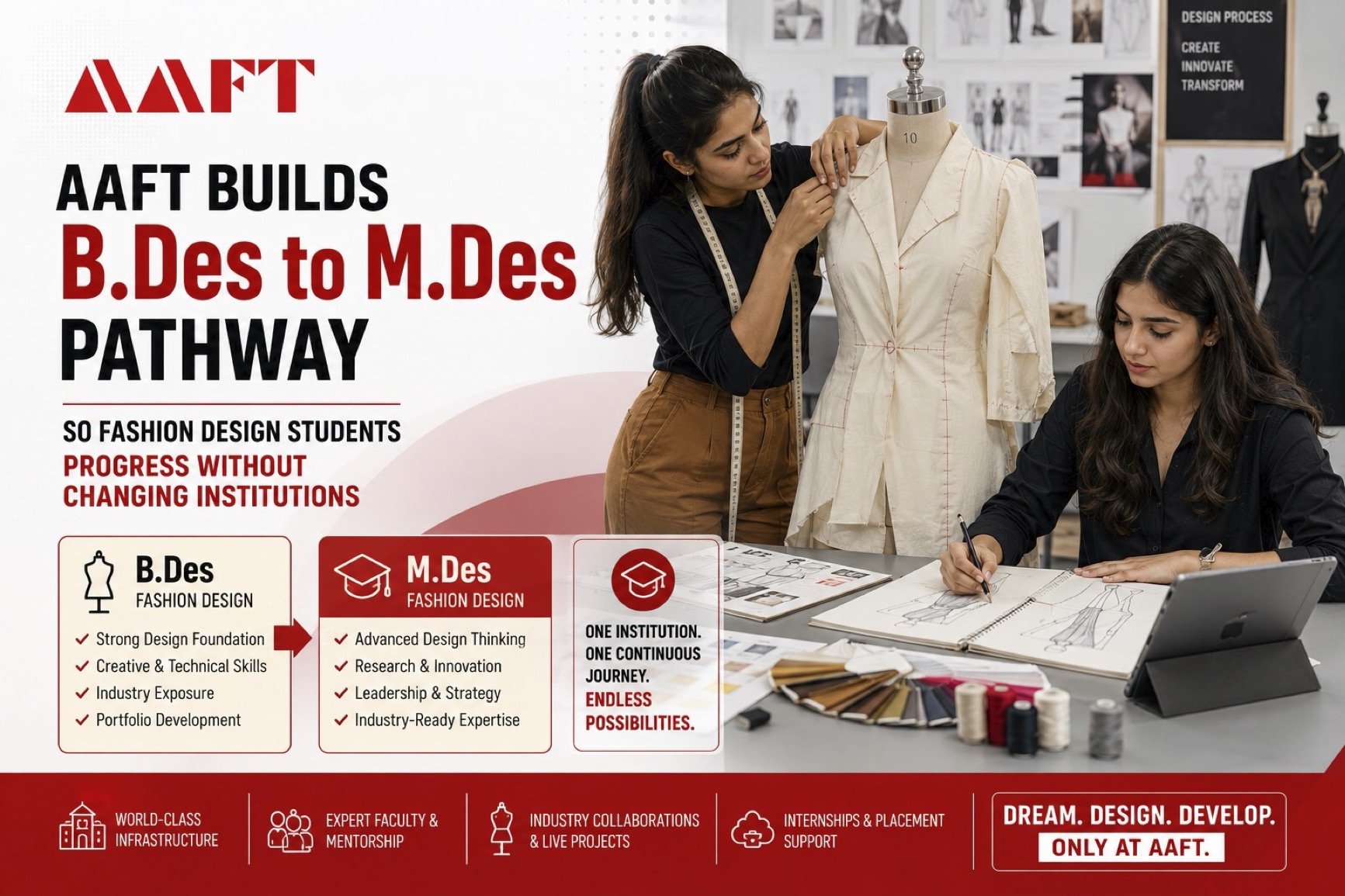
Students who are serious about a fashion design course often face a problem nobody talks about enough. They complete their undergraduate degree at one college, build relationships with faculty, grow comfortable with the studios and infrastructure, and then start over at a different institution for their postgraduate degree.
AAFT Noida offers a connected pathway from the B.Des in Fashion Design through to the M.Des in Fashion Design, so students who want to progress from undergraduate to postgraduate level can do it on the same campus, with the same faculty, inside the same production environment.
For students looking for a fashion design college in India where their education does not stop at the undergraduate level, this matters. A fashion design course after 12th is a starting point, not a ceiling.
Is It Worth Doing an M.Des After a B.Des in Fashion Design?
Most students who complete a fashion design course in Delhi NCR,India at the undergraduate level do not stop there. The fashion industry rewards depth of skill and seniority of creative thinking, and both take time to develop.
The B.Des in Fashion Design at AAFT Noida is a four-year degree. The M.Des in Fashion Design is a two-year postgraduate degree. A student who completes both without switching institutions carries six years of progressive training in a single ecosystem.
What that continuity buys is specific. The portfolio grows in one direction rather than restarting and AAFT publishes student portfolios openly, so the standard is visible before a student applies. Faculty relationships deepen across six years rather than two or three. The studios, the ramp, the pattern labs and the production workflows are already familiar, so postgraduate time goes into the work rather than into learning where everything is. And the industry network built through six years of shows, masterclasses and internships compounds.
The M.Des also carries content the B.Des does not: Techno Fashion covering wearable technology and smart textiles, CLO 3D for virtual garment visualisation and digital sampling, structured Fashion Research Methods, Craft Documentation, and a dissertation. These are postgraduate-level additions, not repetitions.
What Does the B.Des in Fashion Design Course Cover?
The B.Des in Fashion Design is a four-year undergraduate degree built around a 70:30 industry-centric model, with 70% of the programme focused on practical sessions, live projects, fashion shows and portfolio development, and 30% on written assessments and critical analysis. It carries access to 100+ industry workshops and masterclasses, 100% placement assistance, and a dedicated Career Resource Cell.
First Year: Building the Foundation
Semester 1 covers Elements and Principles of Design, Fashion Studies, Drawing and Sketching, Material Exploration, CAD I in CorelDRAW, Sewing Fundamentals, and Communicative Skills. Semester 2 moves into Introduction to Textile, Fashion Illustration I, Pattern Making and Garment Construction I, Design Thinking, CAD II in Photoshop, Environmental Science, and Introduction to the Apparel Industry.
Students begin working in AAFT Noida’s fashion facilities from the first semester, with access to pattern labs, a fashion illustration lab, a styling lab, a studio, high-end equipment, and a full ramp.
Second Year: Technical Depth and Industry Skills
Semester 3 covers Indian Traditional Textile, Fashion Illustration II, Pattern Making and Garment Construction II, Design Project I, CAD III in Adobe Illustrator, Introduction to Fashion Retailing, and Entrepreneurship Development, alongside the CARE Online Program for career readiness. Semester 4 moves into Surface Ornamentation, covering Indian embroidery, dyeing and printing techniques, and Fashion Illustration III, covering menswear croquis and technical illustration.
The second year is also where specialisation begins.
Design Your Own Degree
Most fashion design programmes in Delhi NCR run a fixed curriculum: every student in a cohort takes the same path to the same qualification. AAFT Noida takes a different approach through Design Your Own Degree, which lets students choose the specialisation that aligns with their own interests.
In practice this is four tracks running at three levels, so a student builds real depth rather than sampling an elective:
Semester | Specialisation options |
Semester 3 | Introduction to Photography · Retail Buying & Merchandising · Production Management I · Introduction to Lifestyle and Accessories Design |
Semester 4 | E-commerce & Product Photography · Store Operations Management · Production Management II · Material Exploration and Wearable Products |
Semester 5 | Conceptual Fashion Photography · Customer Relationship Management · Garment Finishing & Packaging · Lifestyle Product Design |
A student drawn to visual work can move from Introduction to Photography through E-commerce and Product Photography to Conceptual Fashion Photography. One drawn to the commercial side can go from Retail Buying and Merchandising through Store Operations Management to Customer Relationship Management. Both graduate with a portfolio reflecting the direction they actually want to take.
What Does the M.Des in Fashion Design Course Cover?
The M.Des in Fashion Design is a two-year postgraduate programme for students who want to create, innovate and lead in the fashion and lifestyle industry. Entry is open to graduates of any discipline, so the first semester establishes a common foundation before the programme moves into postgraduate-level work.
Year One: Foundation, Then Technical Advance
Semester 1 covers Design Basics, Sewing Techniques, Pattern Making and Garment Construction Basic, Fashion History and Culture, Fashion Illustration, Digital Design in Adobe Illustrator, and Textile Studies.
Semester 2 advances quickly: Advance Pattern Making and Garment Construction focused on menswear drafting and precision construction; Fabric Manipulation and Surface Ornamentation; Techno Fashion, covering wearable technology, smart textiles and innovation-driven design that integrates functionality with aesthetics; Advance Fashion Illustration; Apparel Merchandising and Quality Control covering costing, sampling and tech-pack analysis; Fashion Retailing; and a Basic Design Project and Portfolio.
Year Two: Research, Digital Sampling and the Graduation Collection
Semester 3 is where the M.Des separates most clearly from undergraduate work. It covers Fashion Industry and Sustainability; Craft Documentation, developing research skills to preserve and promote Indian craft traditions; Creative Pattern Making and Garment Construction, advancing into 3D structures and designer garment construction; Draping, covering 3D draping, fabric experimentation and pattern grading; Fashion Research Methods, equipping students to design structured research proposals; 3D Digital Design in CLO 3D for virtual garment visualisation, modification and efficient digital sampling; and an Advance Design Project and Portfolio.
Semester 4 is the Graduation Design Collection and Portfolio a market-ready capsule collection showing conceptual clarity, technical expertise and professional presentation alongside a Dissertation built on internship-based design investigation.
CLO 3D is worth pausing on. Digital sampling is how the industry is reducing physical prototyping, and a postgraduate who can build and modify a garment virtually before a single metre of fabric is cut is solving a cost problem every label has.
Fashion, Designed for the Intelligent Era
From January 2026, AI is woven into studio practice across the School of Fashion Design, from concept development through to portfolio presentation. The tools are named per stage rather than gestured at.
On the B.Des: ChatGPT, Gemini, Midjourney and Leonardo for concept and mood development; Perplexity, Gemini and ChatGPT for trend and consumer insight; Ideogram and Leonardo for surface ornamentation and print exploration; AI-assisted workflows for garment visualisation and pre-sampling preview; NotebookLM and ChatGPT for retail and merchandising thinking; Ideogram and Nano Banana for portfolio and lookbook development.
On the M.Des: ChatGPT, Gemini, Midjourney and Leonardo for advanced narrative and collection storytelling; Midjourney, Leonardo and Nano Banana for design iteration at scale; Perplexity and ChatGPT for sustainability and material research; AI-assisted workflows for digital sampling and collection preview; Future Snoops and Reach CAD for design futures; Supergrow and Quillbot for final jury and portfolio refinement.
This sits alongside the traditional toolchain rather than replacing it. Students still learn Adobe Photoshop, Adobe Illustrator, CorelDRAW and Adobe InDesign to professional standard, and the M.Des adds CLO 3D.
In-House Global Fashion Week
The In-House Global Fashion Week at the AAFT School of Fashion and Design is a large-scale, industry-simulated fashion platform conducted annually on campus. Designed as a live fashion week environment, it brings design, styling, communication, production and presentation together under one professional showcase.
Over an intensive, production-driven schedule, students conceptualise collections inspired by global cultures, develop garments, plan styling narratives, and present their work in a professionally curated runway setting. Students from multiple academic years collaborate within real fashion workflows design development, visual communication, show planning, media coordination and execution following professional timelines and industry protocols.
It is executed through dedicated in-house academic and production teams, with continuous mentorship from faculty and engagement with designers, industry leaders, diplomats and media professionals, and contributes significantly to portfolio development. Designed as a full-scale fashion week simulation, it turns the campus into a global fashion platform, letting students experience the scale, professionalism and impact of an international fashion showcase.
For students comparing fashion designing institutes in India, this is a meaningful differentiator. Producing a collection for a real runway show, working with a team on styling, set design and production, and presenting work in front of an industry audience is a level of practical experience that most fashion design colleges cannot match.
The International Immersion Programme
The fee structure lists an Immersion option against each fashion programme, and it refers to the AAFT International Immersion Program an eight-day study abroad experience in Milan, Rome and Brescia, delivered in partnership with Italian creative institutions.
For fashion students specifically, the School of Fashion Design pairs with Ferrari Fashion School Milano. The programme covers workshops with Italian educators and industry professionals, access to design studios and cultural institutions, portfolio development with feedback from international mentors, and networking with designers, stylists and brand professionals working across Italy.
It is open to currently enrolled AAFT students, with selection based on academic performance, professional interest and a screening process. Students receive an official international workshop certificate from the partnering institution, which strengthens the portfolio though it may not carry direct academic credits. The cost covers programme fees, accommodation, training sessions and most on-ground expenses, and AAFT covers the initial visa application. Scholarships are not available for the Immersion Program, and it sits outside the standard degree fee structure which is why the fee table below shows both figures.
Who Teaches the Programmes
The School of Fashion Design is led by Industry Dean Rina Dhaka, a fashion designer with a career spanning decades, celebrated for innovative designs that blend traditional craftsmanship with modern aesthetics. Committed to sustainability and preserving traditional artistry, she has consistently championed ethical fashion, and her work has been recognised with the Rajiv Gandhi Excellence Award and the Yuva Rattan Award. For students on both programmes, her mentorship means 50+ hours of in-person learning, 10 masterclasses, and portfolio review from Rina Dhaka and her team.
The Dean of the school is Prof. Siva Ganesh Babu, a textile chemist, fashion business administrator and sustainable fashion advocate with over 22 years of experience. He has established multiple fashion schools in India and Africa, developed national curricula, and founded profitable apparel industries, and is an active researcher in sustainable fashion.
In Their Own Words
Akshay Marwah, CEO, AAFT Noida, said: “Fashion design is a career that rewards people who go deep, not people who stop at the surface. The B.Des to M.Des pathway at AAFT Noida is built on the understanding that the best fashion designers are those who spend six years developing their craft in a single, consistent environment. We have built that environment here, with the right faculty, the right infrastructure, and the right industry connections to take a student from their first design sketch all the way through to launching their own collection. That is what the pathway delivers, and it is why top brands hire our fashion graduates.”
Placements and Industry Connect
AAFT Noida’s fashion graduates are placed with fashion labels, design studios, retail brands and export houses. Recent placements include Sunidhi Chauhan at Pero by Aneeth Arora, Siddhita Mishra at Arvind Fashions, Yash Rewalia at Puneet Nidhi India, Nishi Kumari at Boutiques Asia, Mohit Vaishnav at A.K. Fashion, Anjali Singh at C.R. Clothing Co, and Aashi at AG Strategic Management.
With 2,800+ hiring partners and a dedicated Career Resource Cell, AAFT Noida has a consistent record of placing fashion graduates in roles that reflect the skills they built across the B.Des and M.Des. For students comparing fashion design course fees and placements across institutions in Delhi NCR, the combination of industry-experienced faculty, an annual in-house fashion week, ramp and studio access, and a wide hiring partner network makes it one of the most career-focused fashion designing institutes in the region.
Fee Structure 2026
Programme | Fee (without Immersion) | With Immersion |
B.Des Fashion Design (4-yr) | ₹9,23,100 | ₹11,63,100 |
B.Sc Fashion Design (3-yr) | ₹6,99,100 | ₹9,39,100 |
B.Sc Fashion Communication & Styling (3-yr) | ₹6,63,100 | ₹9,03,100 |
M.Des Fashion Design (2-yr) | ₹5,03,100 | ₹7,43,100 |
Diploma in Fashion Design (1-yr) | ₹1,80,000 | — |
Career Roles After the B.Des and M.Des in Fashion Design
Career Role | Where They Work |
Fashion Designer | Fashion labels, design studios, retail brands |
Pattern Maker | Garment manufacturers, fashion labels, textile companies |
Textile & Surface Designer | Textile companies, fashion labels, retail brands |
Costume Designer | Film studios, OTT platforms, television productions |
Fashion Stylist / Image Consultant | Advertising agencies, editorial, e-commerce platforms |
Apparel Merchandiser | Retail brands, export houses, e-commerce platforms |
Fashion Illustrator | Fashion labels, design studios, advertising agencies |
Garment Technologist | Garment manufacturers, production units |
Creative Director (M.Des) | Fashion houses, design studios, brands |
Sustainable Fashion Consultant | Fashion brands, textile companies, consultancies |
Fashion Researcher / Trend Analyst | Forecasting agencies, brands, research units |
Fashion Entrepreneur / Brand Owner | Independent label, own design practice |
Admissions Open
Students who have completed 10+2 from a recognised board or institution can apply for the B.Des in Fashion Design. Applicants need a minimum of 50% marks in 10+2 (45% for reserved categories) and must clear the AAFT Global Entrance Test (GET). No prior fashion experience is required. Graduates of any discipline can apply for the M.Des in Fashion Design.
Both programmes are offered at the AAFT campus in Noida Film City. Students can apply at admissions.aaft.com or visit the campus for a studio tour and a free career counselling session.
About AAFT Noida
Established in 1993, AAFT Noida carries a 33-year legacy in creative education and is ranked among the Top 10 creative institutions globally. Its network of 37,000+ alumni spans films, OTT platforms, television, journalism, advertising, fashion, animation, and digital media across India and the world.
The institution operates from Marwah Studios, Noida Film City, one of India’s most active production facilities. With 90+ career-driven courses, 2,800+ hiring partners, and 20+ global academic affiliations, AAFT Noida follows a curriculum that balances creative training with real-world application and remains committed to preparing globally competitive talent for India’s growing creative economy.
For Admission and Media Inquiries, Contact:
AAFT Noida
FC-14/15, Sector-16A
Noida Film City, Uttar Pradesh, India
Phone: 08062911638 / 08062911639 / 09811014536
Email: [email protected]
Website: www.aaft.com