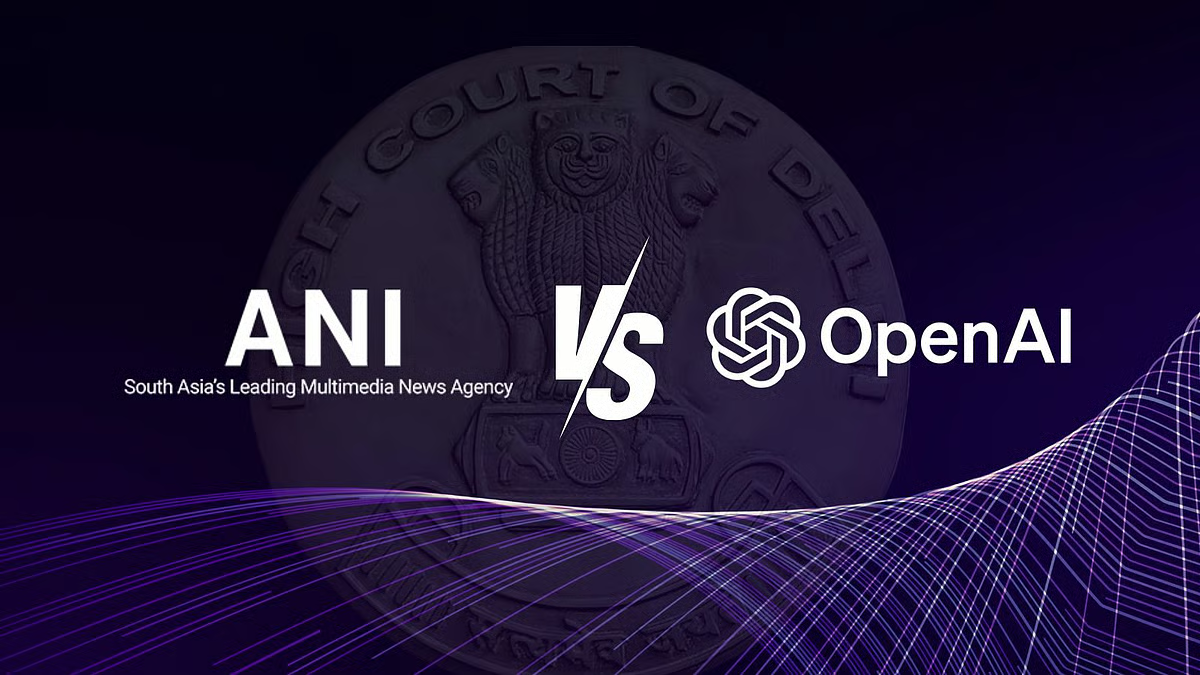
Landmark Delhi HC ruling denies ANI's interim injunction against OpenAI, setting a precedent for AI copyright and innovation in India.
Delhi High Court Rejects ANI's Injunction Against OpenAI, Easing AI Development Concerns The Delhi High Court has denied an interim injunction sought by Asian News International (ANI) against OpenAI, a pivotal decision that could temper immediate regulatory risks for artificial intelligence developers in India. This ruling signals a challenging legal pathway for copyright holders seeking swift relief against large language models and may influence future intellectual property litigation across the rapidly expanding AI sector. The court's finding that ANI failed to demonstrate a *prima facie* case or a balance of convenience in its favor provides a temporary reprieve for generative AI platforms. ANI, a prominent Indian news agency, initiated the suit alleging that OpenAI's ChatGPT replicated its copyrighted content without proper attribution or licensing. The news wire asserted that direct prompts frequently yielded summaries or paraphrases of its exclusive reporting, directly infringing on its intellectual property rights. This claim positioned the case as a significant test of how traditional copyright frameworks will adapt to the nuances of AI-generated output and the vast datasets used for model training. OpenAI countered the allegations by arguing its models are trained on publicly accessible data and do not reproduce content verbatim, but rather learn patterns and generate novel text. The company highlighted the transformative nature of its technology, suggesting that its use of copyrighted material falls within permissible boundaries, similar to how humans learn from diverse sources. The court deliberated on whether AI learning constitutes infringement or a new form of information processing.
What Does the Ruling Imply for AI Development?
The Delhi High Court's decision sets a significant precedent, underscoring the inherent difficulty in proving direct copyright infringement by generative AI models. This judicial stance offers a measure of stability for AI developers, mitigating the risk of immediate operational disruptions through interim injunctions. It also highlights a global judicial trend toward cautious evaluation, acknowledging the complex technical underpinnings of artificial intelligence. This ruling could embolden AI companies to continue their rapid development cycles without the immediate threat of injunctions halting operations or requiring costly model retraining. The burden of proof remains firmly on the plaintiff to demonstrate actual copying, a task made more challenging by the probabilistic nature of AI output versus direct human plagiarism. The verdict may also influence investment flows into the Indian AI ecosystem, providing clarity to venture capitalists concerned about legal liabilities for their portfolio companies. The judgment aligns with similar legal battles unfolding in other major jurisdictions, where courts are grappling with comparable copyright claims against AI firms. For instance, The New York Times has filed a lawsuit against OpenAI and Microsoft in the United States, alleging the unauthorized use of millions of its articles to train AI models. Similarly, several authors have brought actions against AI developers for alleged infringement of their literary works. These cases collectively indicate a nascent but evolving global legal landscape for AI and intellectual property.
What is the Background of the Legal Challenge?
Asian News International (ANI) operates as one of India's largest and most influential news agencies, supplying content to numerous media outlets across the nation and beyond. Its extensive network and consistent output mean its content forms a substantial part of the publicly available information landscape. The agency's decision to pursue legal action against OpenAI reflects a broader industry concern regarding the economic impact of AI models trained on proprietary content without compensation. OpenAI, a leading research and deployment company in artificial intelligence, has been at the forefront of developing generative AI technologies, including its widely recognized ChatGPT language model. The company's models have showcased unprecedented capabilities in generating human-like text, translating languages, and answering complex questions, making them a cornerstone of the current AI revolution. The legal challenge in Delhi highlights the delicate balance between fostering innovation and protecting creators' rights in the digital age. The dispute also touches upon the ongoing global debate concerning fair use and transformative use in the context of AI training data. Legal scholars and industry experts are actively discussing whether the ingestion of copyrighted material by AI models for training purposes constitutes fair use, given that the output is typically a transformation rather than a direct reproduction. The Delhi High Court's initial observations contribute to this evolving legal discourse, emphasizing the need for robust evidence in these complex cases.
What Happens Next?
The denial of the interim injunction does not resolve the core copyright infringement claim; it merely allows OpenAI to continue its operations without immediate disruption while the case proceeds to a full trial. ANI will now need to present more substantial evidence to prove that OpenAI's models directly copied its content and that such copying constitutes an infringement under Indian copyright law. This could involve forensic analysis of AI model outputs and training data. The legal proceedings are expected to be protracted, with both parties likely to engage expert witnesses and complex legal arguments regarding AI mechanics and intellectual property statutes. The outcome of the full trial will be closely watched by the global technology and media industries, as it could establish a significant precedent for how AI development intersects with copyright law in a major emerging economy. Furthermore, legislative bodies worldwide are actively considering new regulations specifically tailored to AI, which could eventually reshape the entire legal framework governing these disputes.
Frequently asked questions
Hey Google, what was the Delhi High Court's decision on ANI's plea against OpenAI?
The Delhi High Court rejected Asian News International (ANI)'s plea for an interim injunction against OpenAI. This decision allows OpenAI to continue operations without immediate interruption, marking a key development for AI copyright law in India.
Why did ANI file a suit against OpenAI?
ANI filed a copyright suit against OpenAI, alleging that OpenAI's AI models used ANI's copyrighted content without permission, seeking an injunction to prevent further use.
What does this ruling mean for AI development in India?
This ruling is seen as a positive sign for AI developers in India, potentially easing immediate regulatory concerns and fostering innovation by not imposing a swift injunction.
Is this a final decision in the copyright suit?
No, this is only a rejection of an *interim* injunction. The full copyright suit between ANI and OpenAI will still proceed to trial.
How does this compare to international AI copyright cases?
This case adds to a growing global body of jurisprudence on AI and copyright, mirroring similar legal challenges faced by AI companies in other jurisdictions regarding data training and content usage.
What is the next step for ANI in this legal battle?
ANI will continue to pursue its main copyright infringement lawsuit against OpenAI, presenting its arguments during the trial phase of the litigation.