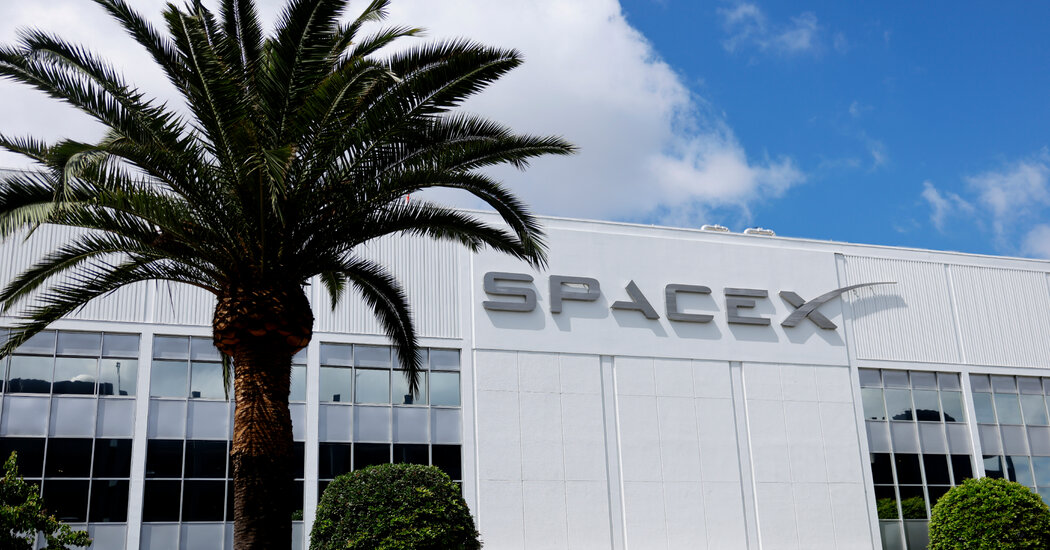
Elon Musk's rocket company is selling 555.6 million shares at $135, valuing it at $1.77 trillion and making it the 7th most valuable US firm.
SpaceX, the rocket company founded by Elon Musk, has officially blasted into the public markets with an initial public offering (IPO) that shatters all previous records. This isn't just another tech debut; it's a monumental moment where everyday investors can finally own a piece of a company valued at an astonishing $1.77 trillion, a figure that puts it among the most valuable enterprises in the U.S. Here's the lowdown: SpaceX is raising a whopping $75 billion by selling 555.6 million shares at a fixed price of $135 apiece. This colossal raise makes it the largest IPO in history, and the company is set to begin trading on the Nasdaq on Friday under the ticker symbol SPCX, marking a pivotal shift for a company that has long been a private, high-flying venture. The valuation alone is enough to turn heads. At $1.77 trillion, SpaceX now stands as the seventh most valuable U.S. company, leapfrogging even Musk's other brainchild, electric vehicle giant Tesla. This massive public offering is not just a financial event; it's a testament to the market's insatiable appetite for visionary tech, even if that vision comes with some hefty financial caveats. Traditionally, companies test the waters with a price range before settling on a final IPO price. SpaceX, however, took a different, more assertive approach, setting a fixed price of $135 per share after a series of "testing-the-waters" meetings. It was a "take-it-or-leave-it" deal for investors, signaling the company's confidence and perhaps the unique allure of its brand. Goldman Sachs spearheaded the offering as lead banker, joined by an impressive syndicate including Morgan Stanley, Bank of America, Citigroup, and JPMorgan Chase. But here's where the narrative gets particularly interesting for prospective investors: this trillion-dollar valuation is for a company that is currently burning cash at a significant rate and, by traditional revenue metrics, is still far smaller than its trillion-dollar peers. The latest filings reveal that SpaceX recorded a net loss of $4.28 billion in the first quarter, following a $4.94 billion loss in 2025. While revenue did grow 15% to $4.69 billion in the first quarter (and 33% to $18.67 billion for all of last year), the company has racked up a cumulative deficit of approximately $41.3 billion since its founding in 2002. It even issued a warning in its prospectus that profitability might not be achieved in the future.
Why this matters to investors
Investing in SpaceX right now is undeniably a wager on the future, and perhaps more specifically, a wager on Elon Musk himself. His track record of disrupting industries, from electric vehicles to digital payments, has cultivated a legion of devoted investors willing to overlook traditional financial metrics in favor of long-term, transformative potential. Musk, 54, who famously took Tesla public 16 years ago, now controls over 82% of the voting power at SpaceX, giving him virtually complete oversight of the company's direction. For Musk, this IPO also marks a personal milestone, with his stake in SpaceX valued at $866.5 billion, pushing him closer to becoming the world's first trillionaire when combined with his other holdings. The company's diverse portfolio is central to its sky-high valuation. While the reusable rocket business is its public face, the Starlink satellite internet service is the primary revenue driver and, notably, its only profitable unit. Adding another layer of complexity and potential, Musk's artificial intelligence division, xAI, merged with SpaceX in February. This strategic move highlights a broader trend: the convergence of traditionally disparate technologies, with space infrastructure increasingly seen as critical for next-generation AI applications. SpaceX's capital expenditures underscore this forward-looking strategy. In the first quarter alone, CapEx soared to $10.1 billion, more than double the previous year. A massive $7.7 billion of that was funneled directly into AI development, with the remainder dedicated to its core space and connectivity businesses. This significant investment signals a long-term play, betting that massive upfront outlays in AI infrastructure will eventually yield exponential returns, a strategy familiar to investors in other high-growth tech sectors. It's a testament to the belief that the company is building an integrated ecosystem, not just isolated services. The market's willingness to embrace such a high-burn, high-potential entity speaks volumes about the current investment climate. In an era increasingly defined by the generative AI boom and a renewed space race, investors are prioritizing disruptive potential and long-term vision over immediate profitability. This reflects a broader trend seen in the valuations of other private tech unicorns, where the promise of future market dominance often outweighs current financial performance. The sheer scale of SpaceX's IPO, roughly three times larger than any previous U.S. offering, suggests a profound confidence in this paradigm shift, even as it invites comparisons to past speculative bubbles where visions sometimes outpaced reality.
The AI factor and what's next
Analyst coverage following the IPO has largely mirrored this sentiment of cautious optimism. Oppenheimer initiated coverage with an "outperform" rating and a 12- to 18-month price target of $190, implying a potential 40% gain from the IPO price. Analyst Timothy Horan highlighted the company's diversified portfolio, particularly its unique positioning as "the only vertically-integrated AI company with the required capital, data, LLMs, hardware, manufacturing and engineering talent." He also noted that its "space infrastructure appears structurally advantaged," suggesting a synergy between its various ventures that few others can match. New Street Research also jumped in with a $165 price target, emphasizing the significant value proposition of xAI, which they estimate to be a $575 billion business. This valuation places xAI in the same league as other leading generative AI players like OpenAI and Anthropic, underscoring the enormous market potential analysts see in SpaceX's integrated AI strategy. The merger of xAI into SpaceX transforms the investment thesis, presenting investors not just with a space exploration company, but a formidable player in the burgeoning artificial intelligence sector. This strategic move highlights a significant trend: the blurring lines between deep tech sectors, with space infrastructure increasingly seen as a crucial enabler for advanced AI capabilities, from data collection to processing and dissemination. This record-setting IPO also arrives at a dynamic moment for the broader tech market. Even as SpaceX dominates headlines, the landscape of massive public offerings could soon see further disruption. Other privately valued AI giants, Anthropic and OpenAI, each reportedly nearing $1 trillion in private valuations, have confidentially filed to go public. These deals, potentially hitting the market within the year, could challenge SpaceX's record and further redefine investor expectations for high-growth, transformative technology companies. For retail investors, Friday's Nasdaq debut offers a rare opportunity to directly participate in the growth story of a company that, until now, has been largely inaccessible. It democratizes investment in a sector previously dominated by venture capital and institutional funds. However, the path forward for SpaceX is not without its hurdles. The company must demonstrate a clear trajectory toward profitability, or at least a sustainable model for its massive capital expenditures, to maintain investor confidence in the long run. The coming years will be crucial in determining whether this record-breaking IPO is merely a high-water mark for market speculation or a foundational step in building a truly unprecedented, trillion-dollar empire spanning Earth, orbit, and beyond.
Frequently asked questions
What is the valuation of SpaceX after its IPO?
SpaceX is valued at $1.77 trillion after its IPO, making it the seventh most-valuable U.S. company, surpassing Tesla. The company sold 555.6 million shares at $135 each.
When is SpaceX debuting on the Nasdaq?
SpaceX is set to debut on the Nasdaq on Friday under the ticker symbol SPCX, giving the public its first opportunity to buy shares in the company.
How much money did SpaceX raise in its IPO?
SpaceX raised $75 billion in its IPO, making it the largest initial public offering on record. It sold 555.6 million shares at $135 a piece.
What are SpaceX's main business units?
Besides its core space business, SpaceX owns the Starlink satellite internet service, which generates the bulk of its revenue and is its only profitable unit, and the artificial intelligence division xAI.
What is Elon Musk's stake in SpaceX worth after the IPO?
Elon Musk's stake in SpaceX is worth $866.5 billion after the IPO, potentially making him the world's first trillionaire when combined with his other holdings.
What were SpaceX's financial results for the last quarter?
In the first quarter, SpaceX's revenue increased 15% to $4.69 billion, but the company recorded a net loss of $4.28 billion, with significant capital expenditures on AI.