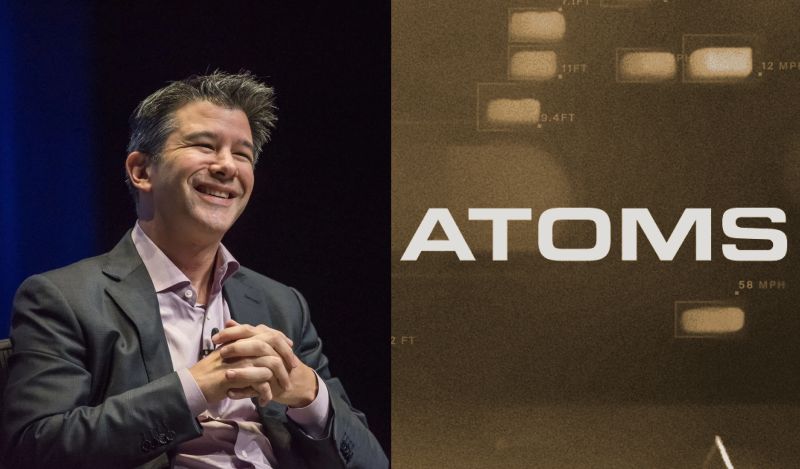
Uber co-founder Travis Kalanick's new venture, Atoms, secures massive $1.7 billion from a16z, Uber, and others to revolutionize industrial AI operations.
Travis Kalanick's latest venture, Atoms, has just secured an eye-watering $1.7 billion in funding, signaling a massive bet on industrial artificial intelligence and marking a significant new chapter for the controversial Uber co-founder. This colossal influx of capital positions Atoms to tackle some of the most complex operational challenges facing businesses today, from manufacturing floors to global supply chains, promising to reshape how physical industries operate in North America and beyond.
Here's what happened: The colossal investment round saw participation from prominent venture capital firm Andreessen Horowitz (a16z) and, notably, Kalanick's former company, Uber, among other undisclosed investors. The funds are earmarked for aggressive expansion into the industrial AI sector, aiming to develop and deploy advanced AI solutions that optimize efficiency, reduce waste, and enhance productivity in real-world physical operations.
Atoms is not Kalanick's first foray since departing Uber in 2017. His previous venture, CloudKitchens, focused on the real estate and infrastructure needed for ghost kitchens, a business that also involved significant physical assets and operational optimization. With Atoms, he appears to be scaling up that ambition, targeting an even broader swath of the physical economy where AI can drive efficiencies.
The company's mission is to bring the kind of sophisticated data analysis and algorithmic decision-making that transformed consumer internet companies to the gritty, often overlooked world of industrial operations. Think smart factories, optimized logistics networks, predictive maintenance for heavy machinery, and automated quality control that can save companies billions. It’s a space ripe for disruption, characterized by legacy systems and immense untapped potential for efficiency gains.
For Travis Kalanick, this $1.7 billion raise from a mix of top-tier VCs and his previous corporate empire signifies a powerful vote of confidence from the investment community. It underscores his enduring ability to attract significant capital and top talent, even after the tumultuous exit from Uber that cast a long shadow over his career.
Why is industrial AI attracting so much cash?
The surge of investment into industrial AI is not happening in a vacuum; it reflects a broader, fundamental shift in the technological landscape. For years, venture capital largely flowed into consumer applications and platforms, promising to make our digital lives easier or more entertaining. Now, the focus is increasingly turning to "hard tech" or "deep tech," which tackles complex, real-world problems in sectors like manufacturing, energy, agriculture, and logistics.
These industries, often considered traditional or slow-moving, are facing immense pressure to modernize. Supply chain disruptions, labor shortages, rising energy costs, and the imperative for sustainability are forcing companies to find new ways to operate. Industrial AI offers a compelling solution, promising to unlock efficiencies that were previously unimaginable by optimizing everything from factory floor layouts to energy consumption in vast warehouses.
What strikes me here is the sheer scale of the potential impact. Unlike consumer apps, which might optimize a small part of an individual's day, industrial AI can optimize entire national or even global supply chains, manufacturing processes, and energy grids. The financial savings and productivity gains for enterprises can be astronomical, making the multi-billion dollar investment in companies like Atoms seem like a rational bet on future economic infrastructure.
Moreover, the technologies underpinning industrial AI have matured considerably. Advances in computer vision, machine learning, robotics, and sensor technology mean that AI systems can now accurately perceive, analyze, and act upon complex physical environments. This isn't just about software; it's about the convergence of advanced software with sophisticated hardware to create truly intelligent operational systems.
What does this mean for Travis Kalanick?
This massive funding round for Atoms represents more than just a successful capital raise; it's a significant moment for Travis Kalanick's legacy and his journey beyond Uber. His ability to secure such a substantial investment, particularly from a player like Uber itself, suggests a complex dynamic at play. It's a tacit acknowledgment from his former company that Kalanick possesses a unique operational genius, even if his leadership style historically proved problematic.
The investment from Uber is particularly intriguing. While it could be a purely financial play, looking for returns on a promising technology, it also hints at a strategic interest. Uber, at its core, is a logistics company that optimizes real-world transportation. Atoms' focus on industrial AI could develop technologies that Uber itself might eventually leverage to further optimize its vast network of drivers, vehicles, and deliveries, especially in areas like autonomous logistics or predictive maintenance for its fleet partners.
My read is that this new chapter allows Kalanick to focus on what he excels at: building complex, highly efficient operational systems, but now within the less publicly scrutinized B2B industrial sector. It's a shift from the consumer-facing battles of Uber, which involved constant regulatory skirmishes and public opinion wars, to a domain where value is measured primarily by efficiency and return on investment for businesses.
The challenge for Kalanick will be to translate his vision for industrial AI into tangible, deployable solutions that can navigate the often-conservative and highly specialized world of manufacturing and logistics. These industries have different adoption cycles and risk tolerances compared to the fast-paced consumer tech world. Building trust and delivering robust, secure, and reliable systems will be paramount.
Atoms will enter a competitive landscape. While the industrial AI market is vast, it's also attracting significant attention from established industrial giants like Siemens, GE, and Honeywell, as well as a growing number of well-funded startups. Kalanick's team will need to demonstrate superior technology and execution to carve out a dominant position.
The long-term implications for workers in these industrial sectors are also a critical consideration. While AI promises to enhance productivity and create new types of jobs, it also raises questions about automation displacing existing roles. Atoms, like other industrial AI companies, will need to address how its technologies will integrate with human workforces, potentially focusing on augmentation rather than outright replacement, or on upskilling initiatives.
This $1.7 billion war chest provides Atoms with the resources to attract top engineering talent, invest heavily in research and development, and potentially acquire smaller, specialized AI firms. It signals a serious intent to build a foundational technology company for the next era of industrial automation, a future where physical assets are as intelligently managed as digital ones.
As the company moves forward, the focus will undoubtedly be on execution. Can Kalanick and his team deliver on the ambitious promise of transforming industrial operations with AI? The market is ready for innovation, and investors have placed a colossal bet on Atoms to be a leader in this critical, emerging field, charting a new course not just for Kalanick, but potentially for industries across North America.
Frequently asked questions
What is Travis Kalanick's new company, Atoms?
Atoms is Travis Kalanick's latest venture focused on industrial artificial intelligence. It aims to solve complex operational challenges for businesses, ranging from manufacturing floors to global supply chains, leveraging advanced AI technologies.
How much funding did Atoms secure?
Atoms secured $1.7 billion in funding.
Who are the key investors in Atoms?
Key investors include a16z (Andreessen Horowitz), Uber, and other undisclosed parties.
What industry will Atoms primarily focus on?
Atoms will primarily focus on industrial AI.
What challenges does Atoms aim to solve?
Atoms aims to tackle complex operational challenges in areas like manufacturing and supply chain.
What is the significance of this funding for Travis Kalanick?
This funding marks a significant new chapter for the controversial Uber co-founder, positioning him as a major player in industrial AI.