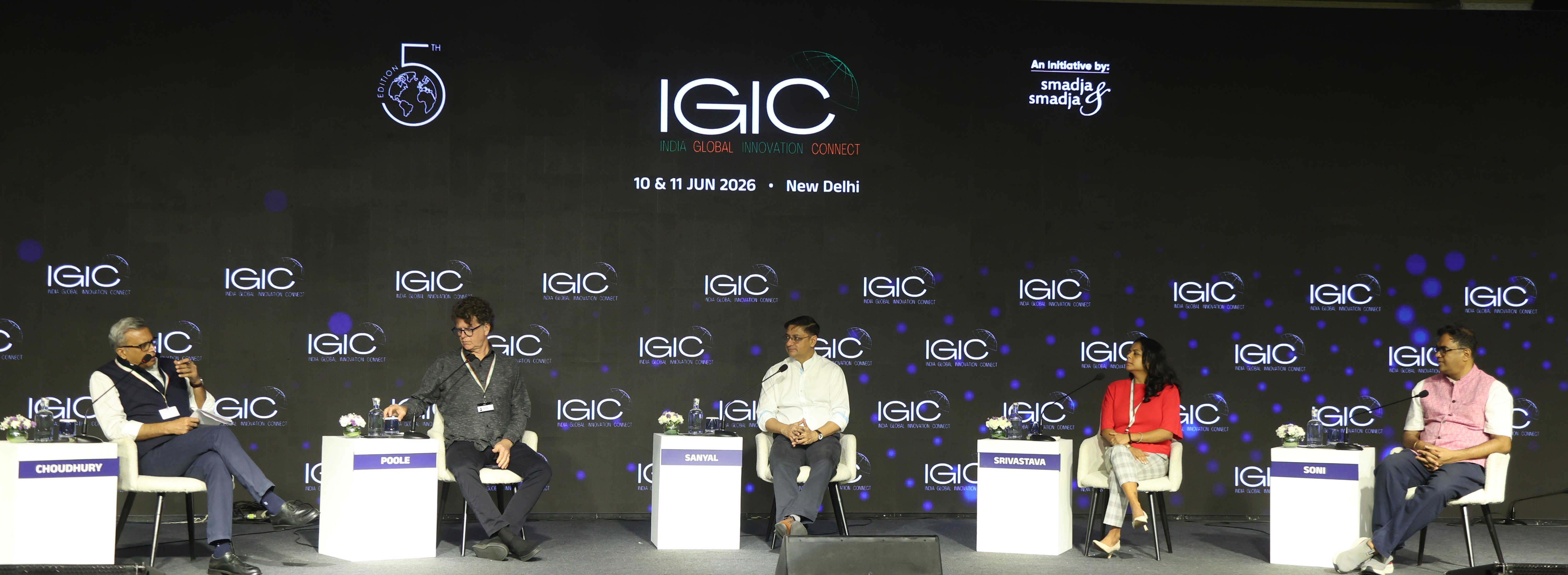
The global race for artificial intelligence dominance is shifting from generalized foundational models to highly specialized, efficient applications. At the 5th edition of the India Global Innovation Connect (IGIC) 2026 in New Delhi, a prominent coalition of policymakers, technologists, and global investors emphasized a critical strategic pivot: India must forge its own distinct tech path by capitalizing on frugal innovation, targeted international alliances, and vertically integrated AI architectures rather than engaging in capital-intensive foundational model competition.
Organized by Smadja & Smadja Strategic Advisory under the central theme "India in the Age of AI", the high-level, two-day summit established a blueprint for how the country can transition from a technology service powerhouse into a sovereign innovation leader.
The Core Foundations: India at an AI Inflection Point
India enters the AI era with a combination of structural, economic, and human capital advantages that few other nations possess. These pillars give the country a unique launchpad to scale purpose-driven digital infrastructure globally.
Key Drivers of India's Technology Ecosystem:
Massive Financial Commitments: Over US$20 billion has been structurally committed to scaling artificial intelligence framework capabilities domestically.
Global Capability Centers (GCCs): The nation hosts nearly 2,200 GCCs, which collectively employ 2.5 million highly skilled technical professionals.
Advanced Digital Public Infrastructure (DPI): India’s open-source, population-scale DPI (built on frameworks like Aadhaar and UPI) provides a standardized data layer to train and deploy scalable AI solutions.
Despite these clear strengths, summit speakers noted that unlocking this deep-tech potential requires immediate reforms to address bottlenecks in public procurement, early-stage deep-tech financing, and rapid commercialization.
Frugal Innovation and Vertical AI: Navigating Around Resource Constraints
A core theme of IGIC 2026 was shifting focus away from capital-heavy foundational LLMs (Large Language Models) toward hyper-efficient, domain-specific AI models designed to solve concrete economic and social problems.
1. The Strategy of Frugal Innovation
Mirroring the cost-efficient approaches that powered India’s remarkable space tech breakthroughs, the country can pioneer "frugal AI." This model leverages open innovation platforms and lean architectures to build highly effective software tools that require significantly less computational capital and energy overhead.
2. Doubling Down on Vertical AI Solutions
Rather than building generic platforms, the long-term commercial opportunity lies in engineering specialized, vertically integrated AI software tailored for high-impact sectors. These tools can solve domestic operational challenges across global value chains and subsequently be exported as enterprise solutions to international markets.
3. Strengthening Multi-Sector Supply Chains
Beyond software, India is actively building out its role across intertwined deep-tech sectors, focusing on semiconductor innovation, biotechnology, healthtech, and hardware design by intensifying collaborations among academic institutions, corporate ecosystems, and government agencies.
Regulating Non-Deterministic Systems: A Fiduciary-First Framework
As AI platforms integrate deeply into corporate and civic life, creating an agile, modern governance architecture has become an absolute necessity. Traditional, predictive regulatory rules fall short when applied to evolving AI algorithms.
Sanjeev Sanyal, Member of the Prime Minister’s Economic Advisory Council (PMEAC), outlined a sophisticated, market-driven approach to AI governance:
“AI is a non-deterministic complex system—and we need to regulate it like one. What works is skin in the game: clear accountability, identifiable actors who bear the consequences of failure. Without that, bad behaviour becomes pandemic. Ultimately, we will need a global governance architecture for AI—not unlike what SWIFT or the IMF represent for finance—but built on the recognition that you cannot tame a complex system through ex-ante rules alone.”
Complementing this regulatory view, V. Kamakoti, Director of IIT Madras, re-emphasized that local and global AI development must be explicitly guided by ethical deployment frameworks, technological accountability, and environmental sustainability.
Investor and Executive Perspectives: The Need for Patient Capital
To successfully pivot toward deep-tech innovation, India’s venture ecosystem must transition from supporting short-term consumer applications to funding long-term engineering cycles.
Claude Smadja, Co-founder of IGIC and Chairman of Smadja & Smadja, summarized the cultural advantage:
"India's strength has always been its ability to achieve more with less. Just as frugal innovation enabled remarkable achievements in sectors like space technology, the AI era presents a similar opportunity. By building purpose-driven partnerships, leveraging open innovation platforms and focusing on strategic sectors, India can accelerate innovation while overcoming resource constraints."
Will Poole, Co-Founder and Managing Partner at Capria Ventures (USA), pinpointed the exact market opportunity for founders:
"The opportunity is not to chase foundation models, but to build vertically focused AI solutions that solve real-world problems at scale and can be exported globally."
Padmaja Ruparel, Founding Partner of the Indian Angel Network (IAN Group), added a crucial note on capitalization:
"While there is growing ambition among Indian founders, there remains a critical need for patient capital and stronger, long-term funding mechanisms designed specifically to support deep-tech ventures through extended commercialization cycles."
Market Outlook: Shaper, Not Just a Participant
India’s engineering talent pool is undergoing a vital transformation from backend operations to frontline architectural creation. Ruchir Dixit, Vice President & Country Manager at Siemens EDA and Chairperson of IESA, concluded that driven by this talent base and cross-sector alignment, India has a definitive opportunity to actively shape the global technology ecosystem rather than merely participating in it.
Over its subsequent sessions, IGIC 2026 continues to unpack the critical elements of digital sovereignty, defense innovation, cross-border venture capital funding, and sustainable technology deployment. By anchoring its macro strategy in capital-efficient architectures and vertical solutions, India is positioning itself as a resilient, highly pragmatic model for the developing world.