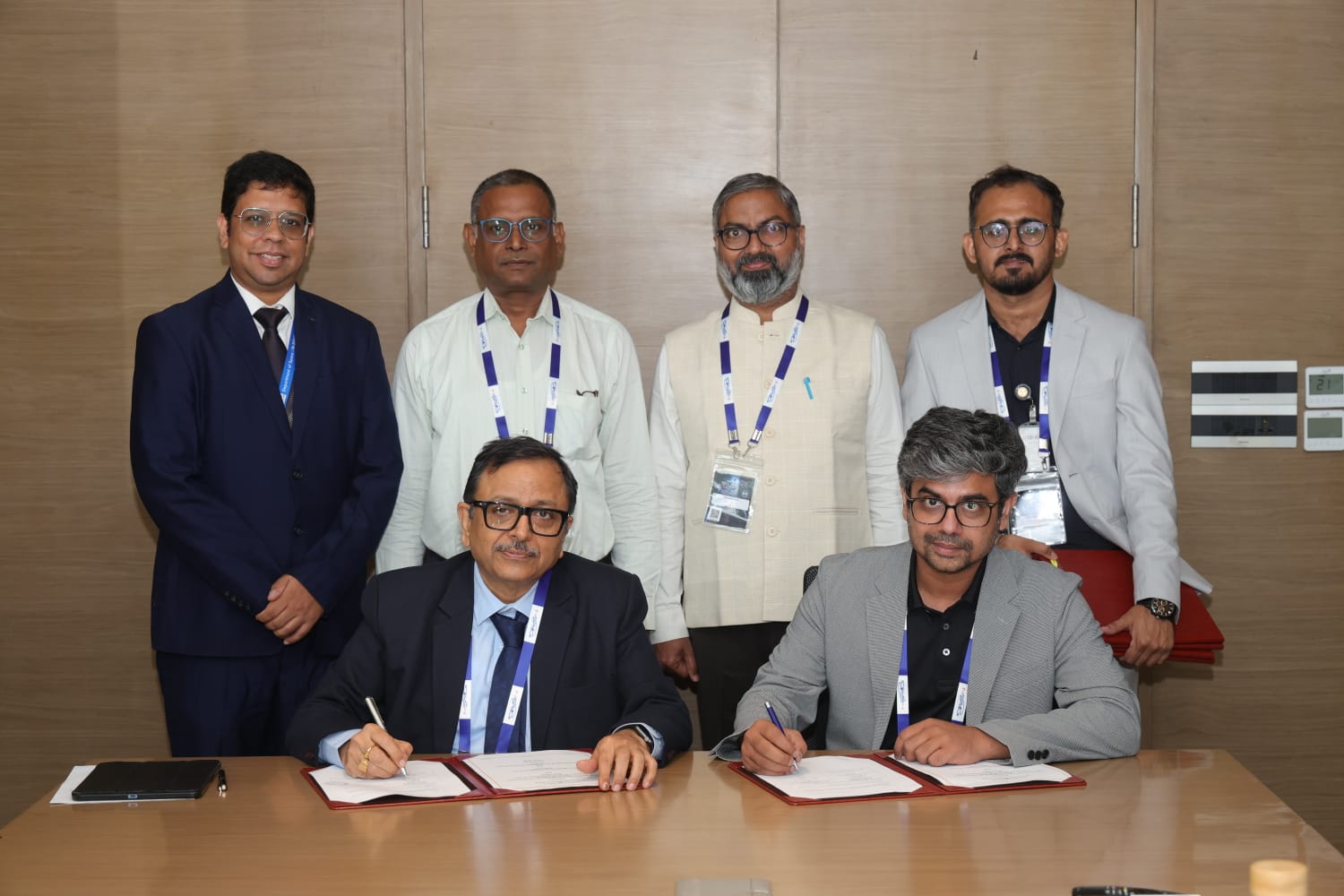
TakeMe2Space (TM2Space), a pioneering deep-tech company building India's first orbital data center infrastructure, today announced it has secured official approval and financial backing under the Indian National Space Promotion and Authorization Centre’s (IN-SPACe) prestigious Technology Adoption Fund (TAF). The strategic funding is dedicated to developing StarSense, India’s first indigenous, artificial intelligence-powered star tracker.
Having already successfully space-qualified its proprietary technology across two distinct orbital missions in 2024, the Hyderabad-based aerospace startup is now focusing its engineering capabilities on ending India's import dependence on one of the most critical subsystems in satellite manufacturing.
Eliminating Foreign Import Reliance in NewSpace Hardware
Star trackers are high-precision electro-optical sensors that serve as the "eyes" of a spacecraft's Attitude Determination and Control System (ADCS). They allow a satellite to determine its exact orientation in deep space by comparing observed star fields against an internal stellar catalog. This system delivers the single-digit arcsecond pointing accuracy that advanced Earth observation imaging, defense reconnaissance, and laser communications missions depend on.
Currently, Indian commercial satellite manufacturers, defense entities, and academic institutions import these critical components almost entirely from manufacturers in the United States and Europe. The StarSense project aims to fundamentally disrupt this dynamic, marking a decisive milestone toward self-reliance in flight-proven, critical space hardware in strict alignment with the Government of India’s Atmanirbhar Bharat vision. The development roadmap follows a structured 24-month timeline, transitioning the system from its current laboratory testing phase to a fully qualified, space-ready flight model.
Meeting the Demands of a Growing Satellite Market
The domestic and international market demand for reliable, accessible attitude determination systems is expanding rapidly. India's space ecosystem is projected to launch approximately 150 satellites over the next three years. Because commercial and defense missions typically require dual-tracker setups for orbital redundancy, the domestic market alone will require at least 300 star trackers in the immediate future.
By replacing expensive imported subsystems with a locally produced, globally competitive alternative, Indian space-tech stakeholders stand to gain immense operational advantages:
Bypassing Restrictive Export Controls: Eliminates the administrative delays and legal hurdles associated with foreign regulatory frameworks like ITAR (International Traffic in Arms Regulations).
Securing the Aerospace Supply Chain: Mitigates the vulnerabilities of global component shortages and international shipping bottlenecks, dramatically accelerating local mission timelines.
Fostering Democratized Access: Provides affordable, high-precision pointing capabilities to early-stage space startups and university small-satellite programs.
Boosting Global Export Potential: Positions India as a highly competitive, trusted international hub for sovereign, cost-efficient subsystem manufacturing.
The Technology: What Makes StarSense Different?
Traditional star trackers rely heavily on legacy geometric star-matching algorithms, which can struggle or fail when blinded by solar radiation, space debris, or high-noise orbital environments. StarSense solves this vulnerability by embedding an artificial intelligence accelerator board directly into its architectural hardware.
To accommodate the diverse requirements of the modern NewSpace landscape, TakeMe2Space is developing two distinct variants of the StarSense platform:
StarSense Lite: Highly optimized for SWaP-C (Size, Weight, Power, and Cost). This model is tailored specifically for the fast-growing CubeSat market, academic research teams, and short-duration low-Earth orbit (LEO) experiments.
StarSense Pro: A high-performance, ultra-precise variant engineered for larger small-satellites and microsatellites weighing over 50 kg that demand stringent, uncompromising pointing knowledge for advanced payloads.
Executive Perspectives on the Space-Tech Breakthrough
“India is on the cusp of an unprecedented satellite boom, but a critical part of every single spacecraft still arrives on a boat or a plane from abroad, often with geopolitical strings attached. With StarSense, our goal is to ensure that every Indian satellite builder—whether it's a student team building a CubeSat or a high-stakes national defense program—can point their spacecraft with world-class accuracy using hardware engineered right here at home. IN-SPACe's backing through the Technology Adoption Fund is a massive vote of confidence in that national mission.”
— Ronak Kumar Samantray, Founder and CEO of TakeMe2Space
“Owning the full hardware stack is not a luxury for what we are trying to build in orbit; it is an absolute operational necessity. Every sovereign subsystem we successfully develop today brings the broader vision of a large-scale orbital data center, completely built and controlled in India, that much closer to reality.”
— Ronak Kumar Samantray, on the 1 GW ODC Vision
A Foundational Building Block for a 1 GW Orbital Data Center
While StarSense addresses immediate commercial market demands, the project serves an even grander purpose within TakeMe2Space’s long-term product roadmap. The deep-tech enterprise is actively working toward establishing a 1 Gigawatt (GW) Orbital Data Center (ODC)—a planned mega-constellation of 20,000 high-performance compute satellites operating in low-Earth orbit.
Building and maintaining digital infrastructure at that unprecedented scale requires complete vertical integration. Developing a sovereign, flight-proven star tracker today secures the critical hardware supply chain required to scale the ODC constellation tomorrow, cementing India's position at the forefront of space-based edge computing.
Technical Specifications Summary
For aerospace engineers, trade media, and satellite constellation managers, StarSense features the following technical baseline:
Primary Function: High-precision electro-optical sensor for satellite Attitude Determination and Control Systems (ADCS), delivering reliable single-digit arcsecond pointing knowledge.
AI Co-Processing Engine: Features an integrated, power-efficient AI accelerator delivering sub-pixel centroid accuracy with high immunity to random cosmic-ray noise spikes and crowded stellar fields.
Hardware Architecture: Utilizes a low-latency, onboard hybrid AI and FPGA (Field Programmable Gate Array) architecture to guarantee real-time telemetry updates during rapid spacecraft maneuvers.
Radiation Hardening: Equipped with advanced opto-mechanical shielding technology designed to protect the internal CMOS image sensor and sensitive logic units from heavy orbital radiation.
Indigenous Optomechanical Supply Chain: The specialized lens assembly is being custom-developed in direct partnership with Hyderabad-based Eon Space Labs, maximizing local sourcing.
About TakeMe2Space
TakeMe2Space (TM2Space) is an Indian deep-tech company dedicated to building accessible, resilient orbital infrastructure. From AI-enabled edge satellites and on-orbit compute clusters to its signature OrbitLab platform, TM2Space allows researchers, academic institutions, startups, and enterprises to deploy and run complex machine learning models directly in space environment configurations. Grounded in the foundational philosophy that space exploration should be open to all innovators, TM2Space continues to lower the barrier to entry for global space-based experimentation.