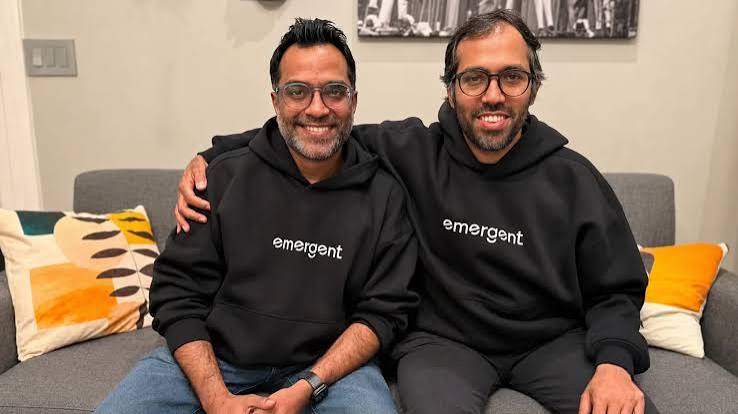
Emergent, co-founded by ex-Amazon scientist, secures major investment from Creaegis, Amazon, and Claypond, pushing valuation to $1.5B.
AI startup Emergent is reportedly finalizing a substantial $200 million funding round, with Creaegis emerging as a lead investor. This move would propel the company's valuation to an estimated $1.5 billion, signaling significant investor confidence in its artificial intelligence capabilities.
Emergent, an AI firm whose co-founder Madhav Jha previously served as an Applied Scientist at Amazon, is making waves in a fiercely competitive market. The nearing of this mega-round underscores a persistent appetite for cutting-edge AI ventures, even as broader tech valuations face increased scrutiny.
Moneycontrol first reported this development on April 9, indicating that Emergent had initiated discussions for the $200 million raise. Creaegis’s prominent role in the round, valuing Emergent at $1.5 billion, highlights a strategic bet on the startup’s future trajectory.
That's a big claim for a company not widely known outside of investor circles, particularly given the recent turbulence in the private market funding landscape for many startups. Achieving a unicorn valuation at this stage raises pointed questions about the specific, perhaps proprietary, technology or market traction driving such optimism.
This development arrives amidst a global surge in AI investments, particularly in generative AI and large language models, echoing the fervent activity seen in regions like the Middle East and Africa. Saudi Arabia’s Public Investment Fund (PIF) recently announced significant commitments to AI infrastructure, while the UAE rapidly positions itself as a regional AI hub with initiatives like the Mohamed bin Zayed University of Artificial Intelligence (MBZUAI). These regional players are actively seeking to cultivate and attract AI talent and companies, making such global deals highly relevant.
For Emergent, a $200 million war chest signals an aggressive expansion strategy is imminent. This capital infusion will likely be directed towards accelerating core R&D, scaling their engineering teams, and potentially exploring new market verticals. Given co-founder Jha's Amazon background, a focus on sophisticated applied AI solutions, perhaps enterprise-grade or platform-oriented, seems a reasonable bet for their direction.
The global AI talent war is fierce, and this funding positions Emergent strongly to compete for top-tier engineers and scientists. Companies across the Middle East and Africa, such as the UAE's G42 or Saudi Arabia's burgeoning tech initiatives like NEOM, are also aggressively recruiting from the same limited pool. Emergent's new valuation could make it an attractive destination for those looking for significant impact and substantial equity.
This $1.5 billion valuation for Emergent is a powerful data point in a market where many are still debating "AI winter" versus "AI summer" narratives. It suggests that genuine innovation and perceived disruptive potential, even in nascent stages, can still command premium multiples. Investors like Creaegis are clearly betting on long-term transformative impact, not just immediate revenue streams.
The Middle East and Africa region watches these global funding rounds closely, often as a benchmark. Local VCs and sovereign wealth funds are increasingly active in AI, seeking to replicate such successes or invest directly in promising ventures. The PIF's recent significant commitment to AI and semiconductor investments, for example, highlights a clear strategy to become a significant global player. It's not just about local startups; it's about attracting and fostering AI powerhouses globally.
Governments across the Gulf and parts of Africa view AI as a critical pillar for economic diversification and future competitiveness, moving beyond traditional resource-based economies. From ambitious smart city initiatives in NEOM to AI-driven healthcare in Dubai, the ambition is palpable. Funds flowing into companies like Emergent reinforce the narrative that AI is not a luxury technology, but a strategic imperative for national development.
Despite the prevailing optimism, AI startups, whether global or regionally focused, face unique challenges that even large funding rounds don't automatically solve. Data availability and quality can be a persistent issue, especially for models requiring diverse and large datasets. In regions like MEA, localization for language and cultural nuances adds another layer of complexity that well-funded companies like Emergent will need to navigate if they eye true global expansion and adoption.
The AI landscape is incredibly crowded and competitive. Emergent will need to demonstrate clear differentiation beyond just a substantial funding round. What proprietary technology, unique architectural approach, or specific market insight justifies a $1.5 billion valuation and the associated expectations? Competitors, both established tech giants and other well-funded startups, are constantly pushing the boundaries of what's possible in AI. That's the real test of this investment.
As AI models become more powerful and pervasive, regulatory scrutiny is intensifying globally. Discussions around AI ethics, bias mitigation, and data privacy are paramount, moving rapidly from academic discourse to legislative action. Companies like Emergent will operate under a growing microscope, especially if their solutions touch sensitive sectors. This is a developing area, with regions like the EU leading the charge, but MEA countries are also beginning to form their own frameworks, adding another layer of operational complexity.
For its investors, the long-term vision for Emergent is critical. Is it being positioned as an eventual acquisition target for tech giants—perhaps even Amazon, given co-founder Jha's prior tenure there? Or does it aim for an independent IPO, building a standalone public company? The current funding round sets an exceptionally high bar for future growth and exit potential, demanding a crystal-clear roadmap for sustained innovation and deep market penetration.
The significant valuation and investment secured by Emergent will undoubtedly influence regional investment strategies across the Middle East and Africa. Local VCs might become more aggressive in their own AI bets, seeking to identify and back the "next Emergent" within their domestic ecosystems. This could lead to a more robust, albeit often smaller-scale, funding environment for African and Middle Eastern AI startups, though often with smaller cheque sizes initially.
While the specific domain Emergent targets remains somewhat opaque, AI's impact is sector-agnostic. From optimizing oil and gas operations in Saudi Arabia to driving fintech innovation in Egypt, and enhancing agricultural yields in Kenya, the demand for specialized AI solutions is immense. A successful Emergent could inspire and validate more targeted AI ventures across these diverse industries, customized specifically for regional needs and challenges.
The role of "ex-FAANG" founders, like Madhav Jha's Amazon background, continues to be a powerful narrative in tech funding. Investors often gravitate towards founders with experience at major tech companies, believing they bring a proven track record of execution, an understanding of scale, and an invaluable network. This trend is also observed in the MEA region, where founders with international experience are often highly sought after by local and regional VCs.
Such a successful raise also opens avenues for potential cross-border collaboration, perhaps even extending into the MEA region. Middle Eastern entities, flush with sovereign capital and a mandate for technological advancement, might seek strategic partnerships or direct investments in promising global AI firms to accelerate their own national AI agendas. This could mean Emergent eventually finding strategic partners, or even significant clients, within the Gulf's rapidly expanding tech ecosystem.
The fundamental market dynamics for AI are not just about building technically superior models; they are about market penetration, user adoption, and defensibility. Emergent's challenge will be to translate this substantial capital into a truly defensible position against well-entrenched incumbents and other well-funded challengers. This involves not just technological superiority but also astute strategic partnerships, effective go-to-market execution, and a deep understanding of customer pain points.
The tech world will be watching closely to see if Emergent can convert this substantial financial backing and lofty $1.5 billion valuation into tangible, disruptive AI products and a sustained, meaningful market presence. The bar has been set exceptionally high. Now, the real work of building enduring value and proving out that valuation truly begins.
Frequently asked questions
Who is investing in AI startup Emergent?
AI startup Emergent is receiving investments from Creaegis as a lead investor, along with Amazon, Ranjan Pai's Claypond, and other undisclosed parties. This funding round is substantial.
What is Emergent's estimated valuation after this fundraise?
Emergent's valuation is estimated to reach $1.5 billion following this $200 million funding round. This significant valuation reflects strong investor confidence in its AI capabilities.
Who is Madhav Jha, Emergent's co-founder?
Madhav Jha, co-founder of Emergent, previously held a position as an Applied Scientist at Amazon. His background highlights the company's strong technical foundation in artificial intelligence.
What kind of company is Emergent?
Emergent is an artificial intelligence (AI) firm. The company is focused on developing and leveraging AI capabilities, attracting significant investment in the tech sector.
Why is this fundraise significant for Emergent?
This $200 million fundraise is significant for Emergent as it propels the company's valuation to an estimated $1.5 billion, signaling robust investor confidence and providing substantial capital for growth and development in the competitive AI market.
What is the total amount of funding Emergent is nearing?
Emergent is reportedly nearing a substantial $200 million funding round. This substantial investment is set to finalize with key investors like Creaegis, Amazon, and Claypond.