DeepMind CEO's groundbreaking claim about AGI's impact sparks global debate, presenting a monumental opportunity for India's tech ecosystem.
DeepMind CEO Demands AGI Rethink, Posing a Monumental Challenge and Opportunity for India
Assertions regarding Artificial General Intelligence (AGI) being more profound than electricity or fire have prompted a global recalibration of AI's ultimate impact.
For the Indian startup ecosystem, the potential of AGI shifts the conversation from merely adopting AI tools to aspiring for foundational breakthroughs, demanding a strategic pivot in investment and innovation.
Assertions have been made that Artificial General Intelligence (AGI) could be a discovery more profound than electricity or fire, challenging conventional wisdom about technology's future. Such statements, emanating from leading AI research, signal a profound shift in how AI's potential must be conceived, moving beyond incremental advancements to contemplate a truly transformative force. For founders and investors across South and Southeast Asia, this isn't just news; it's a call to re-evaluate long-term strategies. The conventional understanding of AI, particularly in rapidly digitizing economies like India, has largely centered on its utility as a powerful tool. AI is seen as an enabler for automation, an enhancer of efficiency, and a driver for personalized services across sectors from fintech to healthcare. India's vibrant startup scene has excelled at applying existing AI models to solve local problems, creating significant value and attracting significant venture funding for these application-layer innovations. Its strength has been in leveraging rather than necessarily pioneering foundational AI research. However, the emerging perspective forces us to confront a different reality: AGI as a new epoch in human history, fundamentally reshaping society, economy, and even human potential. This isn't about better search algorithms or more accurate diagnostics; it's about creating systems that can learn, understand, and apply intelligence across a broad range of tasks, potentially surpassing human cognitive abilities. My read is that this isn't merely an upgrade; it's a redefinition of what technology means. For the Indian startup ecosystem, this redefinition brings both immense challenge and an unparalleled opportunity. While global tech giants like DeepMind, backed by Alphabet, command vast resources and decades of research, the quest for AGI is still in its nascent stages globally. What started as a small idea in a lab could indeed become the most impactful innovation ever, and India has a crucial role to play, not just as a consumer market but as a contributor to this foundational shift. The building phase for Indian entrepreneurs, traditionally focused on market-driven solutions, must now incorporate a long-term vision that considers AGI's implications. This means fostering deeper research capabilities, encouraging riskier, more ambitious projects, and building partnerships with academia and global research hubs. India possesses an unparalleled talent pool, particularly in engineering and mathematics, which could be channeled towards solving the complex, multi-disciplinary problems inherent in AGI development. Furthermore, India's diverse data landscape and unique societal challenges offer fertile ground for developing and testing AGI solutions that are robust and equitable. The current state of AI innovation in India, while robust in application, has yet to fully embrace the foundational research required for AGI. While Indian startups have collectively raised significant funding in recent years, a significant portion has flowed into SaaS, e-commerce, and enterprise solutions leveraging existing AI frameworks. This is a critical gap that needs to be addressed. The vision for India should not just be to adopt AI, but to actively participate in shaping the future of intelligence itself. This would involve a deliberate shift in venture capital priorities, encouraging more "deep tech" investments that may have longer gestation periods but promise exponentially larger returns. Connecting this to the broader trend line, countries like the US and China are already making massive strategic investments in foundational AI research, viewing it as a matter of national competitiveness and future economic dominance. India, with its demographic dividend and burgeoning digital economy, cannot afford to be a passive observer. It needs to cultivate an environment where moonshot projects in AI are celebrated and funded, where the next generation of Indian scientists and engineers feel empowered to tackle problems of this magnitude. The impact of AGI, if realized, promises to be transformative beyond imagination. Imagine personalized education systems that adapt perfectly to every child, medical breakthroughs that eradicate diseases, or sustainable energy solutions that could revolutionize our planet. For India, this could mean leapfrogging development hurdles, democratizing access to advanced capabilities, and establishing itself as a global leader in the defining technology of the 21st century. This moment calls for bold thinking from Indian founders, strategic foresight from investors, and proactive policies from the government. Aspiring entrepreneurs in India should look beyond immediate market needs and dare to dream of building the foundational technologies that will shape humanity's future. By embracing the challenge of AGI, India has the potential to move from a tech-adopter to a tech-pioneer, creating an innovation legacy that truly rivals the impact of electricity or fire. ```
Frequently asked questions
What did the DeepMind CEO say about AGI?
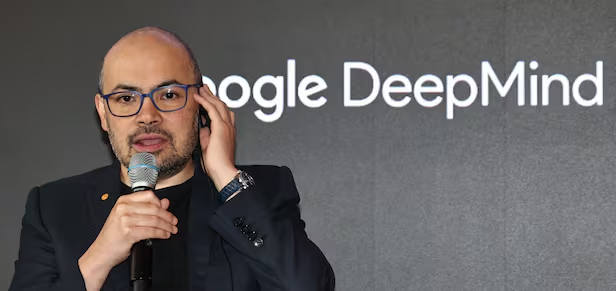
DeepMind CEO Demis Hassabis asserted that Artificial General Intelligence (AGI) will have a greater impact on humanity than foundational inventions like electricity or fire. This statement underscores the monumental potential and transformative power of advanced AI.
How will AGI impact India's startup ecosystem?
AGI shifts the focus for India's startup ecosystem from merely adopting AI tools to aspiring for foundational advancements and leading in global AI development, creating new opportunities.
Is AGI real or hypothetical?
AGI is currently hypothetical, representing AI that can understand, learn, and apply intelligence across a wide range of tasks, similar to human cognitive abilities.
Who is the CEO of DeepMind?
The CEO of DeepMind is Demis Hassabis.
What is the difference between AI and AGI?
AI (Artificial Intelligence) refers to machines mimicking human cognitive functions, while AGI (Artificial General Intelligence) is a hypothetical AI that can perform any intellectual task a human can.
Why is AGI considered a monumental challenge?
AGI is considered a monumental challenge due to the immense complexity involved in replicating human-level intelligence, requiring breakthroughs in learning, reasoning, and consciousness, as well as ethical considerations.