xAI's Grok 4.5 enters the AI coding market, promising "Opus-class" performance at a fraction of the cost, intensifying the race for developer API spend.
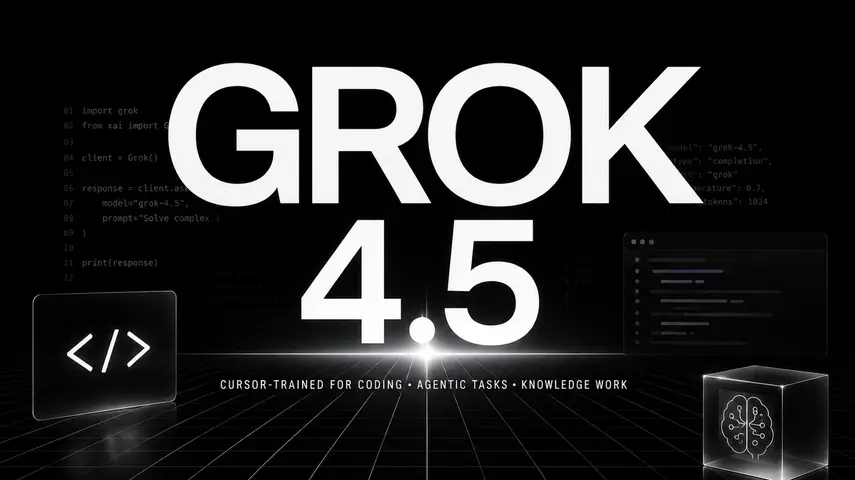
xAI has entered the highly competitive AI coding assistant market with the launch of Grok 4.5, positioning its new frontier model as a significantly more cost-effective alternative to established players. The model, which Musk claims is "Opus-class," began shipping on July 8, 2026, priced at a fraction of Anthropic's Claude Opus 4.8, immediately intensifying the race for developer API spend.
Grok 4.5 is integrated directly into Cursor, the coding tool that xAI credits with helping train the model. This distribution strategy signals a clear focus on developer workflows and integrated development environments rather than a general consumer chatbot update.
The key differentiator for Grok 4.5 lies in its aggressive pricing structure. xAI has set the API rate at $2 per million input tokens and $6 per million output tokens, a substantial reduction compared to its primary benchmark, Anthropic's Claude Opus 4.8. Grok 4.5's output token cost is a fraction of what Anthropic charges for Claude Opus 4.8.
What Grok 4.5's Pricing Means for the AI Market
This aggressive pricing from xAI signals a significant acceleration in the commoditization of high-performance AI models, particularly in specialized domains like coding. Developers and enterprises now face a compelling proposition to shift their API budgets towards solutions offering comparable capabilities at a fraction of the operational cost, potentially driving down average revenue per user (ARPU) across the sector. The move could also compel other major AI players, including OpenAI and Google, to reassess their own pricing strategies and model efficiency.
The launch further intensifies the underlying "AI infrastructure war," where venture capital and technology giants are pouring billions into compute and model development. As core AI capabilities become more affordable, the competitive edge will increasingly shift towards specialized applications, ease of integration, and demonstrable real-world efficiency beyond raw token counts. This dynamic encourages a faster adoption cycle for AI-powered developer tools, potentially unlocking new productivity gains across software development lifecycles.
Grok 4.5 offers significantly lower output token costs compared to Claude Opus 4.8, pricing at $6 per million output tokens.
Grok's Ascent in the Specialized Coding Race
Grok 4.5 marks a strategic pivot for xAI from its previous general chat and reasoning benchmarks to a highly specialized focus on coding, agentic tasks, and knowledge work. This evolution aligns with a broader industry trend where foundational models are being refined and optimized for specific enterprise use cases, moving beyond broad conversational AI to address concrete productivity challenges. The model's training alongside Cursor, a dedicated coding tool, underscores this targeted development approach.
Elon Musk described Grok 4.5 on X as “an Opus-class model, but faster, more token-efficient and lower cost.” This suggests a focus on speed and efficiency alongside capability, addressing critical pain points for developers in interactive coding environments.
The Intensifying Competitive Landscape and Price Pressure
The coding AI market is already crowded, with established players like GitHub Copilot and Anthropic's Claude Code. Grok 4.5's entry creates significant pressure on existing offerings.
This aggressive pricing strategy will likely force rivals to either match xAI's cost efficiency, differentiate through superior benchmark performance, or develop highly specialized features that justify a premium price. The emphasis on "token efficiency" further compounds Grok 4.5's value proposition, suggesting that raw pricing might only tell part of the total cost of ownership story for developers.
Investors and developers will closely watch for independent verification of xAI's performance and efficiency claims, particularly how Grok 4.5 holds up under real-world coding workloads beyond synthetic benchmarks. The pace of developer adoption and any retaliatory pricing or feature announcements from Anthropic, OpenAI, or Google will be key indicators of how this market disruption plays out in the coming quarters.
Frequently asked questions
What is Grok 4.5?
Grok 4.5 is xAI's new AI coding assistant model, launched in July 2026. It's designed to be an "Opus-class" competitor, offering significant cost savings compared to other advanced models like Claude Opus.
How much cheaper is Grok 4.5 than Claude Opus?
Grok 4.5 undercuts Claude Opus by 76%, positioning itself as a highly cost-effective alternative for developers.
When did Grok 4.5 launch?
Grok 4.5 began shipping on July 8, 2026.
Who developed Grok 4.5?
Grok 4.5 was developed by xAI, Elon Musk's AI company.
What is the main benefit of Grok 4.5 for developers?
The main benefit is its combination of "Opus-class" performance with a significantly lower price point, making advanced AI coding assistance more accessible.
What market is Grok 4.5 targeting?
Grok 4.5 is targeting the highly competitive AI coding assistant market, specifically aiming for developer API spend.