The Volkswagen Group, owner of Audi and Porsche, considers shedding 100,000 jobs and closing factories amid a major industry shift.
The Volkswagen Group, a titan of global automotive manufacturing and steward of brands like Audi and Porsche, is reportedly considering drastic measures that include shedding up to 100,000 jobs and shuttering factories. This potential restructuring signals a profound shift in the competitive landscape, where even established giants must fundamentally rethink their operational footprint to navigate the capital-intensive transition to electric vehicles and software-defined mobility, with significant implications for its valuation and long-term market position.
While specific timelines and locations remain undefined, the proposed scale of job reductions underscores the immense pressure on Volkswagen's profitability and efficiency. The automotive conglomerate, known for its extensive global production network and complex corporate structure, faces escalating costs associated with developing new electric platforms, sophisticated software systems through its Cariad unit, and securing critical battery supply chains. These investments are increasingly difficult to absorb within its traditional operational framework, which is heavily geared towards internal combustion engine (ICE) vehicle production and a dense, often redundant, corporate hierarchy.
The imperative for such sweeping changes stems from a confluence of factors, including intense competition from agile new entrants like Tesla and a burgeoning cohort of Chinese EV manufacturers. These rivals often operate with significantly leaner cost structures and a native digital-first approach to vehicle architecture. Volkswagen's historical advantage in scale and engineering prowess is now challenged by the speed and efficiency of these competitors, forcing a re-evaluation of every aspect of its manufacturing and development processes. The proposed job cuts and factory consolidations are not merely about trimming fat, but about fundamentally re-engineering the company's industrial DNA for a different future.
What It Means
For Volkswagen, this rumored restructuring represents a critical juncture that will define its trajectory in the rapidly evolving automotive sector. The sheer scale of potential job losses and factory closures, particularly within its home market of Germany, indicates a strategic pivot away from incremental adjustments towards a more radical overhaul. From my perspective, as someone observing the tech and product shifts in industries, this move highlights the deep structural challenges that legacy automakers face when trying to pivot from hardware-centric engineering to software-defined products.
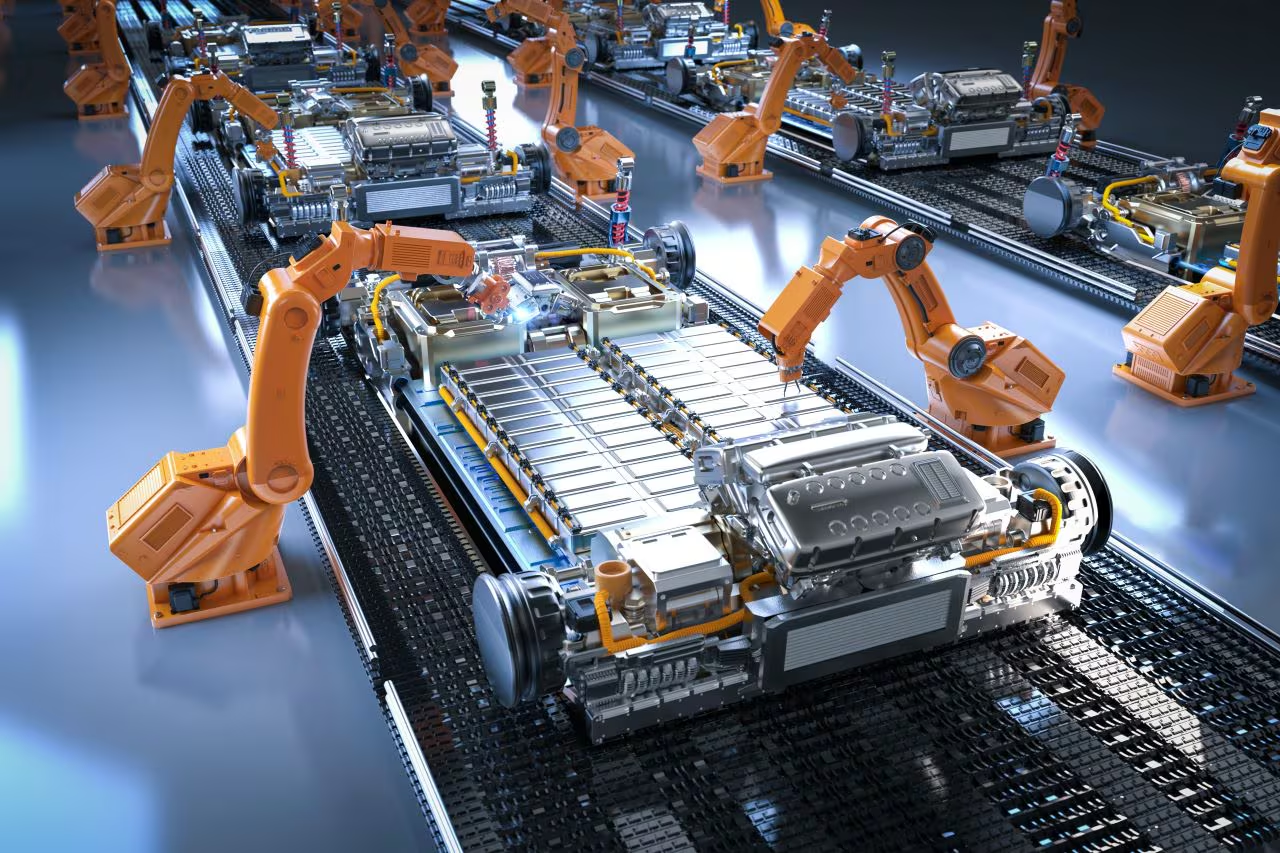
The core tension here is between the existing, highly efficient but ICE-optimized production infrastructure and the emergent requirements of EV manufacturing, which often demands new types of automation, different supply chain logistics, and a significantly smaller, more digitally-focused workforce per vehicle. Furthermore, the company's well-documented struggles with its Cariad software division illustrate that the problem isn't just hardware. It's an entire ecosystem shift that requires different talent, organizational structures, and speed of execution, areas where traditional automotive behemoths often struggle due to entrenched processes and powerful labor representation.
€20 Billion
Volkswagen aims to achieve €20 billion in cost savings by 2026 across its various brands and operational units, with a significant portion targeted at reducing administrative and production overhead.
The Context
Volkswagen's history is replete with moments of industrial transformation, from its post-war rebuilding to its global expansion and leadership in the diesel era. However, the current shift to electric mobility and digitalization presents an unprecedented challenge, requiring capital investments estimated to be in the tens of billions of euros annually across the industry. The company has already embarked on various efficiency programs, including its "Future Pact" for the Volkswagen brand, aimed at reducing costs and boosting productivity. Yet, these measures have seemingly been insufficient to counter the combined pressures of escalating EV development costs, intense price competition, and global economic headwinds.
The automotive industry globally has been grappling with overcapacity and the need for significant retooling of factories designed for ICE vehicles. Germany, in particular, with its strong labor unions and co-determination laws, makes large-scale workforce reductions and plant closures exceedingly complex and often protracted. The powerful works councils, representing employee interests, typically have significant influence over strategic decisions, meaning any proposed cuts would involve extensive negotiations and potential social plans to mitigate the impact on affected workers and regions. This institutional complexity can often slow down the pace of necessary restructuring compared to less regulated markets.
What Analysts Say
Analysts have consistently pointed to Volkswagen's complex multi-brand structure and relatively high fixed costs as impediments to achieving the agility required for the EV transition. The company's diverse portfolio, while offering market breadth, also brings inherent inefficiencies in platform sharing and software integration, particularly when compared to more vertically integrated competitors. My read is that much of the market’s skepticism around legacy automakers revolves around their ability to untangle these complexities without sacrificing brand identity or market share during the pivot. The pressure on profitability at brands like the core Volkswagen passenger cars, and even Audi, necessitates deeper intervention than previously considered.
The ongoing struggle with Cariad, the group's software unit, has become a litmus test for Volkswagen's ability to transform into a tech-driven company. Delays and budget overruns at Cariad have directly impacted key product launches, including critical models from Porsche and Audi, underscoring the deep integration required between hardware and software in modern vehicles. These challenges highlight that job cuts alone will not solve the underlying technological and organizational hurdles; a fundamental change in culture and competency is equally, if not more, crucial.
The prospect of significant job cuts and factory closures, while painful, is often viewed by investors as a necessary evil for a company of Volkswagen's size to regain competitive edge and improve its valuation multiples. However, the execution risk remains high, particularly given the strong social contracts in Germany. The true success of such a strategy will depend not just on the number of jobs cut, but on how effectively Volkswagen reallocates resources, reskills its remaining workforce, and accelerates its software and EV roadmap in a genuinely integrated manner.
Investors will be closely watching for any official statements or concrete proposals emerging from Volkswagen's supervisory board and management team in the coming months. Key dates include upcoming earnings calls, which may provide further details on cost-cutting initiatives and capital expenditure plans, alongside any negotiations with works councils on employment security agreements. The outcome of these discussions will be a critical trigger for market sentiment regarding Volkswagen's ability to navigate its profound industrial transformation.
Frequently asked questions
What layoffs is Volkswagen Group considering?
Volkswagen Group is reportedly considering cutting up to 100,000 jobs globally and shutting down factories as part of a major restructuring effort across its brands, including Audi and Porsche.
Which brands are affected by Volkswagen's potential job cuts?
The potential job cuts and factory closures by the Volkswagen Group would affect its various brands, notably Audi and Porsche, among others within its portfolio.
Why is Volkswagen Group considering such drastic measures?
Volkswagen Group is re-evaluating its operational footprint and considering restructuring measures to adapt to a changing competitive landscape and navigate current economic pressures in the automotive industry.
How many jobs could Volkswagen potentially cut?
Volkswagen Group is reportedly considering shedding up to 100,000 jobs worldwide as part of its potential restructuring plans.
Will Volkswagen shut down factories?
Yes, alongside potential job cuts, the Volkswagen Group is reportedly considering the closure of some of its factories globally.
What is the Volkswagen Group?
The Volkswagen Group is a German multinational automotive manufacturing corporation that designs, manufactures, and distributes passenger and commercial vehicles, motorcycles, engines, and turbomachinery, and provides related services, owning brands like Audi and Porsche.