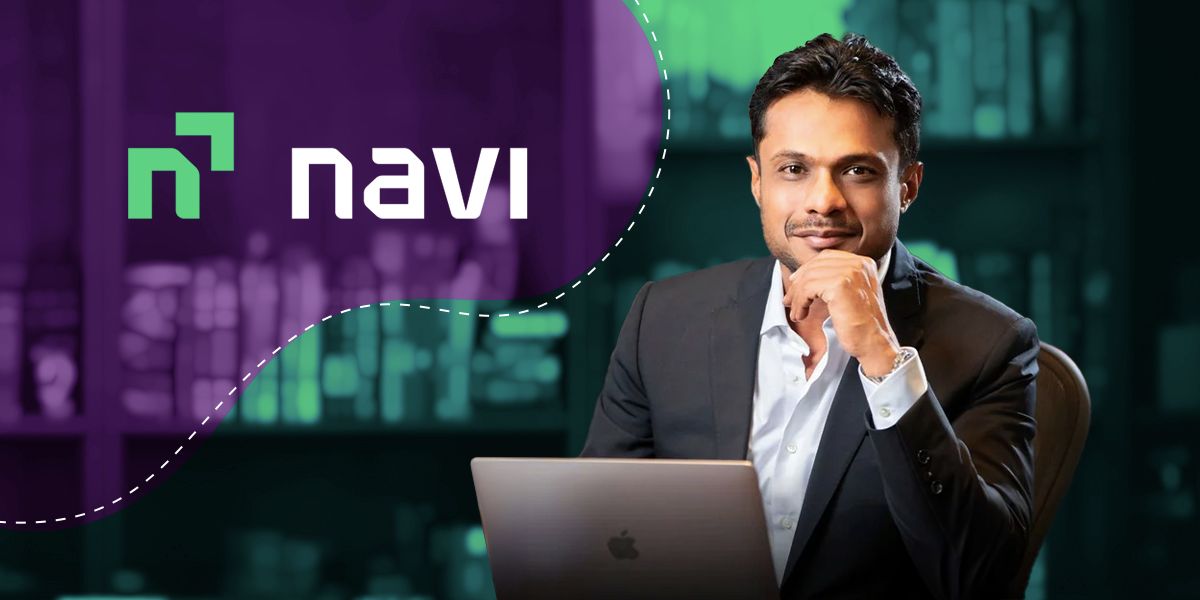
Flipkart co-founder Sachin Bansal's fintech venture, Navi Technologies, eyes significant capital injection from prominent investors for growth.
The murmurs from Bengaluru suggest that Navi Technologies, the ambitious fintech venture helmed by Flipkart co-founder Sachin Bansal, is nearing a significant capital injection. Reports indicate discussions for a $250-300 million private funding round at a post-money valuation of $1.8-2 billion, with prominent names like Prosus and Accel Growth Fund potentially leading the charge. This news, on the surface, might be interpreted by some as a straightforward validation of a high-profile founder’s latest endeavor, signaling robust growth and investor confidence in a dynamic market.
However, a deeper dive into Navi’s trajectory reveals a more intricate narrative, challenging the conventional wisdom that a founder of Bansal's stature can simply conjure capital and scale without confronting the same market realities as any other enterprise. While the headline figures are substantial, they represent not just a funding event, but a strategic recalibration for Navi, marked by pivots, regulatory encounters, and a shift in capital-raising philosophy.
For nearly two years, Navi had been on a different path, preparing for an initial public offering (IPO). The company secured Sebi’s approval for a Rs 3,350 crore IPO in September 2022. This public market ambition, often seen as the ultimate hallmark of a mature, well-governed enterprise ready for broader investor scrutiny, ultimately did not materialize. Previous attempts at private fundraising, including discussions in April 2024 for a $200-300 million round at a similar $2 billion valuation, also did not come to fruition. This current round, if successful, would mark the first external equity capital raised for Navi, a venture Bansal has largely self-funded, maintaining a significant majority stake. This extended period of self-reliance, while admirable in its display of founder conviction, also underscores the challenges in attracting institutional equity under previous market conditions.
The shift from an IPO-centric strategy to a private capital raise is particularly telling in the current global economic climate. The exuberance that characterized the tech IPO market a few years ago has largely dissipated. Investors in public markets now demand a clearer path to profitability, sustainable unit economics, and a demonstrated ability to navigate regulatory complexities, often valuing consistency and resilience over sheer growth potential. For many tech companies, the public market window has narrowed, making private rounds an increasingly pragmatic alternative for growth capital, even at valuations that might not represent a significant step-up from previous internal assessments. My read is that this move by Navi reflects a pragmatic response to these market dynamics, prioritizing expansion and operational solidity over the immediate liquidity and validation of a public listing.
Navi’s operational journey has also been far from linear. The company faced a significant regulatory hurdle in October 2024 when the Reserve Bank of India (RBI) directed Navi Finserv, its lending arm, to cease sanctioning and disbursing loans. The RBI cited "supervisory concerns," including excessive pricing, a critical red flag in the sensitive digital lending ecosystem. While these restrictions were lifted in December 2024 after Navi revamped its processes and systems, this episode highlights the intensified scrutiny faced by fintech lenders. It underscores the imperative for robust governance, transparent practices, and adherence to evolving regulatory frameworks – factors that prospective investors like Prosus and Accel would undoubtedly scrutinize closely. The ability to navigate and address such regulatory challenges is, in my opinion, a more profound indicator of operational maturity than mere growth numbers.
The company’s financials present a mixed picture, typical of ambitious growth-stage ventures. Navi Finserv, the lending arm, reported strong performance: operating revenues of Rs 654 crore for Q3 FY25 (up 14% year-on-year) and a net profit of Rs 75.5 crore (up 21.7%). For FY26, Navi Finserv’s net profit rose 32% to Rs 292 crore, with operating revenues at Rs 2,461 crore. This segment demonstrates healthy growth and profitability. However, Navi Limited, the broader group entity, reported a net loss of Rs 126.3 crore in FY25, a reversal from a profit of Rs 168.9 crore in FY24. This divergence between the profitable lending arm and the broader group's loss signals the ongoing investment in other business verticals – personal loans, home loans, loans against property, health insurance, mutual funds, and UPI-based payments – as Navi strives to build a comprehensive financial services platform. It also indicates the capital-intensive nature of such an integrated strategy, where the profitability of one segment might be offset by investments in others.
Sachin Bansal’s decision to shelve Navi’s IPO for a $250–300 million private round is a pragmatic escape from public market scrutiny, but the intended Southeast Asian expansion warrants heavy skepticism. While exporting an India-honed digital lending playbook sounds compelling on paper, it is a high-risk gamble. Markets like Indonesia and Vietnam possess fundamentally different regulatory architectures, credit behaviors, and local incumbents. Simply copy-pasting a tech stack rarely guarantees cross-border success. Furthermore, Navi is still recovering from recent RBI interventions and must continue proving its compliance resilience at home. At a projected $2 billion valuation, investors are pricing in flawless execution. However, by chasing international horizons before fully cementing domestic dominance, Navi risks spreading its operational bandwidth dangerously thin.
The pursuit of private capital is not Navi’s only fundraising avenue. The company has also been active in the debt market, raising Rs 170 crore through non-convertible debentures (NCDs) in July 2025 and Rs 950 crore in 2024. Significantly, Bansal himself is reportedly raising debt on a personal guarantee to invest further into the lending business. This move is a powerful statement of conviction and commitment. In the venture capital landscape, a founder putting their personal wealth and credit on the line for their enterprise sends a strong signal to potential investors about their belief in the company's future. It de-risks the equity investment to some extent, demonstrating that the leadership is deeply aligned with the company's success and willing to bear personal financial exposure.
The stated purpose of the potential funding round – to expand Navi’s lending business into Southeast Asia – adds another layer of strategic intent. Southeast Asia is a region ripe with opportunity for digital financial services, characterized by large unbanked and underbanked populations, increasing digital penetration, and a burgeoning middle class. However, it is also a fragmented market with diverse regulatory landscapes, consumer behaviors, and competitive environments. Success will require a nuanced understanding of local markets, significant investment in localized technology and talent, and the ability to navigate varying compliance requirements. Navi's strong performance in the Indian lending market, with Rs 3,000-4,000 crore in monthly disbursals, provides a credible foundation, but cross-border expansion in fintech is notoriously complex and resource-intensive. This move positions Navi against a backdrop of regional fintech players and global entrants vying for market share, making execution critical.
The rebranding of Navi Technologies to Navi Limited in August 2025, along with leadership changes that saw Bansal become executive chairman and new CEOs appointed for Navi Finserv and Navi Technologies, reflects a deliberate evolution from a technology-focused entity to a broader financial services platform. This organizational restructuring is a common step for maturing startups aiming to professionalize leadership and deepen domain expertise in various business units. It suggests a move towards a more distributed leadership model, essential for scaling a multi-product financial services entity and preparing it for sustained growth. This structural shift, alongside the strategic capital raise, indicates a concerted effort to fortify the company for its next phase of expansion.
In conclusion, the potential $250-300 million funding round for Navi Technologies is more than just a capital infusion; it's a strategic recalibration for a company that has navigated IPO aspirations, regulatory challenges, and significant internal investment. It signals a pragmatic pivot to private markets in a changed economic climate, a deep personal commitment from its founder, and ambitious plans for regional expansion. For investors, this round represents an opportunity to back a seasoned entrepreneur in a high-growth sector, albeit one with inherent regulatory complexities and intense competition. The true measure of this transaction will be in Navi's ability to translate this fresh capital into sustainable, compliant growth, particularly as it ventures into the diverse markets of Southeast Asia.
Frequently asked questions
Who is Sachin Bansal and what is Navi?
Sachin Bansal is the co-founder of Flipkart and currently leads Navi Technologies, a fintech venture focusing on financial services.
How much funding is Navi Technologies looking to raise?
Navi Technologies is reportedly in discussions to raise between $250 million and $300 million in private funding.
Which investors are potentially leading Navi's funding round?
Prominent investors like Prosus and Accel Growth Fund are indicated as potential leaders for Navi's latest funding round.
What is Navi Technologies' estimated post-money valuation?
The funding round is being discussed at a post-money valuation ranging from $1.8 billion to $2 billion.
What industry does Navi Technologies operate in?
Navi Technologies operates in the fintech industry, offering various financial services.
Where is Navi Technologies primarily based?
Navi Technologies is based in Bengaluru, India, a major hub for technology startups.