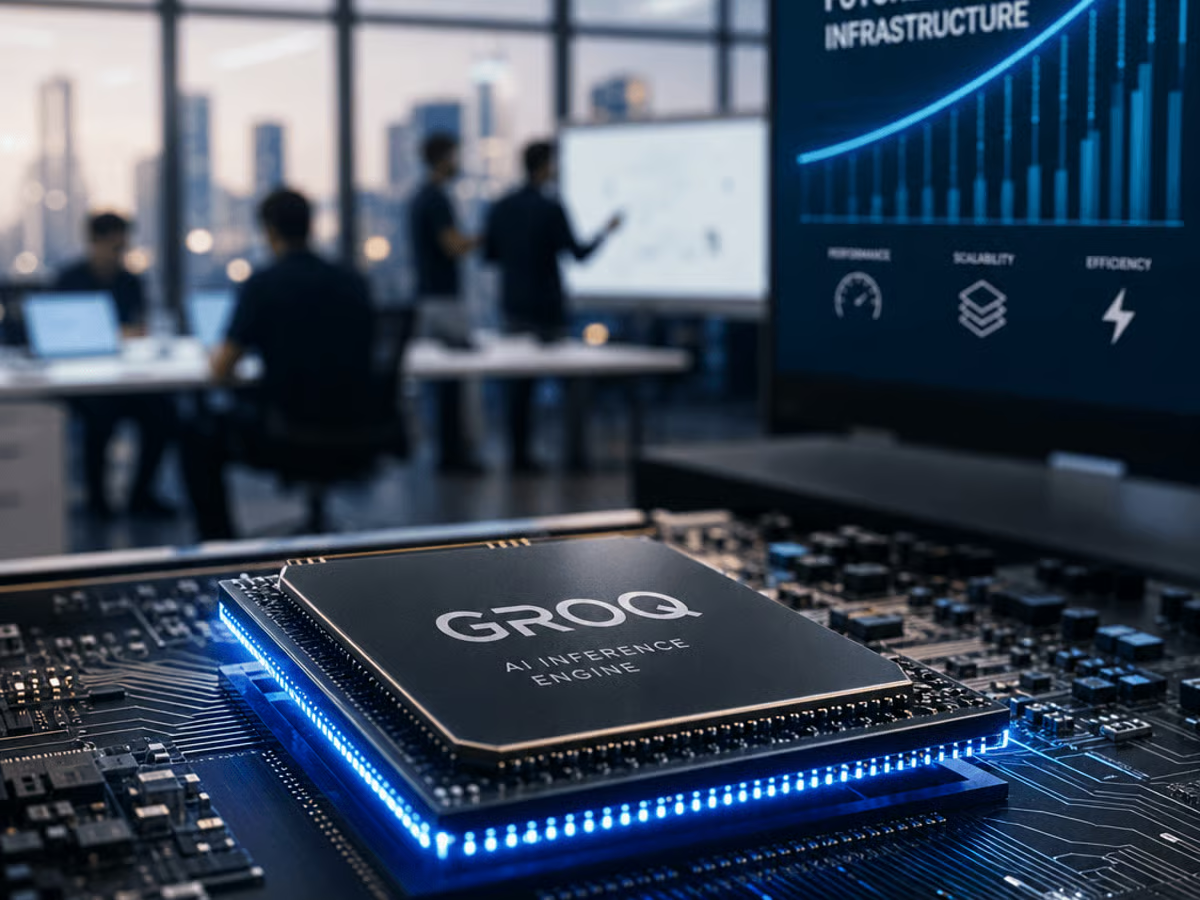
Groq secures $650M to accelerate its unique approach in the intense race to build the fastest, most efficient artificial intelligence.
The race to build the fastest, most efficient artificial intelligence is heating up, and a US-based AI chip and cloud company just secured a massive war chest to accelerate its mission. Groq, a startup that has been quietly making waves with its unique approach to AI computation, has announced a staggering $650 million funding round, a move that signals serious investor confidence in the future of specialized AI hardware.
This isn't just another tech funding announcement; it's a significant infusion of capital into a company positioning itself as a formidable challenger in the fiercely competitive AI hardware landscape, currently dominated by Nvidia. The fresh capital, which reportedly values Groq at over $1 billion, aims to supercharge its efforts to deliver high-speed, low-latency AI inference capabilities directly to businesses and cloud providers, potentially reshaping how we interact with large language models and other AI applications.
For regular people, this matters because it could mean a future where AI chatbots respond faster, AI-powered tools become more affordable for small businesses, and new, more complex AI applications become feasible. Groq's core technology revolves around its Language Processing Unit (LPU), a custom-built chip architecture designed from the ground up to handle the specific demands of AI workloads, particularly inference, which is the process of running an already trained AI model to generate predictions or responses. Unlike traditional GPUs, which are general-purpose parallel processors, Groq's LPU is optimized for sequential processing, allowing for extremely high throughput and low latency, crucial for real-time AI applications.
The company also offers a full-stack solution, combining its powerful LPU chips with a sophisticated software platform and cloud services. This integrated approach is designed to simplify deployment for developers and enterprises, providing an end-to-end solution that promises not just speed but also ease of use. This holistic strategy is a direct response to the complexity and cost often associated with deploying advanced AI models, particularly large language models (LLMs), which demand immense computational resources.
Groq's promise lies in its ability to deliver inference at unprecedented speeds and efficiency, directly tackling one of the biggest bottlenecks in the current AI ecosystem. While much of the industry's focus and investment has been on AI training—the process of teaching models using vast datasets—the actual deployment and real-time use, or inference, of these models is where the rubber meets the road. As LLMs become larger and more complex, the demand for fast, cost-effective inference solutions is exploding, and Groq aims to capture a significant share of this burgeoning market.
Why This Matters for AI's Future
The investment in Groq highlights a critical juncture in the AI industry: the shift from a primary focus on training massive models to the equally, if not more, challenging task of deploying them at scale. Nvidia's GPUs have become the de facto standard for AI training due to their parallel processing power, but inference presents a different set of computational requirements. Groq's LPU is engineered specifically for this inference challenge, promising to deliver significantly faster and more cost-efficient performance for running AI models once they are trained. This specialization is key to understanding the potential disruption Groq represents.
Consider the daily experience of interacting with an AI chatbot. Even a slight delay in response time can make the interaction feel clunky or unnatural. For businesses integrating AI into customer service, search engines, or content generation, these milliseconds add up, impacting user experience and operational costs. Groq's technology aims to shrink these response times dramatically, enabling more fluid human-computer interaction and opening the door for new applications that require instantaneous AI processing. This could range from real-time language translation to instantaneous analysis of complex data streams, fundamentally changing what AI can do in practical, everyday scenarios.
Furthermore, the high cost of AI compute is a major barrier for many businesses and developers. Running LLMs, even for inference, can be incredibly expensive on general-purpose hardware. By offering a purpose-built solution that promises greater efficiency, Groq could democratize access to advanced AI capabilities, allowing more companies, especially those without hyperscaler budgets, to leverage powerful models without breaking the bank. This potential reduction in operational expenditure for AI could fuel an even greater explosion of AI-powered products and services across various sectors, from finance and healthcare to entertainment and education.
The Race to Redefine AI Hardware
Groq isn't alone in recognizing the immense opportunity in specialized AI hardware, but its approach is notably distinct. While companies like AMD and Intel are pushing their own GPU-based solutions and specialized accelerators, and hyperscalers like Google and Amazon are developing custom silicon (TPUs and Inferentia, respectively), Groq's LPU represents a fundamentally different architectural philosophy. Its single-core, software-defined design minimizes latency by eliminating many of the complexities inherent in multi-core or GPU architectures, allowing for predictable and extremely fast processing.
This funding round isn't just about Groq; it's a validation of the broader trend toward hardware specialization in AI. As AI models evolve, so too must the underlying infrastructure. The days of a one-size-fits-all compute solution for every AI task are rapidly fading. The market is increasingly segmenting, with different hardware solutions emerging for different parts of the AI lifecycle—training, fine-tuning, and inference. Groq's significant investment signals that the market believes a specialized, inference-focused player can indeed carve out a substantial niche, even against entrenched giants.
The competition to build the definitive AI chip is fierce, and Groq’s challenge will be to scale its technology rapidly while also building out a robust developer ecosystem. Hardware is only as good as the software that runs on it and the community that adopts it. Groq’s full-stack strategy, which includes a comprehensive software development kit and cloud access, is critical for overcoming the high barriers to entry in this segment. They need to make it easy for developers to port their models and integrate Groq’s capabilities into existing workflows, a task that requires significant investment in developer relations and tooling.
Ultimately, this funding round isn't just about Groq's potential valuation; it's about the future trajectory of AI itself. If Groq can deliver on its promises of ultra-fast, cost-effective inference at scale, it could accelerate the development of truly interactive and responsive AI applications that feel less like tools and more like seamless extensions of our digital lives. The battle for AI compute supremacy is far from over, and Groq has just made a very loud statement about its intentions to be a central player in that ongoing war.
The implications for the broader tech industry are profound. A more diverse and competitive AI hardware landscape could lead to faster innovation, lower costs for businesses, and ultimately, more accessible and powerful AI for everyone. Groq’s journey will be closely watched as it attempts to turn this substantial investment into tangible market share and, in doing so, help define the next generation of AI-powered experiences.
Frequently asked questions
What is Groq?
Groq is a US-based AI chip and cloud company known for its unique approach to AI computation, focusing on building faster and more efficient artificial intelligence systems.
How much funding did Groq raise?
Groq recently announced a massive $650 million funding round, indicating significant investor confidence in its AI technology and future growth.
What does Groq do?
Groq develops advanced AI chips and cloud solutions, aiming to accelerate the processing and efficiency of artificial intelligence, particularly for complex AI computations.
Why is Groq's funding significant?
The $650 million funding round highlights the intense competition and investor interest in the AI sector, positioning Groq as a key player in the race to develop next-generation AI.
What is a US AI chip and cloud company?
A US AI chip and cloud company is a firm based in the United States that specializes in designing and manufacturing artificial intelligence processing chips and providing cloud-based services for AI applications and development.
What is the future of Groq?
With this substantial funding, Groq is poised to accelerate its mission in AI computation, expand its operations, and further innovate its AI chip and cloud technologies in the competitive market.