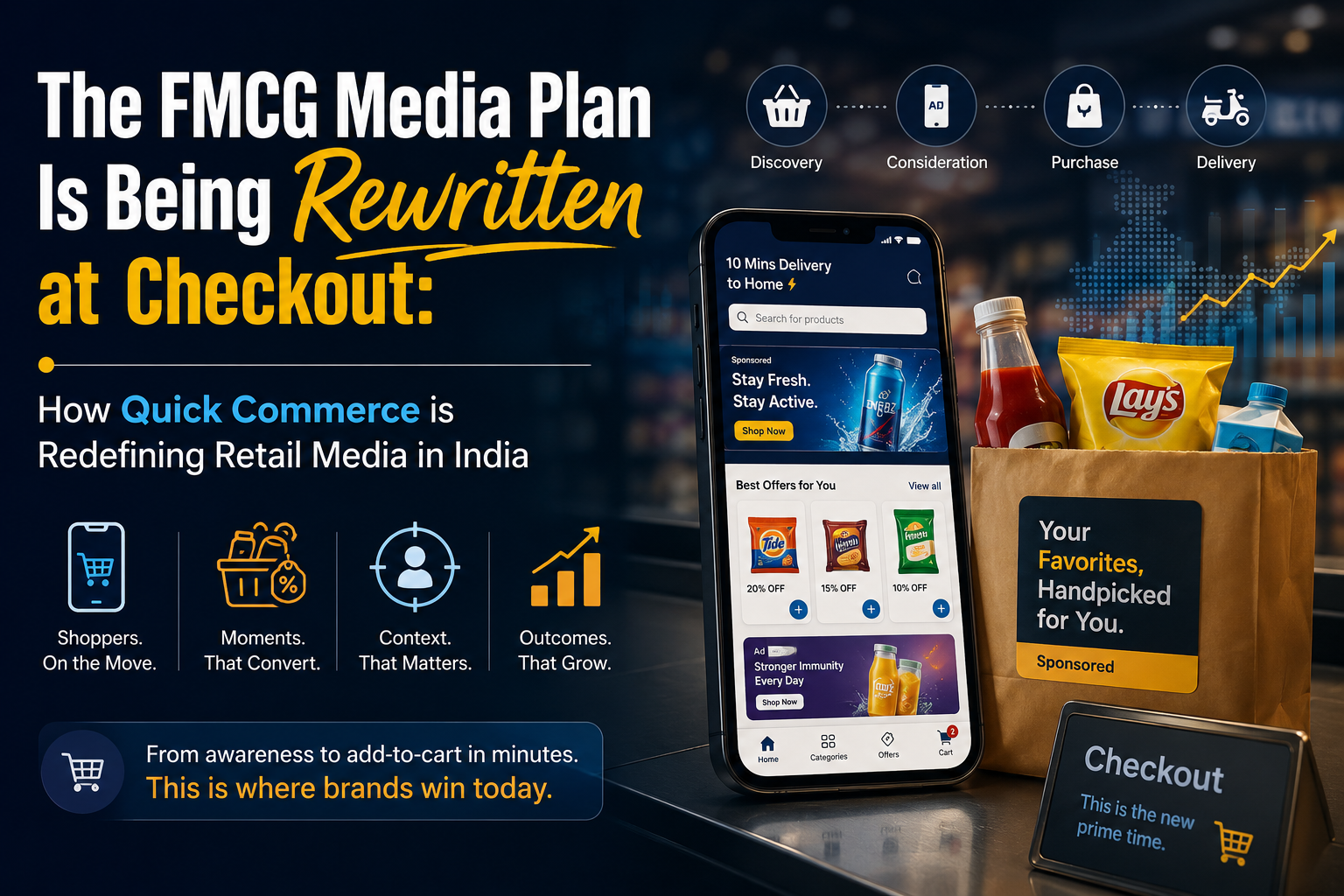
For decades, Fast-Moving Consumer Goods (FMCG) marketing in India operated on a predictable, well-orchestrated bargain. Television built national brand salience, modern trade negotiated prime supermarket shelf visibility, general trade (the trusted local kirana stores) drove massive rural and urban distribution, and digital channels targeted younger demographics.
In this traditional model, the consumer journey was long enough for brands to clearly separate awareness from consideration, and consideration from the final purchase. Today, that entire journey has been compressed into mere minutes.
The Collapse of the Marketing Funnel into a Closed-Loop System
This drastic compression is not merely a supply chain or delivery innovation; it is a profound media innovation. Quick commerce (q-commerce) fundamentally alters where brands are discovered, how consumer demand is created, and how rapidly intent converts into revenue. The most valuable retail shelf in India is no longer found exclusively in a physical supermarket aisle or a standard e-commerce search page. Instead, it sits directly inside a consumer’s smartphone, flashing at the exact moment they possess both buying intent and urgent need.
As a result, the FMCG marketing mix is rapidly evolving from a top-down linear funnel into a self-sustaining loop. In the legacy model, media built awareness, distribution ensured physical availability, and trade schemes drove final conversion. In the modern quick-commerce ecosystem, the platform handles all three actions simultaneously:
Simultaneous Action: A sponsored placement creates instant visibility.
Instant Gratification: Hyperlocal fulfillment ensures immediate conversion.
Data Optimization: Real-time data feeds directly into the next media decision.
FMCG brands are no longer just buying standard ad reach; they are investing in a closed-loop demand ecosystem.
Demystifying the Indian Retail Media & Quick Commerce Boom
The financial metrics highlight why adapting to this shift is no longer an optional digital experiment—it is a core business imperative. According to estimates by CareEdge, India’s quick commerce Gross Order Value (GOV) is pegged at approximately ₹64,000 crore for FY25 and is projected to skyrocket to nearly ₹2 lakh crore by FY28.
As these platforms transition from pure-play hypergrowth to sustainable monetization, they are leveraging advertising, subscriptions, private labels, and tech-driven optimization. Notably, advertisements and brand boosts already account for an estimated 9% to 11% of total quick-commerce revenues.
The broader Indian advertising landscape reflects this massive structural migration:
Total Ad Market Share: WPP Media’s TYNY forecast estimates India’s total ad market at ₹2,01,891 crore in 2026, with retail media emerging as one of the fastest-growing segments.
Retail Media Surge: Retail media advertising in India reached ₹24,280 crore in 2025 and is projected to touch ₹30,360 crore in 2026, commanding a dominant 15% share of total ad revenue.
Q-Commerce Ad Growth: Datum Intelligence estimates that ad revenues for top players like Blinkit, Zepto, and Swiggy Instamart will jump from around ₹3,000 crore in 2025 to ₹4,900 crore in 2026.
E-Commerce Benchmarks: For context, Amazon and Flipkart’s combined 2026 ad revenue is projected at ₹19,000–20,000 crore, while food-delivery giants Zomato and Swiggy are scaling their ad revenues from ₹2,500 crore in 2025 by an additional 20–25% in 2026.
This pattern mirrors global trends. In 2025, Amazon’s global advertising revenue crossed $68 billion, and Walmart’s ad business reached $6.4 billion. Similarly, Instacart reported an impressive $294 million in advertising and other revenue in Q4 2025 alone, proving that proximity-based ad networks are highly resilient and lucrative.
Strategic Pillars: Why FMCG Brands Must Pivot Immediately
To maintain market share in a hyperlocal economy, FMCG companies must stop categorizing quick-commerce advertising as a mere performance add-on. It must become a foundational pillar of the overarching marketing mix for three critical reasons:
1. High-Intent Proximity to Purchase
Traditional top-of-funnel advertising creates consumer demand far upstream. Retail media captures it downstream, right at the digital checkout. Quick commerce collapses both phases into a singular, high-intent environment where users search, compare, add to cart, and buy within a 10-minute window. This format is exceptionally potent for high-frequency replenishment categories, including:
Impulse & Daily Essentials: Snacks, beverages, and impulse-led foods.
Family & Home Care: Personal care, baby care, pet care, and household essentials.
Health & Wellness: Over-The-Counter (OTC) wellness products.
2. Hyperlocal, Real-Time Feedback Loops
Historically, FMCG brands have operated on delayed, proxy-based data, such as monthly retail audits, distributor feedback, and broad regional sales sheets. By the time a distribution gap or a drop in campaign performance was spotted, the market window had already closed. Quick commerce offers a live, unfiltered view of consumer demand at the SKU, city, search term, and neighborhood level.
3. The Power of Advanced Analytics Environments
Platforms are no longer just rapid fulfillment networks; they are turning into sophisticated consumer-intelligence hubs.
Case in Point:Zepto, which boasts over 100 brand collaborations, enables companies to track impressions, share of voice (SOV), conversions, and retention rates in near real-time via Zepto Atom.
Granular Audience Insights: Public reports indicate that Atom’s Persona module engaged more than 1,500 brands during its trial phase and has accumulated over 40,000 hours of usage since its official launch, allowing marketers to target consumers based on exact behavioral traits rather than vague demographics.
Action Plan: Reorganizing the FMCG Marketing Blueprint
This structural shift does not imply that FMCG brands should completely abandon mass media. In a vast, diverse marketplace like India, television, out-of-home (OOH) advertising, creator marketing, and broad digital video remain essential for building long-term memory structures. However, the operational role of mass media has changed: mass media creates broad cultural demand, while quick-commerce media harvests, measures, and compounds it.
To win in this new environment, forward-thinking FMCG leaders must aggressively reorganize their commercial strategies around several core tenets:
Design Platform-Specific Offerings: Create exclusive quick-commerce SKUs, daypart-led combo bundles (e.g., breakfast or late-night snacks), and occasion-based search strategies.
Localize Media Budgets: Move away from blanket national campaigns toward highly dynamic, city-level, and micro-market media plans.
Equate Search Share with Shelf Share: Treat digital share of voice and search ranking on q-commerce apps with the same urgency as eye-level physical shelf placement in modern trade.
Redefine Supply Chain Failures: Track an "Out-of-Stock" status on an app not just as a logistics error, but as a critical media failure that actively wastes ad spend and drives loyal consumers to competitors.
Integrate Channels from Inception: Plan all future product launches with quick-commerce stakeholders present in the strategy room from day zero.
Conclusion: The Risk of Entering Late
Platforms like Zepto, Blinkit, and Swiggy Instamart have successfully positioned themselves at the intersection of media, data, commerce, and fulfillment. For an FMCG brand, the ultimate risk is no longer that quick-commerce advertising will become too expensive or cut into margins. The true, existential risk is that the channel is becoming far too vital to enter late. Brand equity is being won and lost at the digital checkout right now—and the brands that anchor themselves there early will dominate the next decade of Indian retail