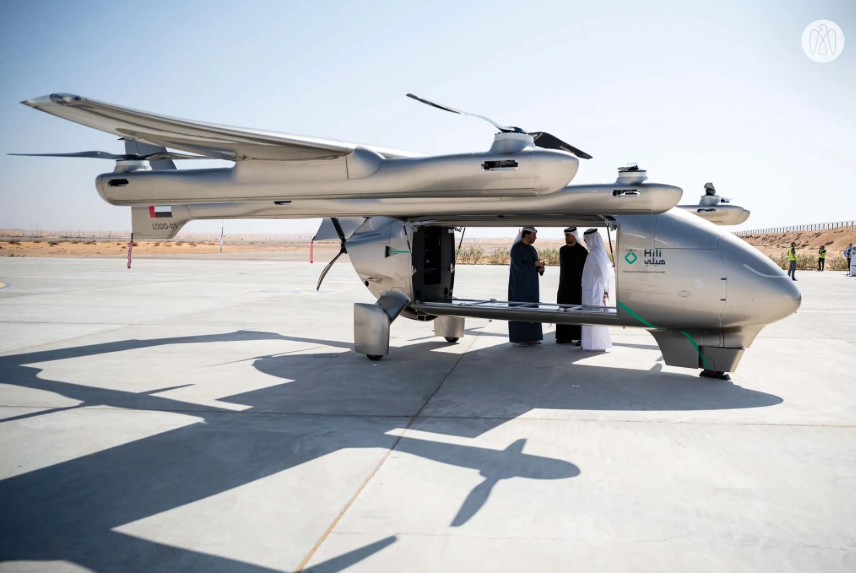
In a historic milestone for advanced air mobility and the aerospace sector in the Middle East, LODD Autonomous has officially initiated the formal civil aviation certification programme for its hybrid cargo aircraft, Hili. Under the supervision of the UAE General Civil Aviation Authority (GCAA), Hili becomes the first autonomous cargo aircraft to enter formal civil aviation certification in the Arab world—designed, engineered, and certified domestically in the UAE.
This critical step marks Hili’s evolution from design, engineering, and flight testing into the formal regulatory compliance phase required for commercial entry into service.
Developed in Abu Dhabi, Hili is a long-range, hybrid-powered Vertical Take-Off and Landing (VTOL) Unmanned Aerial Vehicle (UAV). It is engineered to carry payloads of up to 250 kilograms over operational ranges reaching 700 kilometers, placing it among the longest-range cargo UAV initiatives currently under development in the Middle East and North Africa (MENA) region.
Comprehensive Certification Roadmap and Operational Scope
The certification process is being conducted under the oversight of the Smart and Autonomous Systems Council, with the GCAA serving as the primary certifying authority. The program establishes rigorous benchmarks to evaluate airworthiness, physical build quality, and software safety before Hili begins commercial logistics flights.
The certification scope encompasses a comprehensive evaluation framework:
Aircraft Design Approval: Validating structural integrity, hybrid powertrain reliability, and redundant flight-control avionics.
Airworthiness Compliance Demonstrations: Proving operational safety across varying weather conditions and high-density airspace.
Ground and Flight Testing: Conducting extensive physical test flights under real-world operational environments.
Operational & Safety Assessments: Developing fail-safe protocols, supervised autonomous navigation rules, and hazard mitigation systems.
Abu Dhabi’s Autonomous Mobility Ecosystem Drive
Hili’s entry into formal civil certification aligns directly with the UAE’s strategic mission to establish Abu Dhabi as a global hub for smart aviation and autonomous transport. The initiative is backed by major institutional stakeholders across the Emirate's mobility ecosystem, including Abu Dhabi Mobility (Integrated Transport Centre - ITC) and the Abu Dhabi Investment Office (ADIO) through its dedicated Smart and Autonomous Vehicles Industry (SAVI) Cluster.
By supporting locally manufactured hardware and proprietary autonomous flight software, Abu Dhabi’s SAVI cluster is building an integrated supply chain capable of competing with global aerospace hubs.
Leadership Perspectives: Shaping Next-Generation Air Mobility
Highlighting the importance of entering the formal certification path, Rashid Al Manai, CEO of LODD, stated:
"The launch of the Hili certification programme marks one of the most significant milestones in the evolution of the aircraft and reflects the progress we have made across design, engineering and flight testing. Entering formal certification demonstrates the maturity of the Hili programme and moves Hili from development into the pathway towards commercial operations. It brings us one step closer to delivering a UAE-developed supervised autonomous cargo aircraft system capable of transforming how critical goods are moved across the UAE, the region and globally. We are working with the GCAA throughout the certification process to demonstrate compliance with the highest airworthiness and safety standards."
Emphasizing regulatory leadership and airspace integration, Eng. Aqeel Al Zarooni, Assistant Director General for Aviation Safety Affairs at the GCAA, added:
"The initiation of the Hili certification programme demonstrates the UAE's commitment to enabling innovation while maintaining the highest standards of aviation safety. Advanced aircraft programmes such as Hili play an important role in the evolution of aviation and support the safe integration of next-generation technologies into the national aviation ecosystem."
Supporting the Emirate's broader infrastructure strategy, Dr. Abdulla Hamad AlGhfeli, Acting Director General of the Integrated Transport Centre (Abu Dhabi Mobility), noted:
"The certification of advanced autonomous aviation systems such as Hili represents a significant step in advancing Abu Dhabi's integrated mobility ecosystem. At the Integrated Transport Centre, we are committed to enabling and supporting the development of innovative transport solutions that enhance efficiency, safety and sustainability across the Emirate."
Highlighting the strength of local industry collaboration, Ali AlHashmi, Head of the SAVI Cluster at the Abu Dhabi Investment Office (ADIO), remarked:
"Hili's progression into formal certification demonstrates the strength of the collaborative environment being built across industry, regulators and ecosystem partners to support the development, testing and commercial deployment of next-generation aviation technologies."
Future Impact on Regional and Global Logistics
Once full airworthiness certification is granted by the GCAA, Hili will transition into active commercial deployment. The VTOL capabilities remove the requirement for traditional runway infrastructure, allowing the aircraft to land in remote industrial zones, offshore platforms, and underserved rural locations.
By combining a 250 kg payload capacity with an extended 700 km range, Hili fills a crucial gap between small delivery drones and heavy cargo aircraft. This makes it an ideal solution for middle-mile distribution, medical emergency supply chains, and industrial logistics across the UAE, the broader GCC, and global export markets.
About LODD Autonomous
LODD Autonomous is an Abu Dhabi-based aviation technology company specializing in the design, engineering, and manufacturing of advanced autonomous cargo aircraft systems. Focused on building high-payload, long-range hybrid VTOL platforms, LODD is pioneering next-generation logistics systems to support sustainable supply chains across the energy, healthcare, humanitarian, and commercial transport sectors.