Indian startup Agnikul Cosmos aims to recover rocket boosters, marking India's first foray into reusable rocketry and challenging global leaders.
India's Agnikul Cosmos Joins the Global Race to Revolutionize Space Travel with Reusable Rockets
A significant shift is happening in the global space industry, and India is ready to play a starring role. Private launch vehicle company Agnikul Cosmos is gearing up for a monumental mission, aiming to recover its orbital-class rocket booster on Indian soil, a move that could dramatically alter the economics of space travel for everyone. This pioneering effort positions India as a serious contender in the reusable rocket race, a domain previously dominated by Elon Musk's SpaceX and recently joined by China.
Here's why this matters: Agnikul's upcoming launch represents India's first serious foray into rocket reusability, a technology essential for driving down launch costs. The ability to reuse rocket stages, much like an airplane, dramatically reduces the expense of sending payloads into orbit, making space more accessible for various industries and nations. This technical leap is critical for anyone hoping to compete in the burgeoning commercial space market.
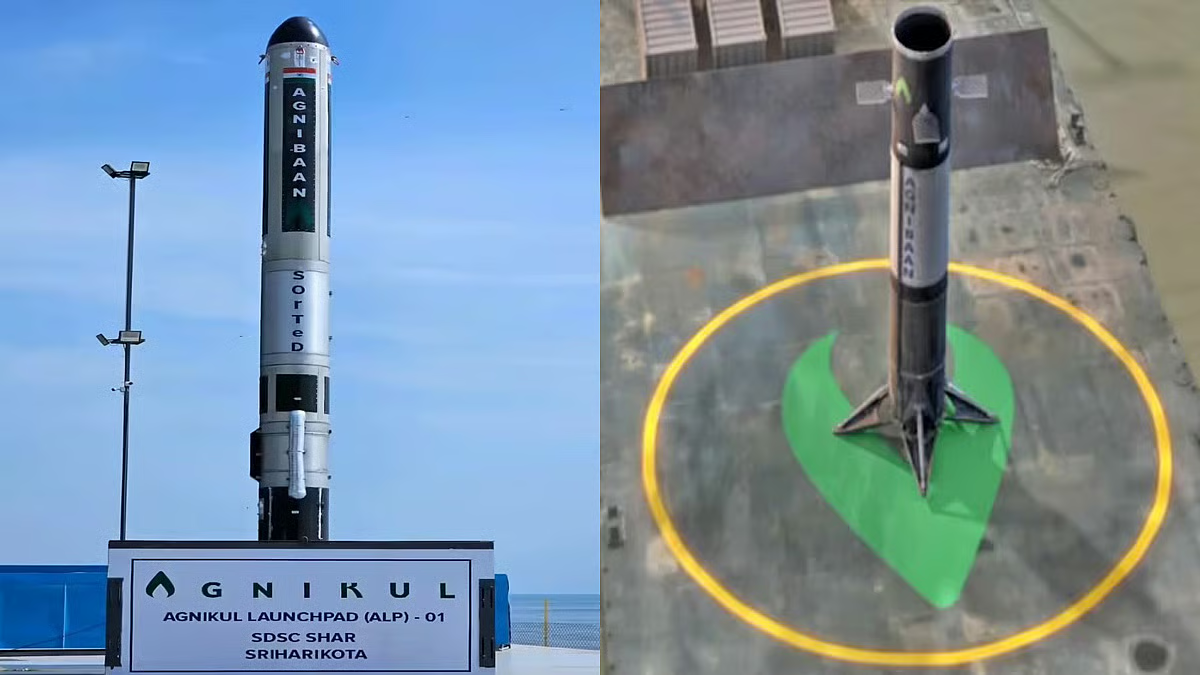
The startup, incubated at IIT Madras, announced its ambitious plan shortly after China successfully recovered its first orbital-class rocket booster last week, signaling a clear global trend. Agnikul develops the Agnibaan family of configurable small-lift launch vehicles, notably powered by the world's first single-piece 3D-printed semi-cryogenic engine, showcasing cutting-edge engineering. Their upcoming mission aims to put satellites into orbit while simultaneously attempting a controlled descent and ocean recovery of its first-stage booster, a complex maneuver that requires precision and advanced technology.
What does rocket reusability mean for global industries and investors?
For consumers and businesses alike, the promise of reusable rockets translates directly into cheaper access to space. Historically, every rocket launch meant building a new, incredibly expensive vehicle, a cost borne by satellite operators, research institutions, and ultimately, taxpayers or consumers of space-derived services. Reusability turns this model on its head, much like commercial aviation transitioned from disposable planes to reusable aircraft, making launches more frequent and affordable.
This fundamental shift impacts everything from satellite internet providers, who can deploy constellations more affordably, to climate monitoring agencies needing frequent updates from orbit, and even defense organizations. Lower launch costs encourage more innovation, as the barrier to entry for space-based services diminishes, fostering a more dynamic and competitive global market. For North American investors, this trend opens up new avenues in the space tech sector, both domestically and internationally, as companies like Agnikul challenge established norms and expand the addressable market.
SpaceX, under Elon Musk, has been the trailblazer in this arena, conducting numerous Falcon 9 booster flights with stage reusability, with some individual boosters completing many missions. Their success has drastically driven down the cost-to-orbit, setting a new benchmark that expendable rockets simply cannot match. This dominant position has forced competitors, and indeed entire nations, to re-evaluate their space strategies, making reusability a critical competitive barrier for the next generation of launch providers.
How is India positioning itself in the global space race?
The entry of Agnikul into the reusable rocket domain signifies India's ambition to move beyond being just a cost-effective launch provider to a leader in advanced space technologies. For North American companies and governments, India's rise means a new competitor, but also a potential partner, in the complex and capital-intensive space industry. The long-term implications involve a more diversified global launch market, potentially leading to greater resilience and innovation in space access.
Agnikul's upcoming mission will fly an Agnibaan configuration. The first-stage booster, after separation, will execute a controlled descent for ocean recovery.
This kind of technological advancement is crucial for attracting global investors, particularly from North America, who are constantly seeking disruptive technologies with significant market potential. The ability to reuse a booster represents a significant advantage in cost efficiency and operational flexibility. Investors are keen on companies that can demonstrate a clear path to profitability and scalability, and reducing the per-launch cost is paramount for achieving those goals.
The global space economy is projected to reach significant growth in the coming decades, fueled by increasing demand for satellite internet, Earth observation, space tourism, and lunar/Martian exploration. Within this expanding pie, the small-lift launch segment, catering to smaller satellites and specific orbital needs, is experiencing intense competition. Agnikul's entry into reusability positions it squarely against these formidable global contenders.
The success of Agnikul's recovery attempt would be a powerful signal to the international community, validating India's private space capabilities and its commitment to sustainable and economically viable space access. It would also further democratize access to space, potentially leading to new partnerships and collaborations that transcend national borders, fostering a more interconnected space ecosystem that benefits everyone.
The implications extend beyond just launch costs. A reliable, reusable launch capability offers strategic advantages in times of geopolitical uncertainty, ensuring resilient access to space for national security assets and critical infrastructure. For businesses, it means greater predictability and flexibility in planning satellite deployments, reducing risks associated with launch delays or failures. This robust infrastructure is vital for the continued growth of the digital economy, which increasingly relies on space-based services for everything from navigation to communication.
Looking ahead, Agnikul's mission is more than a technical demonstration; it's a testament to the ingenuity and rapid progress occurring within India's private space sector. If successful, this endeavor will not only cement Agnikul's position as a significant player but will also inspire a new wave of innovation across the global space industry. The race to make space more affordable and accessible is intensifying, and India, with Agnikul leading the charge, is showing it's ready to compete at the highest level, promising a future where space is within easier reach for all.