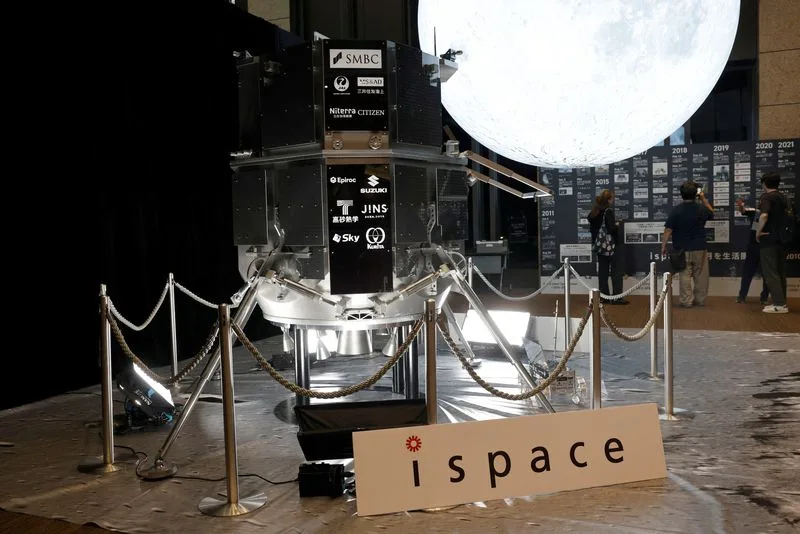
Japan's ispace finalizes Starship deal with SpaceX for third lunar mission, set to revolutionize deep space logistics and accelerate moon commercialization.
Japan's ispace Inc. has finalized a landmark ride-share agreement with SpaceX for its third lunar mission, utilizing the formidable Starship launch system, a development poised to dramatically recalibrate the unit economics of deep space logistics and accelerate the commercialization timeline for lunar operations. This strategic partnership underscores a growing trend of private entities leveraging next-generation launch capabilities to pursue ambitious extraterrestrial endeavors, signaling a potential paradigm shift for investors tracking the burgeoning space economy. The agreement specifies that ispace's Mission 3 (M3), codenamed "Resilience," will embark on a trajectory to the Moon aboard a Starship vehicle from SpaceX's Starbase facility in Boca Chica, Texas. While specific financial terms of the contract remain undisclosed, the deal represents a significant commitment from both parties. Mission 3 is designed to deliver a larger and more complex suite of payloads to the lunar surface than ispace's previous Hakuto-R missions, including advanced rovers and scientific instruments, highlighting Starship's unparalleled cargo capacity as a key enabler for more ambitious commercial payloads. This mission builds on ispace’s prior experience, which included the Hakuto-R Mission 1 lunar lander that attempted a soft landing in April 2023, providing invaluable data despite its eventual hard landing. Its Hakuto-R Mission 2 is also slated to launch in 2024, carrying a micro-rover for lunar surface exploration. This collaboration is not merely a transport service but a strategic alignment that could de-risk future lunar endeavors for a broader spectrum of commercial and international clients. By securing a slot on Starship, ispace gains access to a launch platform capable of delivering payloads measured in tens of metric tons directly to the lunar surface, a capability far exceeding that of conventional launch vehicles. This capacity is critical for establishing sustainable lunar infrastructure, including communication relays, power grids, and habitats, which are essential for long-term human presence and resource utilization. The move by ispace, a publicly traded entity on the Tokyo Stock Exchange's Growth market, reflects investor confidence in the long-term prospects of lunar industry, even as the sector navigates early-stage operational challenges and capital expenditure requirements.
What Does This Partnership Mean for Commercial Lunar Missions?
The implications of an ispace-Starship partnership extend far beyond a single mission; they signal a fundamental shift in the commercial lunar landscape. Starship's design, emphasizing full reusability and unprecedented payload volume, fundamentally alters the cost-per-kilogram to orbit and, subsequently, to the Moon. For companies like ispace, this means the ability to conceive missions with greater mass budgets, allowing for more robust lander designs, larger scientific instruments, and potentially, the deployment of modular lunar infrastructure that would be prohibitively expensive or complex with smaller launchers. This expanded capability could accelerate the timelines for lunar resource prospecting, in-situ resource utilization (ISRU) demonstrations, and the establishment of precursor lunar bases. This partnership also diversifies the commercial lunar ecosystem beyond the immediate scope of NASA's Commercial Lunar Payload Services (CLPS) program, which has primarily relied on smaller, more traditional launch vehicles and lander designs. While CLPS has been instrumental in fostering private lunar capabilities, Starship offers a leap in scale that could enable non-NASA entities, including international space agencies and private consortia, to pursue independent, large-scale lunar initiatives. The sheer capacity allows for aggregated missions, where multiple clients could share a single Starship launch, spreading costs and maximizing efficiency, thereby opening the lunar frontier to a wider range of participants. This represents a significant step towards a truly multi-polar lunar economy, less reliant on a single national space agency's procurement strategy.
The global space economy is projected to exceed $1 trillion by 2040, with lunar exploration and resource utilization expected to be a significant growth driver, attracting substantial private and government investment.
The Context of Lunar Exploration and Infrastructure
The agreement between ispace and SpaceX is set against a backdrop of intensifying global interest in lunar exploration and the nascent stages of building a sustainable lunar economy. For decades, lunar missions were primarily the domain of national space agencies, characterized by high costs and infrequent launches. However, the advent of commercial space ventures, coupled with initiatives like NASA's Artemis program and CLPS, has dramatically lowered barriers to entry and fostered a vibrant private sector. Companies such as Astrobotic Technology and Intuitive Machines, both participants in the CLPS program, have already launched or are preparing to launch their own landers to the Moon, demonstrating the growing commercial viability of lunar transport. ispace has positioned itself as a key player in this evolving ecosystem, aiming to provide regular and affordable transportation services to the Moon. Its Hakuto-R program, named after the white rabbit of Japanese folklore, signifies the company's long-term vision for a lunar economy. The company's strategy involves not just landing payloads but also developing a robust data service and exploring lunar resource potential, including water ice. The successful execution of M3 via Starship would significantly validate this vision, demonstrating a scalable and powerful pathway to achieving these goals, especially for clients requiring substantial payload delivery. This collaboration underlines a broader trend where established space giants are increasingly partnering with agile commercial startups to leverage complementary strengths and accelerate technological development.
Navigating the New Space Economy's Investment Landscape
The commercial space sector, particularly deep space exploration, remains a high-risk, high-reward investment arena characterized by significant upfront capital requirements and long return horizons. However, the potential for groundbreaking scientific discovery, resource extraction, and new industries like space tourism continues to attract substantial private capital. ispace itself became the first lunar exploration company to list publicly, raising ¥6.8 billion ($49 million) in its IPO in April 2023, a testament to investor appetite for exposure to the lunar economy. This partnership with SpaceX could enhance investor confidence by demonstrating a credible, high-capacity launch solution for future missions, potentially mitigating some of the technical and logistical risks associated with lunar development. The strategic choice of Starship also reflects a broader market trend towards consolidating launch providers and capabilities. As the space industry matures, companies are increasingly seeking partnerships that offer economies of scale and technical robustness, rather than developing every component in-house. This dynamic fosters a competitive environment where launch service providers like SpaceX, with its ambitious Starship program, become critical enablers for a multitude of downstream space ventures. The success of such large-scale reusable systems is crucial for bringing down the overall cost of space access, which in turn unlocks new commercial opportunities that were previously economically unfeasible. This collaborative model, combining specialized lunar services with powerful launch capabilities, is likely to become a template for future deep space commercialization efforts. The success of Starship's ongoing test flight campaign will be a critical determinant for the precise timing and feasibility of ispace's Mission 3. Investors will closely monitor SpaceX's progress towards achieving orbital and eventually lunar-capable Starship flights, as any delays could impact the mission schedule and associated financial projections for ispace. Beyond launch readiness, the market will also watch for the specific manifest of payloads on M3, which will provide insight into the immediate commercial demand for large-scale lunar delivery services and the types of industries poised to benefit most from enhanced lunar access. The regulatory landscape governing lunar resource extraction and international cooperation, particularly under the framework of the Artemis Accords, will also shape the long-term investment horizon for companies like ispace.
Frequently asked questions
What is ispace's latest mission with SpaceX?
Japan's ispace Inc. has partnered with SpaceX for its third lunar mission, utilizing the Starship launch system. This agreement aims to provide ride-share services to the moon.
Which SpaceX system will ispace use for its lunar mission?
ispace will be utilizing the formidable SpaceX Starship launch system for its third lunar mission, a key development in deep space logistics.
What is the significance of the ispace-SpaceX partnership?
This strategic partnership is poised to dramatically recalibrate the unit economics of deep space logistics and accelerate the commercialization timeline for lunar operations, marking a new era in space exploration.
What is ispace Inc.?
ispace Inc. is a Japanese lunar exploration company that develops lunar landers and rovers, aiming to provide transportation services to the moon and establish a sustainable lunar economy.
How many lunar missions has ispace planned with SpaceX through this agreement?
This specific agreement covers ispace's third lunar mission, marking a significant step in their ongoing collaboration with SpaceX for lunar endeavors.
What trend does this partnership highlight in the space industry?
This strategic partnership underscores a growing trend of private entities leveraging advanced launch systems like Starship to accelerate the commercialization of lunar operations and foster deep space logistics.