Northrop Grumman's MRV will attach life-extending jetpacks to aging communication satellites, saving millions for operators.
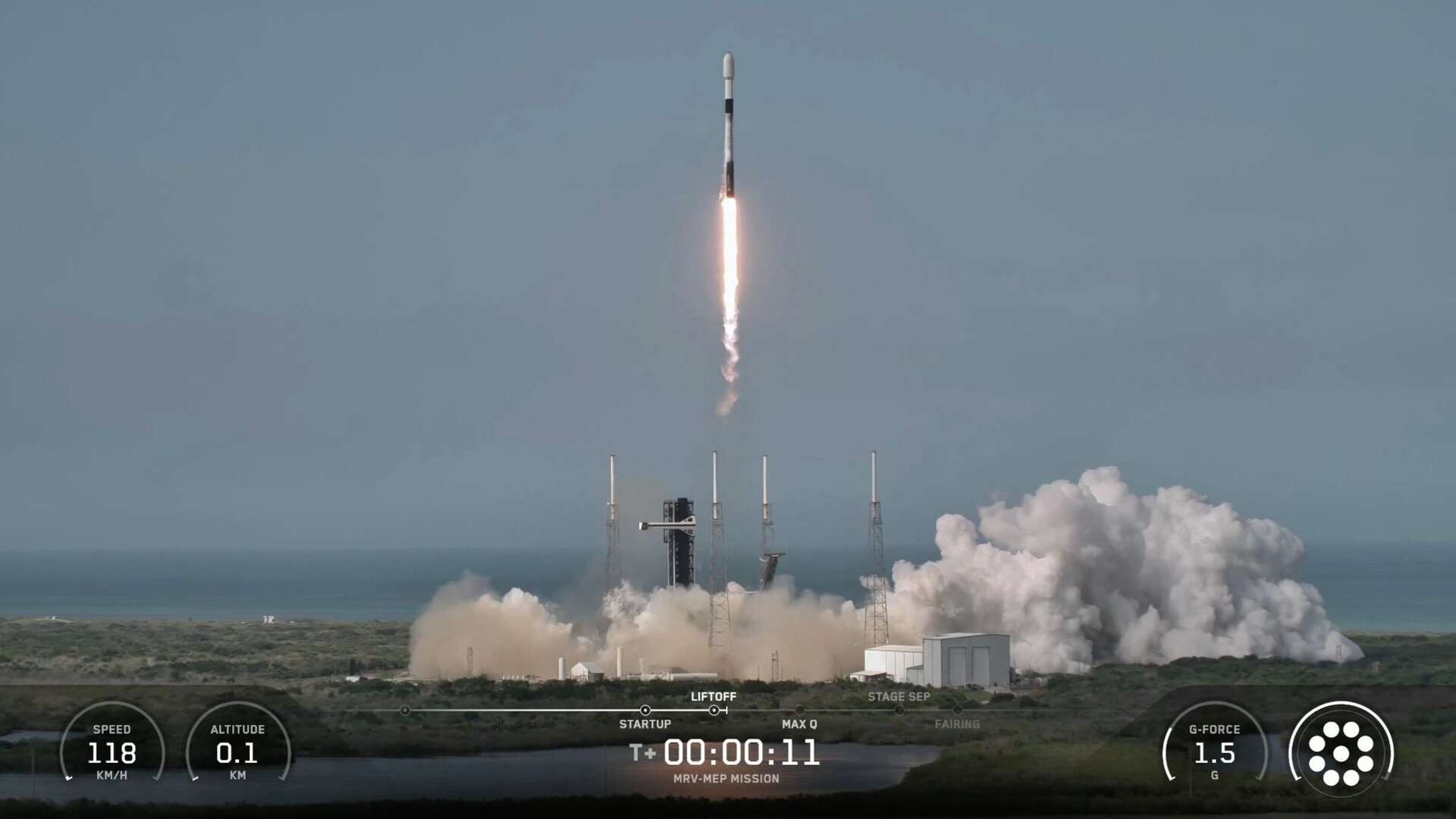
A two-armed space robot launched by SpaceX on Tuesday initiated a private salvage operation, marking a significant step in extending the operational lifespan of communication satellites running low on fuel in geosynchronous orbit. The Northrop Grumman mission, deploying its Mission Robotic Vehicle (MRV) and attached jetpacks, could fundamentally alter satellite economics by offering a cost-effective alternative to premature decommissioning and new satellite procurement for operators.
The MRV, a minivan-sized spacecraft, is scheduled to reach its operational orbit 22,300 miles (36,000 kilometers) above Earth by mid-2027. Once positioned, it will utilize its 10-foot (9-meter) robotic arms to attach electric-propelled jetpacks to aging communication satellites, providing the necessary thrust for several additional years of service. Its debut flight carries three such washing machine-sized jetpacks, which will independently maneuver to the target orbit using xenon gas thrusters, awaiting robotic integration.
This initiative represents the latest evolution in Northrop Grumman's satellite-servicing ventures, building on prior missions in 2019 and 2020 where the company successfully extended the life of faltering communication satellites through direct steering. Early beneficiaries for the current mission are expected to include satellite operators like SES of Luxembourg and Optus of Australia, potentially saving them millions of dollars in replacement costs for their critical orbital assets.
What are the financial stakes of satellite servicing?
The burgeoning in-orbit servicing (IOS) sector promises to disrupt the traditional economic model of satellite operations, where end-of-life typically necessitates costly replacement. Extending operational life by several years offers substantial capital expenditure savings for satellite operators, potentially saving them millions of dollars in replacement costs. This shift allows companies to optimize returns on existing infrastructure, deferring significant investments in new hardware and launch services.
The ability to refuel, repair, or relocate satellites transforms them from finite assets into potentially renewable ones. This enhances financial flexibility and predictability for operators, potentially impacting future insurance premiums and asset valuation models across the space industry. The market for in-orbit services is projected to expand significantly, driven by the increasing number of satellites in orbit and the economic imperative to maximize asset utility.
NASA is investing $30 million in Katalyst Space Technologies to boost its Swift Observatory back to its original 373-mile (600-kilometer) altitude, a fraction of the nearly $400 million original cost of the gamma-ray observatory.
How does in-orbit servicing address space sustainability challenges?
Beyond immediate financial gains, satellite servicing plays a crucial role in mitigating the growing problem of space debris and enhancing orbital sustainability. Geosynchronous orbit, a highly trafficked region, is becoming increasingly congested, raising concerns about potential collisions. By extending the operational life of existing satellites, the need for new launches to replace them is reduced, thereby directly limiting the amount of new material introduced into orbit that could eventually become debris.
Furthermore, the long-term vision for robotic servicing includes capabilities such as relocating live satellites to less congested zones and actively de-orbiting dead ones. These advancements are critical for maintaining the usability of key orbital highways and preventing a cascade of collisions. Collaboration with entities like the U.S. Naval Research Laboratory and the Defense Advanced Research Projects Agency underscores the strategic importance of these capabilities for both commercial and national security interests.
What are the technological and operational hurdles?
The execution of complex robotic operations in the vacuum of space, thousands of miles from Earth, presents formidable engineering and operational challenges. Precision rendezvous and proximity operations (RPO) are required to safely approach and dock with another spacecraft, often one that was not designed for such an interaction. Robotic manipulation, involving the delicate attachment of components like jetpacks, demands extreme accuracy and robust autonomous systems to account for communication delays and environmental factors.
Early missions highlight these complexities. Katalyst Space Technologies, which launched its Link satellite helper earlier this month to service NASA's Swift Observatory, encountered initial communication and pointing problems requiring software patches. Such instances underscore the developmental nature of this technology and the continuous need for innovation in space robotics, propulsion systems like xenon gas thrusters, and fault-tolerant software architectures.
The coming months will be critical for validating the commercial viability and technical prowess of these in-orbit servicing missions. With Northrop Grumman's MRV expected to become operational by mid-2027 and Katalyst's Link preparing for its critical boost of the Swift Observatory in the coming weeks, the space industry will closely monitor successful contract fulfillments. Future developments will likely focus on an expansion of servicing contracts, the evolution of regulatory frameworks for orbital operations and debris removal, and the introduction of next-generation robotic capabilities that could further transform the economics and sustainability of space assets.
Frequently asked questions
What is the purpose of the private mission launched by Northrop Grumman?
The private mission, led by Northrop Grumman's Mission Robotic Vehicle (MRV), aims to extend the operational life of out-of-gas communication satellites. It achieves this by attaching life-extending jetpacks, saving satellite operators millions in replacement costs.
Which companies are involved in this satellite-saving mission?
Northrop Grumman developed the Mission Robotic Vehicle (MRV), which was launched by SpaceX. Katalyst Space Technologies is also mentioned for its Link satellite helper mission for NASA's Swift Observatory.
How do the jetpacks extend a satellite's life?
The electric-propelled jetpacks provide the necessary thrust, using xenon gas thrusters, to keep an out-of-gas satellite operating for several more years, preventing it from retiring prematurely.
What orbit will the MRV and jetpacks operate in?
The MRV and its jetpacks will operate in geosynchronous orbit, approximately 22,300 miles (36,000 kilometers) above Earth, where satellites match Earth's rotation for continuous coverage.
What are the economic benefits of this satellite servicing?
This satellite servicing technology is a boon for operators like SES and Optus, as it saves them millions of dollars in the cost of replacing aging, out-of-fuel satellites.
What are Northrop Grumman's future visions for satellite servicing?
Northrop Grumman envisions future versions of its robotic helpers repairing and relocating live satellites, and even removing dead ones from highly trafficked orbits, expanding the scope of in-orbit services.