Discover how a Spanish innovator developed a revolutionary bladeless wind turbine that generates clean electricity through silent oscillation, marking a new era for renewable energy.
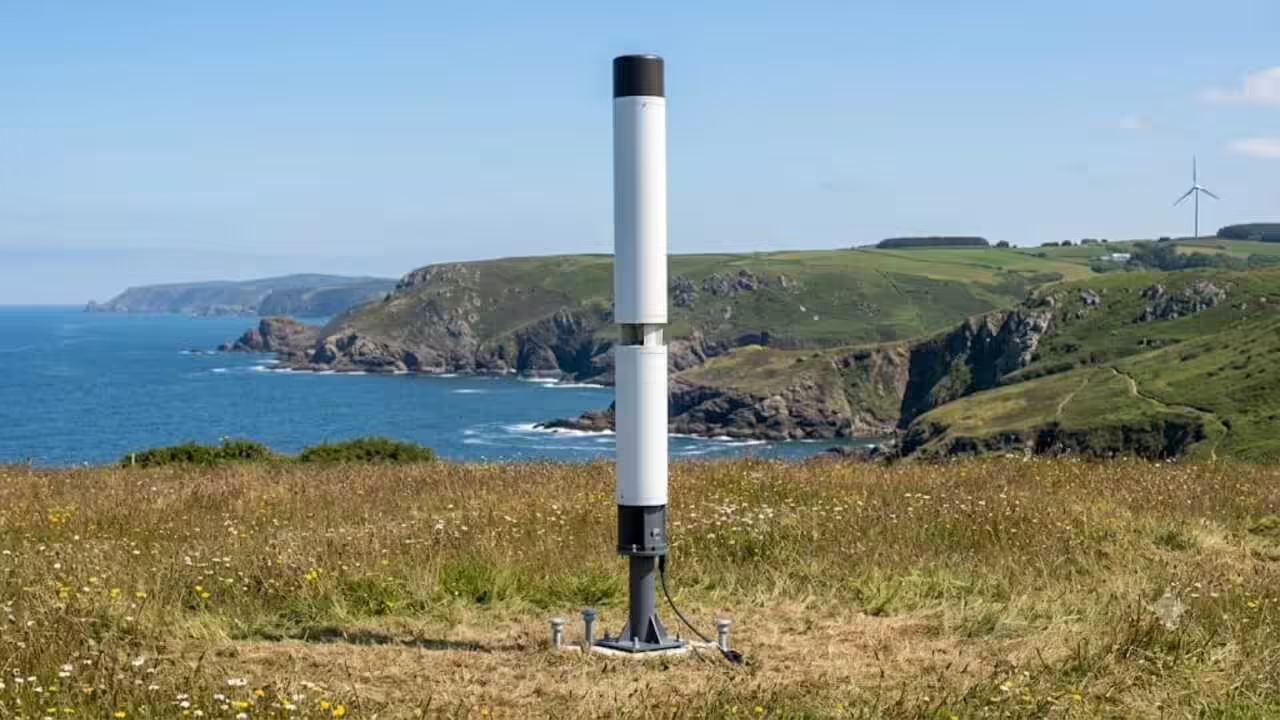
A Spanish company has unveiled a radical new approach to wind energy, replacing traditional spinning blades with an oscillating mast that silently sways to generate electricity. This innovative technology, developed by the Spanish innovator, marks a significant departure from conventional turbine design, promising more adaptable and environmentally conscious renewable power.
A Spanish innovator has developed a bladeless wind turbine that sways with the wind, converting vibrations into electricity.
This silent, and bird-friendly technology offers a compelling solution for decentralised energy, with significant implications for India's burgeoning green economy.
For the engineers and visionaries behind the innovation, the moment of inspiration arrived not in trying to build bigger, better blades, but in questioning their very necessity. Traditional wind turbines, while powerful, come with inherent challenges: their massive scale, the noise generated by their rotating blades, and the environmental impact on birds and bats. The innovators questioned whether the wind's energy could be harnessed in a fundamentally different, gentler way, turning a typically destructive force into a source of clean power. This core challenge led to efforts to reimagine wind energy from the ground up. The concept that propelled this Spanish company's venture forward was aeroelasticity, a phenomenon often mitigated in engineering to prevent structures from oscillating dangerously in the wind. Instead of fighting this natural sway, the company's team sought to embrace it. Their design features a slender, vertical mast, devoid of any rotating blades, which oscillates or sways gently with the wind. As the wind flows past the mast, it creates vortices, causing the structure to vibrate. These vibrations are then converted into electricity through a system of alternators, effectively turning what was once a structural engineering problem into a sustainable energy solution. The initial concept quickly evolved into a dedicated building phase, marked by rigorous research, computational fluid dynamics simulations, and the construction of numerous prototypes. The challenge was immense: designing a structure that could efficiently capture the wind's kinetic energy through oscillation, maintain structural integrity, and produce consistent electrical output. This iterative process involved fine-tuning the mast's materials, shape, and internal mechanisms to maximise energy harvesting from even moderate wind speeds, ensuring durability against various weather conditions. In its current state, the company has demonstrated working prototypes that are a fraction of the weight of conventional wind turbines, offering significant advantages in manufacturing, transport, and installation. While these initial models generate less electricity than utility-scale wind farms, their distinct benefits lie in their application. Without massive spinning blades, these units are quieter, safer for wildlife, and have a smaller visual footprint, making them far more suitable for urban environments, remote communities, and even residential settings where large traditional turbines are simply impractical or unfeasible. The ongoing refinement of the technology aims to steadily improve its efficiency and durability, expanding its practical applications across diverse landscapes. The implications of such a technology for a rapidly developing nation like India are particularly profound. India is aggressively pursuing ambitious renewable energy targets, a monumental undertaking that requires innovative solutions across the board. Conventional wind farms often demand vast tracts of land, face logistical hurdles in transporting massive blades, and can raise concerns about noise pollution and impact on local ecosystems. A bladeless, oscillating turbine could offer a compelling alternative, especially for decentralised power generation, which is a critical component of India's energy security strategy. Imagine these slender masts integrated into smart cities, powering telecom towers in remote regions, or providing supplemental energy to agricultural communities where grid access is inconsistent. This technology aligns perfectly with the trend towards distributed energy resources, empowering local communities with sustainable power generation closer to the point of consumption. The reduced maintenance needs and lower installation costs, owing to the simpler design, also present an attractive proposition for entrepreneurs and local bodies looking to invest in green infrastructure without the prohibitive overheads of traditional wind projects. Furthermore, the technology resonates with the broader global trend of seeking unobtrusive and silent renewable energy solutions. Across South and Southeast Asia, many regions grapple with energy poverty or reliance on costly fossil fuels, particularly in island nations or densely populated urban centres. For these areas, the minimal environmental impact of bladeless turbines could unlock new possibilities, allowing for the deployment of wind power in spaces previously deemed unsuitable. This innovation is not merely about generating electricity; it's about making renewable energy more accessible, more integrated into daily life, and ultimately, more harmonious with the environment. It complements existing solar installations, offering a more consistent power supply by tapping into different weather patterns, thereby bolstering the reliability of micro-grids and off-grid solutions. Looking ahead, while it is unlikely that bladeless turbines will entirely replace the gigawatt-scale output of offshore wind farms, their strength lies in their potential to complement and diversify the renewable energy portfolio. For India, a nation where innovation often thrives on necessity and local adaptation, this Spanish invention offers a fresh perspective on harnessing one of nature's most abundant resources. It presents an opportunity for local manufacturing, skill development in green tech, and the fostering of a vibrant ecosystem around next-generation sustainable energy. The innovation offers a vital lesson for entrepreneurs in India and beyond: true disruption often comes from challenging established paradigms and daring to build a better future, one sway at a time.
Frequently asked questions
What is a bladeless wind turbine and how does it work?
A bladeless wind turbine is an innovative device that generates electricity by oscillating or swaying in the wind, rather than using traditional spinning blades. It harnesses energy from the vortices created by wind flow, converting these vibrations into usable power.
What are the main advantages of bladeless wind turbines over traditional ones?
Bladeless turbines offer several benefits, including reduced noise pollution, lower maintenance costs due to fewer moving parts, increased safety for birds, and a smaller visual footprint, making them more adaptable to various environments.
Which company developed this new bladeless wind turbine technology?
This specific bladeless wind turbine technology was developed by a Spanish innovator, as highlighted in the article, marking a significant advancement in the field of renewable energy.
Is this bladeless wind turbine technology currently available?
While the technology has been unveiled and is under development, its widespread commercial availability will depend on further testing, scaling, and market adoption. It represents a promising future direction for wind energy.
How does the bladeless design impact the efficiency of energy generation?
The efficiency of bladeless turbines is a key area of ongoing research. While they may not capture as much energy as large traditional turbines in high wind speeds, their unique design allows them to operate effectively in lower wind conditions and urban environments, offering different advantages.
What is the environmental impact of bladeless wind turbines?
Bladeless wind turbines are designed to be more environmentally friendly. They significantly reduce bird fatalities common with traditional turbines and have a smaller overall ecological footprint, contributing to more sustainable and harmonious renewable energy production.