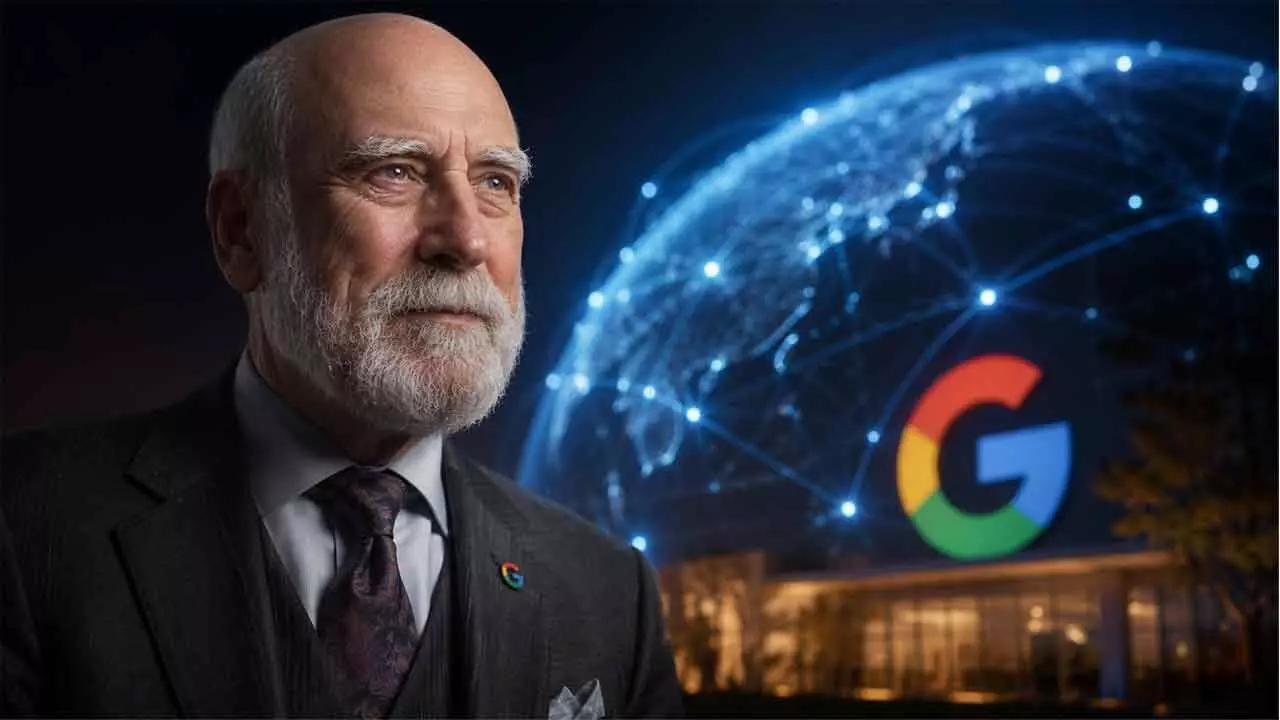
The architect of the internet's foundational protocols, Vinton Cerf, concludes his influential career at Google, sharing insights on AI's future interoperability.
Vinton Cerf, The 'Father of the Internet,' Retires from Google, Leaving Behind a Vision for AI's Interconnected Future
One of the most influential figures in technology, Vinton Cerf, the man widely known as the "Father of the Internet," is stepping down from his role as Google's chief internet evangelist next week. His departure marks the conclusion of an extraordinary career at a company he helped define, but more importantly, it’s a pivotal moment to reflect on the foundational work that underpins almost every aspect of our digital lives today. The news of his impending retirement came to light at the Open Frontier conference, where UC Berkeley professor Dave Patterson publicly announced Cerf's departure, acknowledging his more than two decades of service at Google and his "relatively good career" to a room full of applause. Cerf, now 83, leaves behind an indelible legacy that extends far beyond his tenure at the search giant, touching every corner of the global tech ecosystem. For anyone who uses the internet daily—which is practically everyone in the modern world—Cerf's name might not be immediately familiar, but his profound impact is undeniable. Alongside collaborator Robert Kahn, he co-architected the networking protocols, specifically TCP/IP, that became the internet as we know it today. This basic set of rules allows disparate computer networks to communicate seamlessly, creating the global interconnected web that has reshaped commerce, communication, and culture worldwide. It's the silent infrastructure that enabled the entire startup boom of the last three decades, from e-commerce to social media to the cloud. His pioneering work, which began in the 1970s, earned him numerous accolades, including the Presidential Medal of Freedom, the Turing Award—often considered the "Nobel Prize of computing"—and a host of other prestigious honors from institutions globally. These awards highlight not just the technical brilliance of his contributions but also their transformative societal and economic impact. Cerf’s foresight in designing an open, extensible architecture paved the way for unprecedented innovation and the free flow of information, a concept that attracted billions in venture funding and spawned countless startups. Since 2005, Cerf has served as Google's vice president and chief internet evangelist, a role that, as some might quip, became almost redundant once the internet was fully evangelized. Yet, his tenure at Google was far from ceremonial. He continued to advocate for internet access, policy, and its ethical evolution globally, always with an eye on its societal implications, from digital inclusion to protecting the fundamental openness that allowed Google itself to thrive. His role was a constant reminder of the internet's roots and the principles that should continue to guide its development.
The Enduring Impact of Open Protocols
What's particularly striking about Cerf's retirement is how it coincides with a pivotal moment in technology, one where the very principles of openness and decentralization he championed are being re-examined in the context of artificial intelligence. At the Open Frontier conference, a significant portion of the discussion revolved around the inherent tension between the decentralized, open internet Cerf helped build and the current trend of centralizing advanced AI models within a few well-resourced labs. This is a crucial distinction for any founder or investor betting on the future of innovation. This centralization stands in stark contrast to the open-source ethos that characterized much of the internet's early growth, posing a potential risk to the equitable distribution of AI's benefits and potentially stifling the kind of grassroots innovation seen with the web. Cerf himself offered a compelling counter-narrative, predicting that the rise of AI agents—autonomous software designed to interact and coordinate—will inevitably push the industry back towards standardized, interoperable protocols. "The agentic model of AI, with multiple agents from multiple sources interacting with each other, is going to force composability, and a requirement for interoperability and standardization," he stated. This perspective suggests that while today's AI might feel centralized, the next wave could very well be built on a foundation reminiscent of the early internet, where a common language allowed diverse systems to collaborate. It’s a powerful call back to the fundamentals that enabled the internet to scale globally without a single controlling entity. This isn't just an academic observation; it has profound implications for the startup ecosystem and the flow of venture capital. If Cerf is correct, the companies that manage to define and popularize these interoperability standards early could gain outsized influence, much like the early players in the internet protocol wars who shaped how data moved across networks. Founders building in the AI space should be keenly aware of this potential shift, as it could dictate the very architecture of future AI products and services, determining which platforms become dominant and which remain niche. My read is that this foresight from Cerf isn't just about technical elegance; it's about fostering an ecosystem that is robust, competitive, and truly open, preventing a future where a few gatekeepers control all AI interaction and, by extension, much of the world's digital economy. The capital will follow where the standards lead.
The AI Protocol Wars Ahead?
Cerf's vision for these future standards is particularly nuanced and highly practical. While some panelists at the conference speculated that natural language communication between large language model (LLM) agents might suffice, he firmly argued for formal standards. "I don’t think English is going to be the best choice," Cerf explained, highlighting the inherent ambiguity of natural language versus the precision required for inter-agent interaction. He invoked the classic "telephone game" analogy, underscoring the potential for catastrophic miscommunication if autonomous agents rely on imprecise natural language for critical tasks or transactions. Imagine an AI agent negotiating a complex supply chain contract if it only has a "general understanding" of the terms; the risks are enormous. This isn't just a philosophical debate for computer scientists; it's a critical practical challenge for anyone building agentic AI systems today, and a significant opportunity for startups. Ensuring that two autonomous pieces of software from different vendors, or even different teams within the same company, can reliably understand and execute agreements requires a level of precision that natural language simply struggles to provide. For startups developing AI applications that need to interact seamlessly with a broader ecosystem, embracing or even pioneering these new interoperability standards will be a critical differentiator. It's an echo of the early days of the internet, where open standards allowed for explosive growth and innovation precisely because they fostered trust and predictability across disparate systems. The next wave of successful startups might not just build great AI models, but great AI *protocols*. Beyond his monumental technical contributions, Cerf has always been known for his distinctive style, a human touch point in a field often perceived as purely technical. Dave Patterson humorously recalled meeting Cerf in the 1970s, noting his consistent wardrobe of three-piece suits, even as a grad student. "He’s always been the best dressed computer scientist I’ve ever met," Patterson quipped, with Cerf confirming he intentionally dressed differently to stand out. It’s a small, human detail that speaks to a pioneering spirit, someone always willing to forge their own path and challenge the conventional wisdom, whether in fashion or in networking protocols. This kind of independent thinking is what drives true innovation in the startup world. Vinton Cerf's retirement marks the formal conclusion of an extraordinary career at the forefront of digital innovation. But his final public pronouncements as Google's internet evangelist offer a powerful challenge and a roadmap for the next generation of builders. The emphasis on open standards, interoperability, and precise communication for AI agents feels like a timely reminder of the very principles that allowed the internet to flourish into the global phenomenon it is today. As we stand on the cusp of the AI era, poised for another wave of transformative technology, it seems the lessons from the "Father of the Internet" are more relevant than ever, urging us to build not just powerful models, but a truly interconnected, composable, and durable future that benefits everyone, not just a select few. For founders and investors, his words serve as a potent reminder that the architecture of tomorrow’s digital world is still very much in play.
Frequently asked questions
Who is Vinton Cerf and what is his legacy?
Vinton Cerf is widely recognized as the 'Father of the Internet' for his co-development of TCP/IP, the foundational networking protocols that enable the internet. His influential career includes roles at Google as chief internet evangelist and numerous honors for his contributions to technology.
When is Vinton Cerf retiring from Google?
Vinton Cerf is scheduled to retire from his role as Google’s chief internet evangelist next week, following more than 20 years with the company, as of the article's publication date of June 30, 2026.
What are Vinton Cerf's predictions for the future of AI?
Cerf predicts that the rise of AI agents will necessitate a return to standardized protocols, pushing for composability and interoperability. He believes formal standards, rather than natural language, will be crucial for precise inter-agent interaction.
What is TCP/IP?
TCP/IP (Transmission Control Protocol/Internet Protocol) is the basic set of rules or networking protocols that allows different computer networks to communicate with each other, forming the backbone of the internet.
What was Vinton Cerf's role at Google?
Since 2005, Vinton Cerf has served as vice president and chief internet evangelist at Google, advocating for the internet's open principles and future development.
Who else was on the panel with Vinton Cerf?
Vinton Cerf spoke on a panel alongside other computer scientists including Dave Patterson, François Chollet, John Ousterhout, and Matei Zaharia, discussing durable open source projects and the future of AI.