Users are ditching Google's AI-driven search, fueling a 30% surge in DuckDuckGo installs. This shift signals a new era for user privacy.
Google's aggressive integration of generative artificial intelligence into its flagship Search product has triggered a significant user exodus, propelling a surge in installations for privacy-focused alternative DuckDuckGo. This shift signals a burgeoning market preference for user control and privacy over AI-driven search, potentially recalibrating competitive dynamics within the multi-billion dollar search engine sector.
DuckDuckGo reported an 18.1% average week-over-week increase in U.S. app installs between May 20 and May 25, compared to the prior period of May 13 to May 18. The growth trajectory for these installations peaked at an impressive 30.5% on May 25, demonstrating an immediate and tangible user response to Google's recent AI overhaul. For users on Apple's iOS platform, the adoption rate was even more pronounced, with average week-over-week growth reaching 33% and a peak of 69.9%.
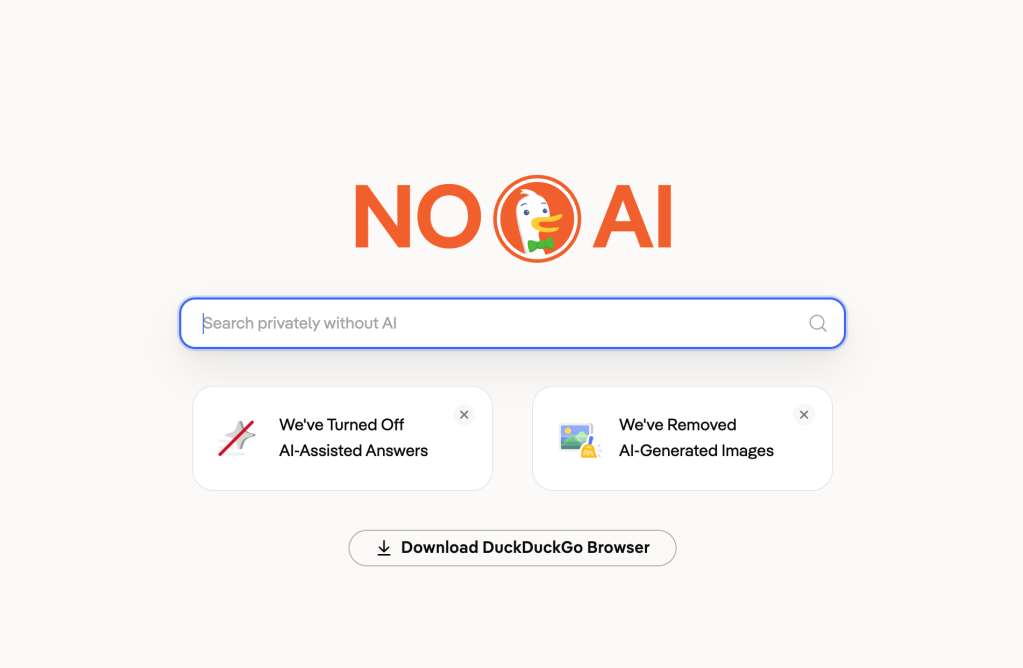
Visits to noai.duckduckgo.com, a dedicated search page that deactivates all AI features by default, also saw substantial gains, averaging a 22.7% week-over-week increase and peaking at 27.7% on May 24. This trend, particularly strong in the United States, continued over the Memorial Day weekend, a period usually associated with a dip in traffic, indicating a robust and sustained user migration.
What It Means
The recent surge in DuckDuckGo adoption underscores a critical market segmentation emerging within online search, where a significant user cohort prioritizes explicit control over AI integration and data privacy. This bifurcation presents a tangible threat to Google's traditional dominance, particularly if the attrition rate accelerates or if advertisers perceive a dilution of user engagement with AI-infused results. DuckDuckGo's ability to capitalize on this sentiment could enable it to incrementally chip away at Google's formidable market share, which currently limits DuckDuckGo to approximately 2% of the U.S. search market.
The broader implication extends to the entire AI ecosystem, suggesting that forced adoption of generative AI features, even by market leaders, carries inherent risks of user alienation and potential regulatory backlash over data usage and algorithmic transparency. Companies deploying AI must navigate a delicate balance between innovation and user autonomy to avoid similar market reactions and maintain user trust.
DuckDuckGo's U.S. app installs surged by an average of 18.1% week-over-week from May 20-25, peaking at 30.5% on May 25, signaling a rapid user response to Google's AI Search integration.
The Context
Google initiated a sweeping overhaul of its Search at its annual I/O developer conference, announcing the replacement of traditional blue links with an AI agent designed to answer queries, execute tasks, and run background monitoring. This strategic shift prompted immediate and sharp criticism from various stakeholders, who raised concerns about the potential erosion of the open web, the surfacing of inaccurate AI-generated responses, and a perceived loss of user control and simplicity. Gabriel Weinberg, DuckDuckGo CEO, articulated this sentiment, stating in a recent statement that "Google is force-feeding AI with no way to opt out." He emphasized that "their results are getting worse, not better," positioning DuckDuckGo as a platform where users maintain agency over AI integration.
DuckDuckGo has historically championed privacy, a core tenet reinforced by Mr. Weinberg's 2023 testimony during Google's search antitrust trial, where he argued that Google's exclusive default search contracts hampered competitors like his own. Despite its anti-AI-by-default stance in search, DuckDuckGo offers its own advanced AI solutions, such as Duck.ai. This free service provides access to robust models including Anthropic’s Claude 4.5 Haiku, Meta’s Llama 4 Scout, Mistral’s Small 3 24B, and OpenAI’s GPT-5 mini, all without requiring user accounts. Crucially, DuckDuckGo implements stringent privacy safeguards for Duck.ai chats, stripping user IP addresses before requests reach model providers, deleting conversations within 30 days, and preventing chats from being used for AI training, affirming that "everything you do in DuckDuckGo is private."
The company also offers other AI-assisted features like Search Assist, which parallels Google’s AI overviews, and an AI Image Filter designed to remove AI-created images from search results. Kamyl Bazbaz, DuckDuckGo’s chief communications and policy officer, noted that both Search Assist and the AI Image Filter are among the company’s most popular AI features, despite their differing ethos regarding AI integration. Mr. Bazbaz underscored the underlying user demand, stating that "people just want a choice" in how they interact with AI in their search experience.
Investors and market observers will closely monitor Google's response to this nascent user backlash and any potential adjustments to its AI Search rollout strategy. Key indicators will include sustained or accelerated growth rates for DuckDuckGo and other privacy-focused search alternatives, alongside any regulatory inquiries into dominant platforms' AI deployment practices. The coming quarters will reveal whether this initial user migration represents a temporary protest or the early stages of a more enduring shift in user preferences and market share dynamics.
Frequently asked questions
Why are DuckDuckGo installs up 30%?
DuckDuckGo installations are up 30% because many users are rejecting Google's aggressive integration of generative AI into its flagship Search product. This shift is driven by a preference for user control and privacy over AI-driven search experiences.
What is Google's AI Search?
Google's AI Search refers to its flagship search product that now aggressively integrates generative artificial intelligence features, aiming to provide more direct answers and new interactive experiences within search results.
What is DuckDuckGo?
DuckDuckGo is a privacy-focused alternative search engine that emphasizes user control and does not track users or store their personal information, offering a distinct contrast to other major search providers.
How does user privacy impact search engine choice?
User privacy significantly impacts search engine choice, as shown by the recent surge in DuckDuckGo installs. Many users prefer engines that offer greater control over their data and do not track their online activity.
What market shifts are occurring in the search engine industry?
The search engine industry is seeing a shift towards privacy-focused alternatives, with users increasingly opting for services like DuckDuckGo over AI-heavy offerings from Google, recalibrating competitive dynamics.
Are users rejecting AI in search?
A segment of users is indeed rejecting the aggressive integration of AI in search, particularly Google's approach. This group is opting instead for privacy-focused alternatives like DuckDuckGo which prioritize user control.